


There is a recurring observation about powerful men and clothing that gets misread almost every time it is made. The observation is this: that men at the highest levels of business, politics, and culture tend to dress with notable consistency. Not identically — there is significant variation in quality, formality, and personal inflection — but consistently. The wardrobe contracts as influence expands. The choices become quieter. The visible effort diminishes.
This is usually interpreted as indifference to appearance. It is almost always the opposite. What successful men wear, and the precision with which they wear it, reflects a sophisticated understanding of how clothing operates on perception — both other people’s and their own. The psychology at work is not simple or accidental. It is the product of experience, observation, and in many cases, deliberate strategy. Understanding it does not reduce style to manipulation. It reveals clothing as a form of intelligence.
The Signal in Simplicity
The most immediately legible characteristic of the dress of powerful men is restraint. Barack Obama wore exclusively grey or blue suits during his presidency. Steve Jobs built an entire public identity around a black turtleneck and Levi’s. Mark Zuckerberg’s grey t-shirt is not, despite appearances, the wardrobe of a man indifferent to image. It is a studied one.
The psychological mechanism involved is well established. Decision fatigue — the gradual erosion of cognitive quality that follows repeated choices, which can lead to poorer decision-making over time — affects everyone. Eliminating clothing decisions removes one category of daily friction entirely. But this explanation, while accurate, is insufficient. It describes the function of a uniform without explaining its effect on observers.
The deeper dynamic is one of status signalling through what is withheld.
In most social contexts, effort is visible. People who are trying to impress dress in ways that announce the attempt — through conspicuous labels, through fashion-forward choices, through combinations that require explanation. This is not inherently a failure of taste. It is the natural behaviour of someone who has not yet secured the social position they desire and is using clothing to argue for it.
The man who no longer needs to argue communicates this by stopping the argument. Restraint, at a certain level, reads as sufficiency. The absence of visible effort signals that effort is no longer required. This is why understated dressing, in contexts of genuine authority, projects more power than its opposite. The clothes are saying nothing loudly. They do not need to.
Fit as the Primary Language
Ask any tailor, stylist, or careful observer of men’s dress where the meaningful information lives in a man’s clothing, and the answer is consistent: fit.
Not brand. Not fabric, though fabric matters. Not colour, though colour operates. Fit.
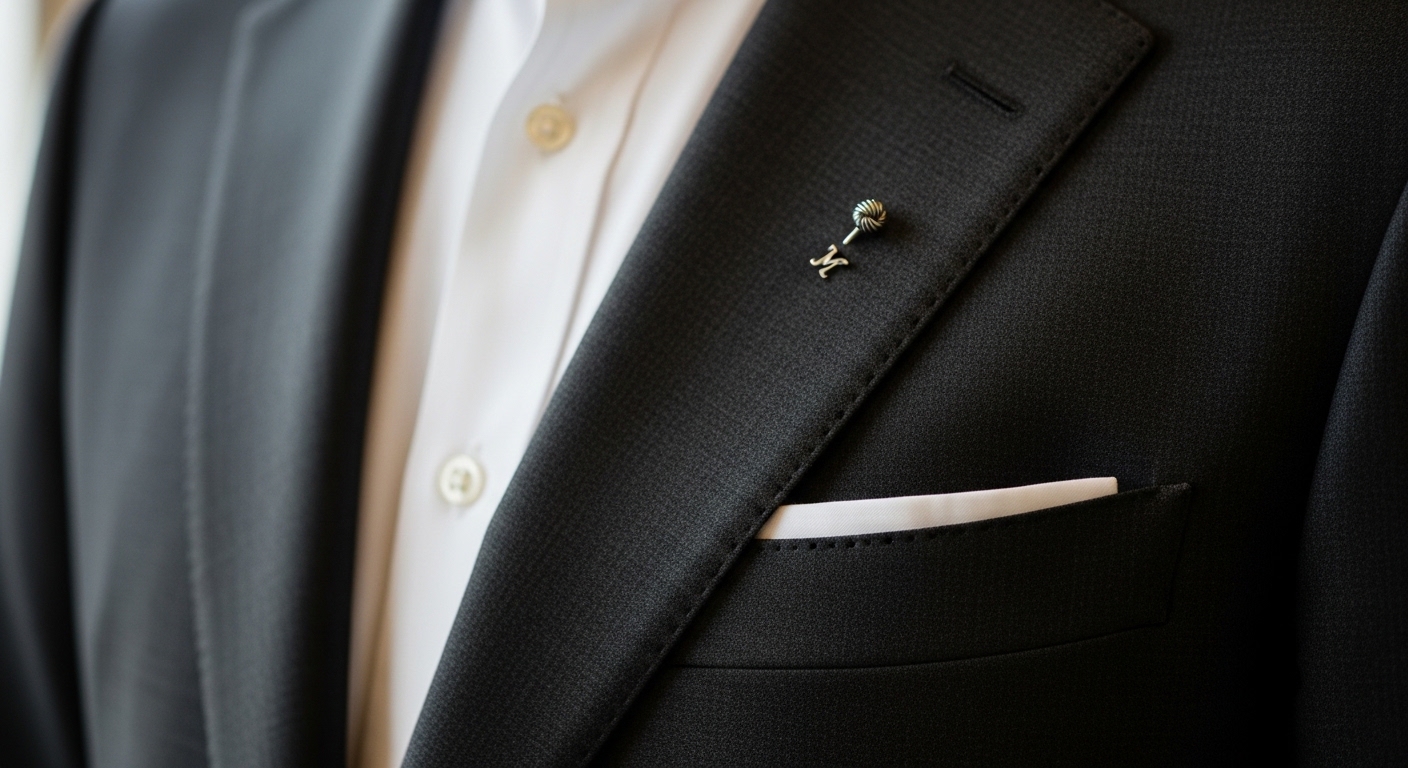
The reason is psychological before it is aesthetic. Clothing that fits well — that sits correctly on the shoulder, breaks at the right point on the shoe, and drapes cleanly across the torso — reads as intentional. It tells the viewer, without a word, that the wearer understands his body, knows how clothes are supposed to behave, and has taken the decision to wear this particular garment seriously.
Clothing that fits poorly communicates the opposite regardless of its cost. An expensive suit that pulls at the button or sits too long in the sleeve does not read as wealth. It reads as someone who has spent money without paying attention. And paying attention — to the world, to the room, to the situation, to oneself — is a quality that successful men in every field are understood to possess as a precondition of their success.
There is also a less discussed dimension to fit: what it does to the wearer rather than the observer. Clothes that fit correctly alter posture, which alters demeanour, which alters how the wearer moves through a room. This is not vanity. It is physiology. A man whose suit is fitted properly stands differently than a man whose suit is not. The difference is perceptible to everyone in the room, including him.

The Colour Grammar of Authority
Colour in men’s dress is not decorative in the way it might be in women’s fashion. It functions more like punctuation — structuring meaning, setting pace, signalling register.
The dominant palette of professional male dressing — navy, charcoal, white, and mid-grey — is not arbitrary. These colours have accumulated specific associations over more than a century of use in contexts of business and governance. Navy reads as reliable, trustworthy, and composed. Charcoal reads as serious and authoritative without aggression. White, in shirting, reads as clean — in both the literal and moral senses. The combination of dark suiting with a white shirt is the closest thing men’s dress has to a default signal of credibility.
Successful men understand this grammar well enough to work within it and, occasionally, to work against it deliberately. The single note of colour — a particular shade of blue in a tie, a burgundy pocket square, an unexpected choice of shoe — functions as a controlled divergence from the norm. It says, ‘I understand the rules of this context completely, and I am choosing, with full awareness, to introduce this one variation.’ Controlled divergence of this kind signals confidence, specificity of taste, and the security to be slightly different without needing approval for it.
Colour can also function as dominance signalling. Research in social psychology has consistently linked the colour red with perceptions of power and status. This is why the red tie became — during a particular era of American politics — something close to a uniform for men who wished to project authority visibly. The signal is blunt, but it works because it exploits a deeply conditioned association. More subtle uses of warm colour — a rich terracotta knit, a copper-toned accessory — can achieve similar ends with greater sophistication.
Quality Without Display
There is a distinction in men’s dress that separates those who have recently acquired wealth from those for whom it is a long-standing condition. The distinction is between visible quality and intrinsic quality.
Visible quality is quality that announces itself — through logos, through recognisable brand signatures, through materials and details that the uninitiated know to notice. It is quality directed outward, at an audience, with the aim of producing a specific social response. It is not tasteless, exactly. But it is legible, which is to say that it depends entirely on the viewer being able to read the signals it is sending.
Intrinsic quality is quality that exists for itself. The shirt with a collar that sits correctly regardless of who notices. The shoe with a last that has been worn to the exact shape of the wearer’s foot. The suit in a cloth so precisely weighted that it moves with the body rather than on it. These things are expensive, but they are not expensive in a way that requires demonstration. Their value is evident to anyone who touches them, and often to no one else.
The men who dress with the most authority tend to operate primarily in the register of intrinsic quality. Their clothes are not trying to impress. They are simply correct — a standard that is both harder to achieve and harder to fake than conspicuous display.
Recommended For You
Grooming as Frame
Clothing does not operate in isolation. It is received as part of an overall visual proposition that includes grooming, posture, and the condition of accessories. A well-chosen suit on an unkempt man does not produce the effect of a well-chosen suit. It produces the effect of a man who has put on a suit.
Successful men, almost uniformly, treat grooming not as personal care — though it is that — but as professional maintenance. The haircut is regular and precise. The nails are clean. The shoes are polished, or at minimum, are in good condition. These things are not luxuries. They are the frame within which the clothing is read. A good frame elevates the painting inside it. A poor frame diminishes it regardless of what it contains.
There is also a psychological effect on the wearer that should not be underestimated. The ritual of dressing carefully — of ironing a shirt, of polishing a shoe, of attending to the small details that no one may consciously notice — produces a condition of readiness. Not confidence exactly, but its precondition: the sense that one has prepared for the encounter, that nothing has been left to chance that could have been attended to. This is, in miniature, the same disposition that characterises high performance in almost every field.
Dressing for the Room You’re Entering
One quality that distinguishes the best male dressers from merely good ones is situational intelligence: the ability to read a room’s expectations and respond to them with precision.
This is not about conformity. The goal is not to disappear into the expected. It is to understand the context well enough to make a deliberate choice—to meet the expectation where it is useful and depart from it where departure will be productive.
A lawyer who dresses more casually than his clients expects is communicating something. So is the creative director who wears a suit to a pitch meeting. So is the executive who removes his jacket for a conversation with junior staff. These are not accidents. They are calibrations, made possible by a clear understanding of what clothing communicates in each specific context and how those communications can be adjusted to serve specific ends.
The man who dresses the same way in every room is not expressing a coherent identity. He is failing to pay attention. Identity in dressing, as in social life more broadly, is not a fixed quantity that clothing expresses uniformly. It is a position taken in relation to a specific context. The most successful men understand that dressing well means dressing accurately — and accuracy requires knowing where you are.
The Psychological Core
What unites all of these elements — the restraint, the fit, the colour intelligence, the quality, the grooming, and the situational calibration — is a single underlying disposition.
It is the disposition of a man who takes himself seriously enough to prepare, but not so seriously that the preparation becomes performance.
This is the psychological core of successful male dressing, and it is harder to achieve than any of its individual components. It requires genuine self-knowledge: an accurate assessment of one’s own body, context, professional position, and the kind of authority one actually possesses rather than the kind one wishes to project. Aspirational dressing — dressing for the job you want, rather than the one you have — can work, but only when it is calibrated to a realistic understanding of the distance between the two. Overdressing for a context reads as anxiety. Underdressing reads as disregard.
The men who dress most powerfully are those for whom the gap between clothing and self has closed. They are not performing authority through what they wear. They are expressing it. The clothes are not a strategy. They are a conclusion — the visible result of a man who has worked out, over time, what he is and what he requires of the world, and has dressed accordingly.
That is what successful men wear. And that, precisely, is why it works.