

There is a business model so successful, so durable, and so deeply embedded in the architecture of modern life that it has become almost impossible to see as a business model at all. It does not announce itself. It does not require legislation or enforcement. It operates through images and language and the slow accumulation of small signals, and it produces, in its target market, a condition so widespread that it has come to seem like a feature of female psychology rather than the manufactured outcome it actually is.
The condition is inadequacy. The business is the beauty industry. And the relationship between the two is not incidental or unfortunate — it is foundational. The global beauty industry is, at time of writing, worth in excess of five hundred billion dollars. It encompasses skincare, cosmetics, haircare, fragrance, aesthetic procedures, and the vast and growing category of wellness products that have annexed the language of health to sell what are, in most cases, beauty products under a different name. It employs millions of people, sustains entire media ecosystems, and generates some of the most sophisticated marketing in the history of commerce.
And its primary product — the thing it is actually selling, beneath the serums and the foundations and the treatments — is the feeling that without it, you are not quite enough.
The Problem Must Come Before the Product
To understand how the beauty industry works, it is necessary to understand a principle that its founders grasped early and its practitioners have refined across more than a century of application: you cannot sell a solution until you have established the problem.
This is not unique to beauty. It is a feature of consumer capitalism more broadly. But the beauty industry applied it with unusual precision to a target market — women — whose relationship to social approval was already structured by centuries of being evaluated, primarily, on their appearance. The anxiety was not invented from nothing. It was found, recognised, and then systematically amplified until it became the organising principle of an entire industry.
The history of this amplification is well documented in the advertising archives of the early twentieth century. Listerine, originally a surgical antiseptic, invented the condition of halitosis — bad breath as a social pathology capable of destroying marriages and careers — in order to create a market for a product that had previously had no mass-market application. Dove soap ran campaigns in the nineteen-twenties warning women of the social consequences of dull skin. Deodorant advertising of the same period introduced the concept of underarm odour as a source of shame so acute that it could make a woman unmarriageable. In each case, the sequence was the same: name the deficiency, attach a social consequence severe enough to produce anxiety, and offer the product as a remedy.
What distinguished these early campaigns was their transparency, in retrospect. They were obviously selling something. The sophistication of the contemporary beauty industry lies in how thoroughly it has naturalised this process — how completely it has made the problems it invented feel like pre-existing conditions that its products merely address.
The Standard That Cannot Be Met
The structural genius of the beauty industry — and it is a form of genius, however troubling its application — is the creation of a standard positioned permanently beyond reach.
A standard that could be met would produce satisfied customers. Satisfied customers do not continue purchasing. The beauty industry’s commercial logic therefore requires a standard that is approached but never achieved — one that recedes at approximately the same rate as its pursuit advances, so that the gap between the woman and the ideal remains constant regardless of how much time, money, and effort she invests in closing it. This is accomplished through several mechanisms that operate simultaneously and reinforce each other.
The first is the endless creation of new problems. Each decade introduces new categories of inadequacy that did not previously exist as consumer concerns. Cellulite — a natural feature of approximately ninety percent of post-pubescent women — was not a beauty problem before the late nineteen-sixties, when it was named as such in a French beauty magazine and the term was subsequently adopted by a cosmetics industry that had products ready to address it. The concept of anti-ageing as a beauty category — the idea that the ordinary process of growing older constitutes a failure of maintenance requiring commercial correction — is a twentieth-century invention. Pore size, uneven skin tone, thinning brows, sparse lashes, hyperpigmentation, and the specific texture of the skin on the backs of one’s arms: each of these has been transformed, at a specific moment and for specific commercial reasons, from a feature of ordinary human bodies into a problem.
The second mechanism is the continuous raising of the standard already established. Products do not simply address problems. They introduce progressively more demanding versions of the solution, so that the woman who has achieved adequate moisturisation is now being asked to consider radiance, and the woman who has achieved radiance is now being asked to consider luminosity, and the woman who has achieved luminosity is now being asked to consider the glass-skin finish that luminosity, it turns out, was only an approximation of. The goalpost is always, precisely, one product-length ahead of where she is.
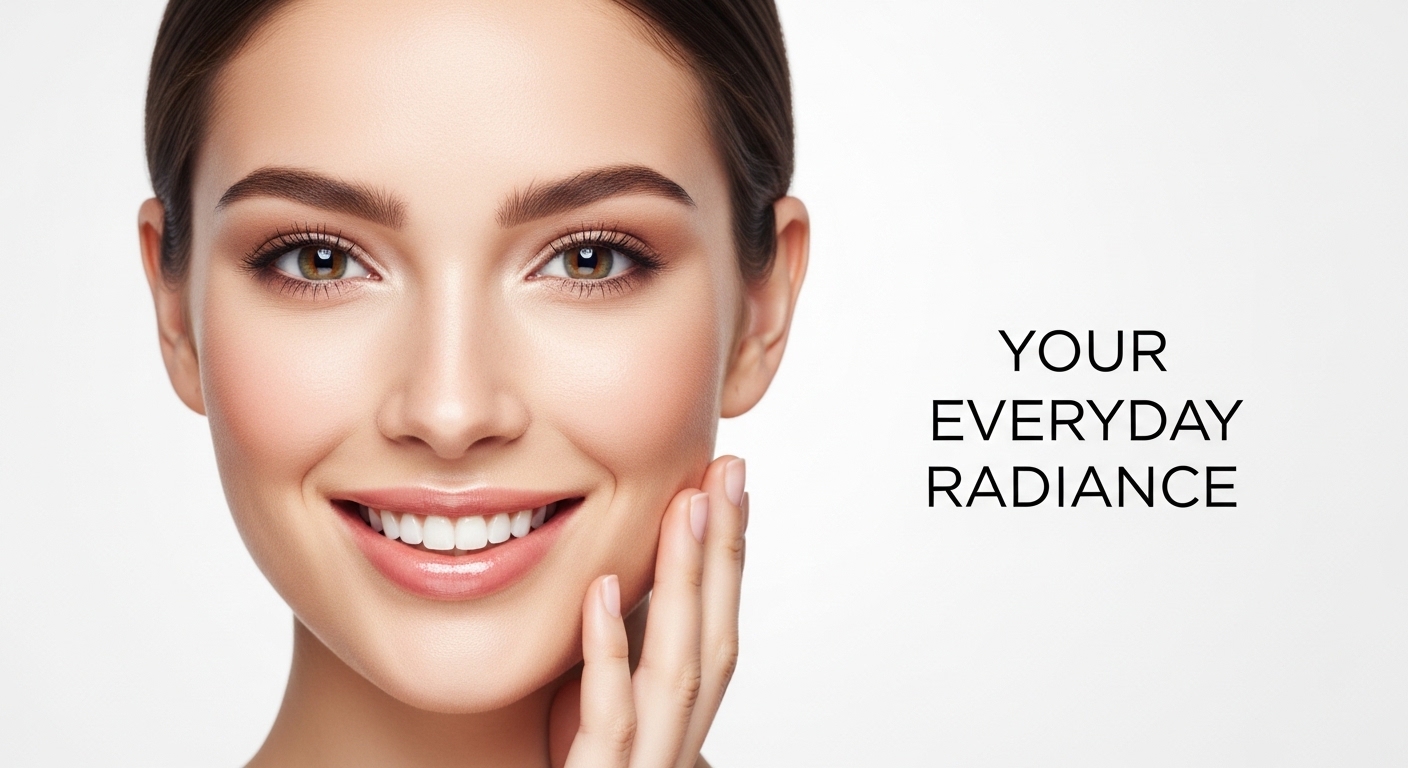
The third, and most powerful, mechanism is the use of imagery that presents the standard not as an ideal but as an ordinary baseline — the thing women simply look like when they are properly maintained. The models in beauty advertising are not presented as exceptional. They are presented as the inevitable result of using the product correctly. The subtext, received and processed below the level of conscious analysis, is not that this is what a model looks like. It is that this is what you could look like, which implies its inverse: that the way you currently look is a form of failure.
The Language of Empowerment
Sometime in the nineteen-nineties, the beauty industry recognised a threat. Feminist critique of beauty standards had become sufficiently mainstream that the industry’s traditional advertising language — which had operated, with minimal disguise, through the direct invocation of inadequacy and the fear of social rejection — was beginning to generate resistance. Women were, in increasing numbers, identifying and naming the manipulation embedded in advertisements that sold products by making them feel bad about themselves.
The industry’s response was not to change its business model. It was to change its language. The vocabulary of empowerment — of self-expression, self-care, self-love, confidence, and choice — was integrated into beauty marketing with remarkable speed and thoroughness. Makeup was no longer something women wore because they were afraid of how they looked without it. It was something they wore as a form of self-expression, a celebration of who they were, a creative act entirely disconnected from any anxiety about the male gaze or social approval.
This reframing was commercially brilliant and intellectually dishonest in equal measure. It was brilliant because it neutralised the critique without addressing the underlying dynamic. The feminist argument against beauty standards had been that they were externally imposed — that women were pressured, by advertising and media and social expectation, into a relationship with their appearance that primarily served commercial and patriarchal interests rather than their own. The empowerment reframe conceded this point in theory while reversing it in practice: by locating the source of beauty behaviour in women’s own freely chosen self-expression, it made external critique appear as the imposition. Now it was the feminist who was telling women what to do — or, more precisely, what not to do. The industry was simply offering options.
The dishonesty lay in the unchanged business model beneath the new language. Dove’s Real Beauty campaign — launched in 2004 and frequently cited as a landmark in the industry’s adoption of body-positive messaging — was produced by Unilever, which also owned Axe, a brand whose advertising, running simultaneously, depicted women as trophies for male grooming. The language of self-love was being deployed to sell products whose commercial logic remained entirely dependent on the feeling that the self, without intervention, was insufficient. The contradiction was not incidental. It was the point. Empowerment language sells products to women who have been taught to identify purchasing with autonomy. The transaction is the same. The framing has changed.
Recommended For You
The Clothes We Keep That We Never Wear
Fashion Influencers You Need to Follow for Style Inspiration
Who Pays, and How
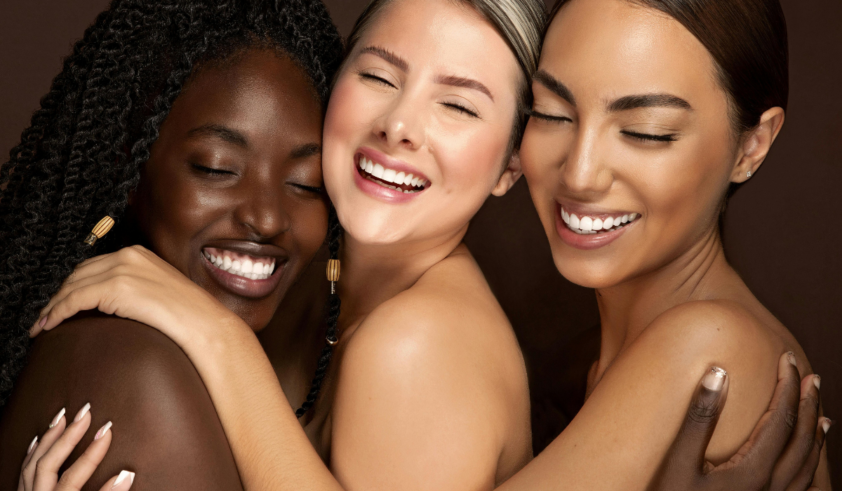
The costs of the beauty industry’s business model are not evenly distributed. They fall, first and most heavily, on women who are furthest from the standard the industry promotes — which is to say, women whose bodies, skin tones, hair textures, and facial features are least represented in the imagery the industry uses to establish what beauty looks like. For these women, the gap between self and standard is not a minor source of dissatisfaction. It is a structural condition, maintained by an industry that has historically produced products for a narrow range of consumers and then treated that narrowness as a market reality rather than a choice.
The expansion of shade ranges, the inclusion of a broader range of body types, the increased visibility of darker skin tones in beauty advertising: these are genuine changes, and they matter. But they have occurred primarily in response to the commercial recognition that underserved markets represent untapped revenue, not in response to a fundamental reckoning with the standard-setting machinery that produced the exclusion in the first place. Inclusion, in this context, is not the dismantling of the inadequacy model. It is the extension of it to new markets.
The costs fall also on younger women and girls, who are encountering the industry’s imagery at an earlier age, through more intimate channels, than any previous generation. The research on the relationship between social media use and body image in adolescent girls is by this point extensive and largely consistent in its findings. The mechanisms are the same as those that operated through magazine advertising in the twentieth century — the curated standard, the gap, the inadequacy — operating at a scale and intimacy that the magazine industry never achieved.
And the costs are financial in the most literal sense. The average woman in the United Kingdom spends approximately £70,000 on beauty products over the course of her lifetime. Figures for women in the United States and Western Europe are comparable. This is money spent, in significant part, on products addressing problems that did not exist before the industry that sold the products named them.
The Question Worth Asking
None of this is an argument that women should not use beauty products, or that the pleasure of a well-formulated skincare routine or a perfectly chosen lipstick is false or politically compromised. Pleasure does not require ideological purity to be real. Beauty can be a genuine source of creativity, self-expression, and enjoyment without any of that being negated by an understanding of the industry that produces it.
What an understanding of the industry produces is not guilt. It produces clarity.
The clarity that the feeling of inadequacy in relation to your appearance did not arise naturally, from an honest assessment of yourself against an objective standard. It was installed gradually, systematically, by an industry with a direct commercial interest in its maintenance. The clarity that the products offered as solutions were developed after the problems they address were invented. The clarity that the standard you are measuring yourself against was not discovered but constructed, and constructed specifically to remain out of reach.
This clarity does not empty the beauty counter of its appeal. But it changes the terms on which you stand in front of it. It changes the question from whether you are enough — a question the industry has spent a century and a half ensuring you will never answer with a settled yes — to something more useful: enough for what, and according to whom, and why should that authority be trusted? The industry has a very good answer to none of these questions. It has, instead, a new product. It always does.