

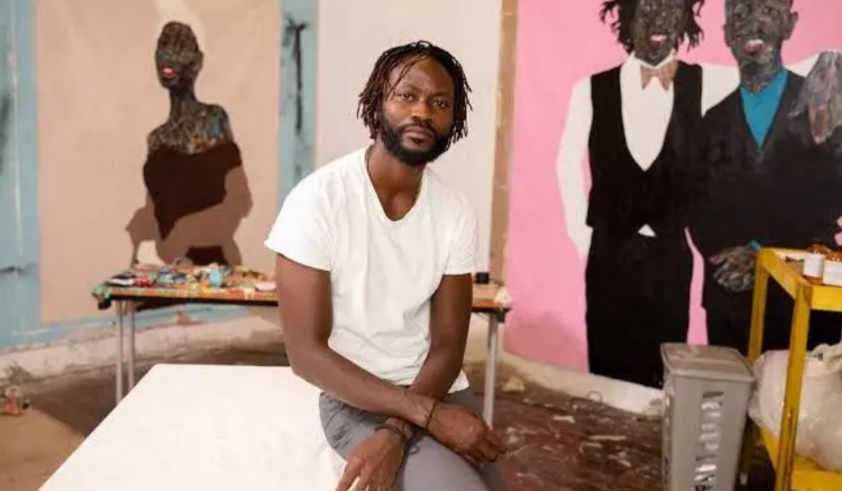
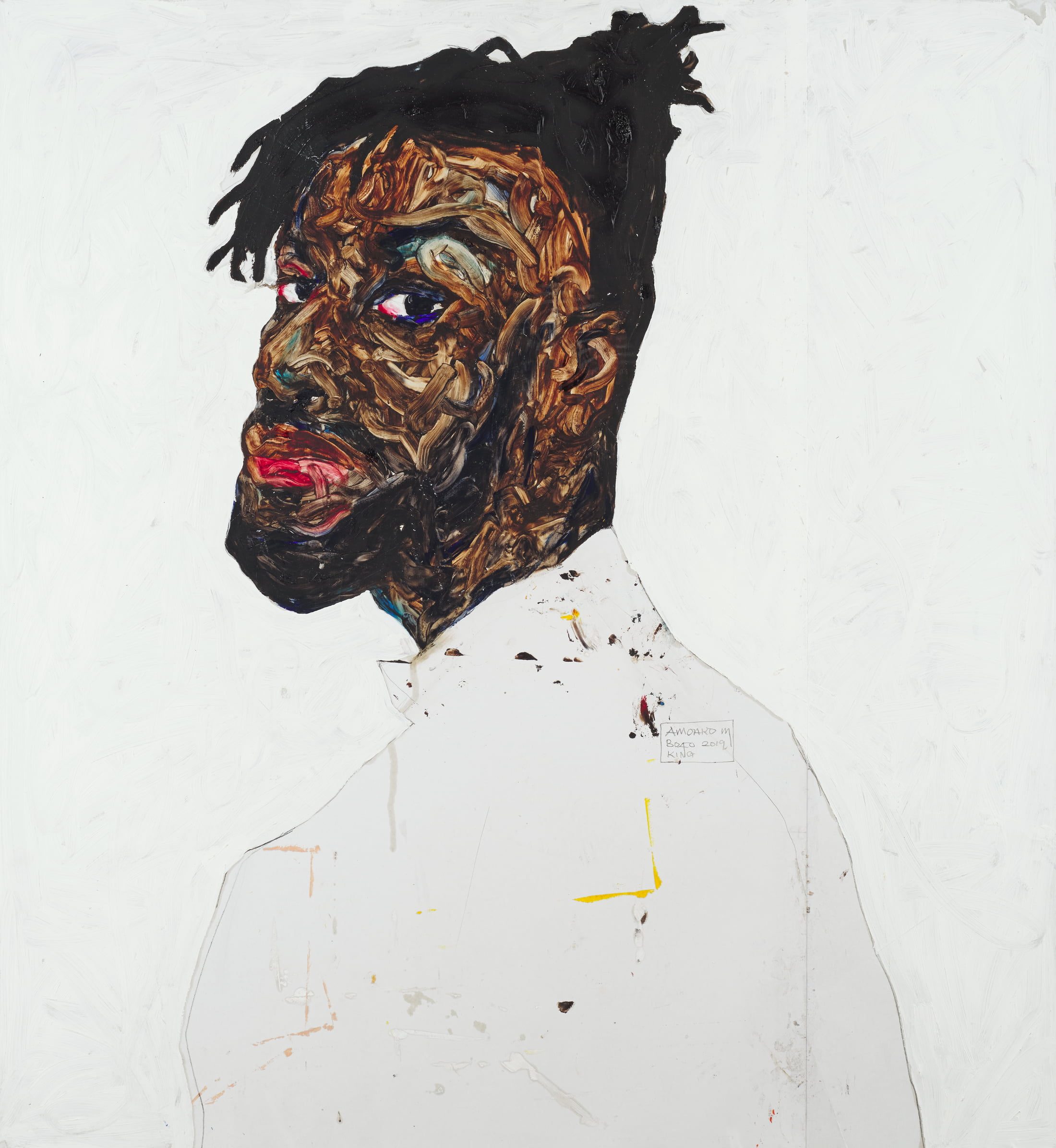
This is the story of how a Ghanaian painter transformed Viennese modernism into a radically Black visual language. There is a particular quality of attention in Amoako Boafo’s portraits. Quality that announces itself the moment you enter a room in which they hang. His subjects do not recede. They do not wait to be discovered or invite the slow contemplative gaze that much figurative painting rewards. Looking directly at the viewer, frontally, with a self-possession. The dynamic of the encounter is immediately and unmistakably clear: you are not studying them. They are receiving you.
This quality, at once intimate and authoritative, is the central achievement of a practice. A practice that has positioned Boafo as one of the most significant painters working anywhere in the world. It is also the product of a specific and unlikely geography: the distance between Osu in Accra. This is where he was born in 1984, and the Academy of Fine Arts in Vienna, where he arrived in 2013. This is where he was told, in the early stages of his studies, that his figures were too Black.
He kept painting them anyway. And in doing so, he built something that is larger than a body of work. He built a counter-argument, rendered in pigment and applied with the bare hands, to everything the European painting tradition had decided Black bodies were permitted to be.
From Osu to the Academy
He grew up in Osu, a district of Accra whose cultural filters influence his understanding of community, style, and the social meaning of appearance from an early age. Art was not a conventional career path in the Ghana of his youth. He pursued it anyway, graduating from the Ghanatta College of Art and Design in Accra in 2008, where he was named best portrait painter of his class. Before making his way to Europe, he spent time as a semi-professional tennis player, a detail that is surprising only until you consider the particular discipline it shares with serious painting: the repetitive refinement of technique in the service of precision and the understanding that mastery is as much a physical as an intellectual pursuit.
He arrived at the Academy of Fine Arts in Vienna in 2013, one of the world’s oldest and most prestigious art schools, whose alumni include Friedensreich Hundertwasser and whose rejection of Adolf Hitler’s application twice has entered historical legend. It is an institution saturated in the tradition of Viennese Modernism, and Boafo’s engagement with that tradition, under teachers including Ashley Hans Scheirl and Kirsi Mikkola, would prove foundational. The works of Egon Schiele and Gustav Klimt, which he encountered in depth during these years, left lasting impressions that are visible in his finished canvases: the flattened, ornamental treatment of clothing and background that recalls the decorative intensity of Klimt; the psychological exposure of the body, rendered with expressive line, that recalls Schiele’s willingness to show the figure as a site of feeling rather than merely of appearance.
But the influence was not one of imitation. It was one of inheritance questioned and redirected. Where Schiele used expressionist distortion to expose the existential anxieties of early twentieth-century Vienna, Boafo seized the same tradition to do something Schiele never did and the entire Western canon had largely failed to attempt: to place a Black body at the centre of a European painterly vocabulary and insist, through every decision of composition, colour, and technique, on its dignity, beauty, and self-sufficiency.
Black Skin, Viennese Modernism, and the Art of Amoako Boafo
Boafo developed his now-globally-recognised finger-painting technique during his Vienna years, and this technique carries both formal and philosophical significance.
To paint with the fingertips rather than a brush is to paint with the body. It removes the instrument that, in most painting traditions, mediates between the artist’s intention and the surface. The contact is direct. The mark is literal: the impression of skin on paint, transferred to canvas. In a body of work whose entire argument concerns the dignity and visibility of Black skin, this choice of method is not incidental. It is the method’s meaning. Boafo does not depict skin from a distance. He touches it, repeatedly, in the act of making it visible.
The technical result is a striking visual tension that structures every canvas. Boafo renders the bodies of his subjects with sculptural depth. Layered pigment builds form and light across skin, giving the figures their remarkable presence and warmth. He handles the clothing and backgrounds, by contrast, with deliberate flatness. He borrows the ornamental quality of Viennese Modernism to treat garments almost as collage elements: patterned, surface-dwelling, drawn from the vocabulary of floral and geometric wallpaper and filtered through the historical and political dress codes of Black culture. The effect is a compositional hierarchy that could not be more explicit. The skin is given volume, life, and light. Everything else is decoration. Everything else is backdrop. The body is what is real.
This hierarchy is the opposite of what Western portraiture has historically done with Black subjects, when it depicted them at all. For centuries, the Western canon treated Black bodies in precisely the reverse way. Painters rendered them as background, as ornament, as the supporting material against which they foregrounded white subjects. Boafo inverts the structure entirely and does so not through polemic or overt gesture but through the internal logic of painting. The argument is formal before it is political. And a formal argument, made with sufficient skill, is harder to dismiss than a declarative one.
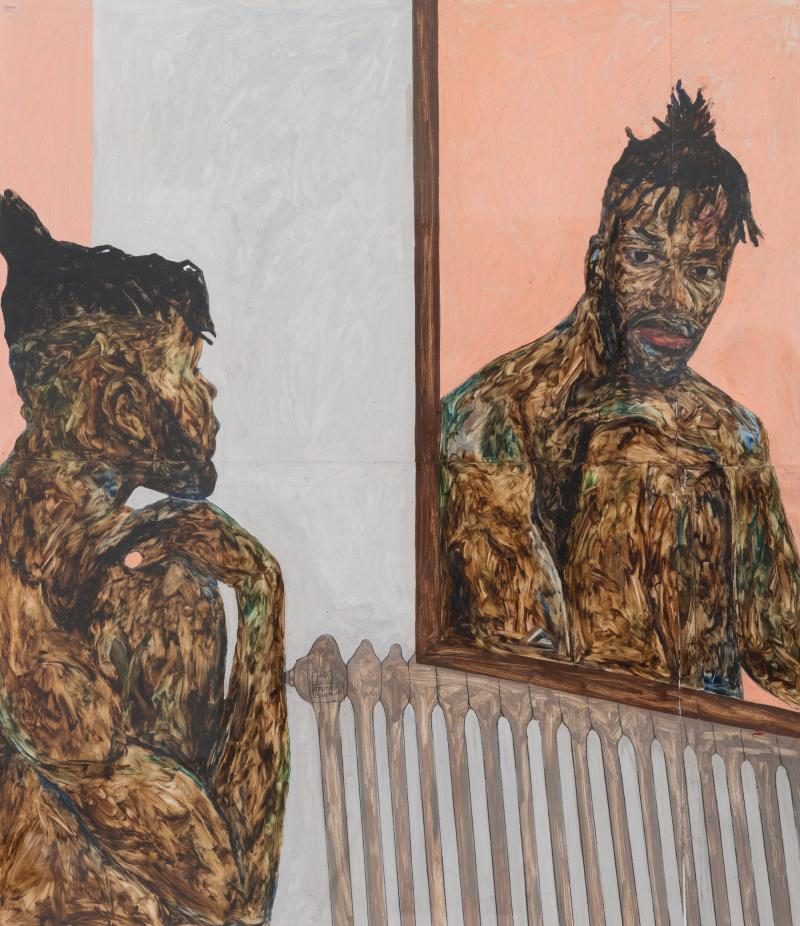
Proper Love at the Belvedere
In October 2024, Boafo returned to Vienna for a homecoming. The city had taken a decade to prepare for it. His debut museum exhibition in Europe, Proper Love, opened at the Belvedere. The Belvedere is one of Austria’s most prestigious cultural institutions. The exhibition presented more than fifty works. These spanned portraits and self-portraits made between 2016 and the present. A major European museum mounted a solo show of his work for the first time. The location carried significance that went beyond symbolism. It was structural.
The Belvedere houses the world’s largest collection of works by Klimt, including The Kiss. It also holds a comprehensive collection of Schiele’s work. Placing Boafo’s work in this institution put it in explicit conversation with the tradition that shaped him. Curators made a deliberate decision here. They showed a selection of his paintings on the upper floor. This sat alongside the permanent collection’s presentation of Vienna 1900. That choice made the conversation visible and navigable. Viewers moving through Proper Love could trace something remarkable. In the same building, on the same visit, they could see where the formal vocabulary came from. They could also see what Boafo had done to it.
What he had done was take an aesthetic framework developed by and for a specific European cultural moment and turn it toward an entirely different purpose. The ornamental flattening of Klimt, deployed in the service of Viennese bourgeois self-celebration, became in Boafo’s hands the treatment he gives to clothing and background, the element he deliberately subordinates to the sculptural presence of his subjects’ skin. The psychological exposure of Schiele, directed at the neuroses of a white avant-garde, became the directness with which Boafo’s sitters meet the viewer’s gaze: exposed, yes, but not vulnerable; seen, but seeing back with considerably more composure than the viewer is typically prepared to reciprocate.
The exhibition’s title carried its own weight. Proper Love is not an ironic formulation or a theoretical provocation. It is a statement about the quality of attention that Black subjects deserve and have been systematically denied, in art as in the wider culture. To love properly, the title implies, is to look without the distortions of projection, stereotype, and the historical residue of how the viewing relationship between white institutions and Black bodies has been conditioned. It is to see what is actually there.
Recommended For You
African Style Archive Is Decolonising Fashion Documentation
Harriet Hala on Motherhood, Entrepreneurship and Leading FAB L’Style
Fashion as Claim
The role of clothing in Boafo’s portraits is one of the most formally sophisticated and least discussed aspects of his practice, and it is directly relevant to how his work intersects with fashion as a field of cultural meaning.
In the Western portrait tradition, clothing served primarily to identify social position. The quality of fabric, the cut of a coat, the presence or absence of particular accessories: these were legible signs of a sitter’s place in a social hierarchy, and the portrait painter’s job included rendering them with sufficient fidelity that the hierarchy could be read. Clothing in these portraits confirmed the existing order. It did not question it.
In Boafo’s portraits, clothing does something categorically different. His subjects are styled with a specificity and intention that draws on Black culture’s own relationship to dress, a relationship that has always been, in ways that Western fashion history has rarely acknowledged, both aesthetic and political. The way Black communities in the diaspora have used clothing, from the sharp tailoring of the Harlem Renaissance to the expressive maximalism of West African formal wear, reflects an understanding that how you present yourself is a form of speech, particularly when you inhabit a society that has historically sought to define you by characteristics other than your own self-presentation.
Boafo’s collage-like treatment of garments, built from floral and geometric patterns referencing both wallpaper and textile traditions, places fashion in the composition as a flat field against which the dimensional reality of the body registers with greater force. But the garments themselves are not incidental. They are chosen, imagined, and constructed with deliberate reference to the visual codes of Black style and Black history. The nail polish in a work like White Nail Polish (2021) is as considered a choice as anything in the composition. The shawl in Enyonam’s Black Shawl (2020) is not background. It is a declaration of a specific aesthetic sensibility, belonging to a specific person, within a specific cultural inheritance.
This is clothing understood not as a status signal but as an identity claim: the sitter’s assertion that they are a particular kind of person, with a particular set of references and allegiances, presented for the viewer to reckon with rather than to simply admire. It is a use of fashion that has always existed in Black culture and has rarely been represented in European painting until Boafo decided to represent it.
The Axis and What It Produces
The Accra-Vienna axis that structures Boafo’s biography is not simply a story of an African artist educated in Europe who returned home transformed. That narrative, familiar and somewhat comfortable, implies a direction of influence that runs one way. The reality of what Boafo has built is considerably more complex and considerably more interesting.
He took Vienna seriously. He engaged deeply and honestly with the tradition he encountered there, studying it on its own terms, absorbing its formal intelligence, and placing himself in genuine creative dialogue with painters who had been dead for a century. The works of Schiele and Klimt are not references in his painting in the way that a logo is a reference: visible from the outside, worn as a marker. They are internal to the practice. They are part of the grammar.
But Boafo did not arrive in Vienna empty-handed. He arrived with the visual culture of Osu, with the portrait tradition of West African studio photography, with the sartorial intelligence of Accra, with a community of friends and subjects and relationships that would populate his canvases for the next decade, and with a perspective on the European tradition that no European painter could possess: the perspective of someone for whom that tradition was not a birthright but a resource, to be used where it served his purposes and departed from where it did not.
What the Accra-Vienna axis produces, at its best, is not synthesis. It is friction, made productive. It is the result of two traditions in genuine, unresolved dialogue, neither entirely at home in the other, neither willing to concede the argument. The tension between the sculptural depth of Boafo’s skin rendering and the decorative flatness of his backgrounds is not a formal device adopted for visual interest. It is a structural enactment of the axis itself: the depth of what he brought, held against the surface of what he found.
Institutions have taken notice with a speed unusual in the art world’s typically measured pace of recognition. The Hirshhorn, the Guggenheim, the Hammer, LACMA, the Albertina, and the Leopold Museum are among the collections that now hold his work. His representation by Mariane Ibrahim Gallery, one of the foremost galleries in the world for art from Africa and the African diaspora, places him within a curatorial intelligence that understands the full context of his practice. His debut London solo at Gagosian, titled I Do Not Come to You by Chance, opened in 2025, expanding his portraiture into immersive installation while maintaining its insistence on presence, on skin, and on the unapologetic visibility of Black life rendered with the whole body of the artist pressing against the canvas.
He does not come to you by chance. He comes with a decade of work, a continent’s visual inheritance, a European education put to uses its institution did not anticipate, and the same direct gaze with which his subjects meet the viewer every time. The figures are not too Black. They are exactly as Black as they need to be. That, in the end, is the whole point.