
On June 20, 2026, Dataland, the first museum in the world dedicated to AI arts, opened in Los Angeles. Founded by Turkish-born artist Refik Anadol and housed in Frank Gehry’s Grand LA development, it does not simply display AI-generated work. It asks whether art can feel you back. The answer is more complicated, and more urgent, than the question.
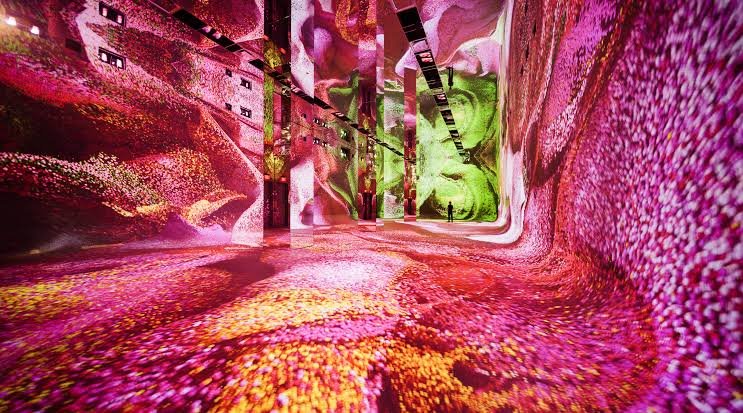
You walk in from Grand Avenue carrying the heat of a Los Angeles afternoon, and within thirty seconds you are standing in the Amazon rainforest. Not a representation of it. Not a photograph or a film. Something stranger: 25,000 square feet of floor-to-ceiling imagery built from half a billion pixels, fed by real ecological data, redesigned in real time by the collective heartbeats of everyone in the room with you. A device on your wrist is reading your pulse. A ring around your neck delivers a rotating sequence of twelve scents, designed in partnership with the olfactory team at L’Oréal Luxe, triggered by your own biodata. The forest changes as you breathe.
This is Dataland, and it opened to the public just weeks ago, across the street from the Walt Disney Concert Hall in downtown Los Angeles. It is the world’s first institutional museum dedicated entirely to AI arts. It is also, depending on your disposition, the most thrilling thing to happen to the museum as a form in a generation, or a $49-a-ticket theme park dressed in the language of culture, or both of those things at once.
The Artist Behind Dataland Museum
Refik Anadol, the Istanbul-born, Los Angeles-based artist who co-founded the museum with his partner Efsun Erkiliç, would probably accept all three descriptions and find them insufficient. He has been working at the intersection of machine intelligence and sensory experience for a decade, projecting data onto the face of the Walt Disney Concert Hall, visualising the Los Angeles Philharmonic’s archive as a living architectural intervention, and training models on glacier imagery to document what we are losing. Dataland is the institutional home for all of that thinking. It is also, in the bluntest possible terms, a building where he can finally build rooms with no walls.
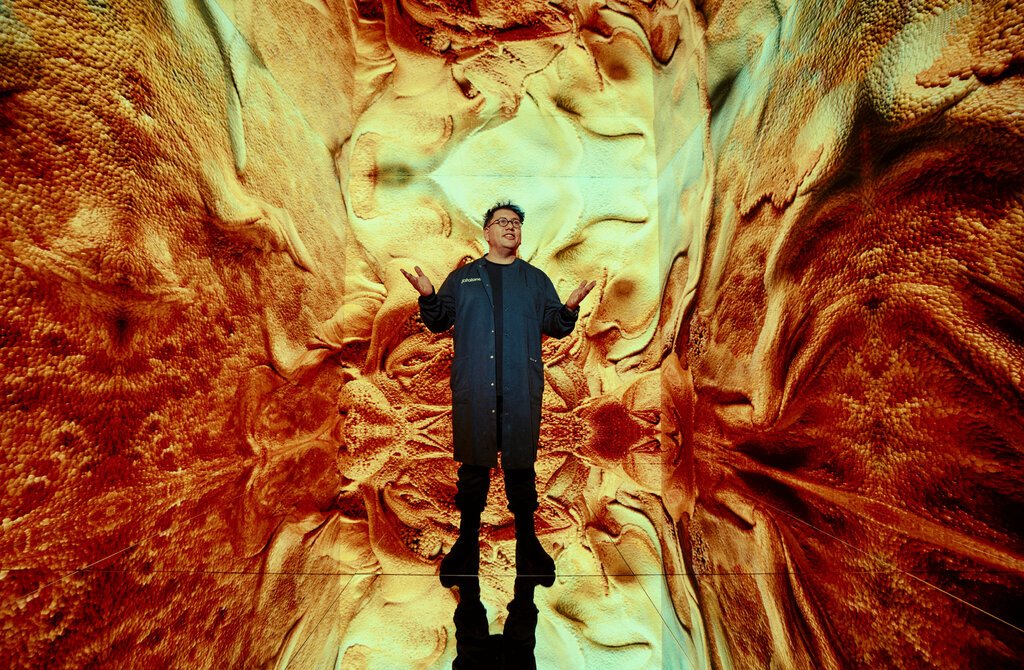
“This is a laboratory of imagination,” he said at the opening. “We have walls, but no limits in the ideation.”
The building it occupies is significant. The Grand LA was designed by Frank Gehry, who died last December at ninety-five and did not live to see the museum open inside his creation. Anadol has called him one of the most important architects in human history. More personally: Gehry was a mentor. In 2018, Anadol projected one of his early data pieces onto the exterior of Walt Disney Concert Hall, the building Gehry designed just across the street. That projection was, in a sense, the opening argument for everything that followed. Gehry, Anadol has said, left these concrete shells for dreamers. Dataland is the dream that moved inside.
The museum sits within the city’s Grand Arts Corridor, alongside the Museum of Contemporary Art, the Broad, and the Philharmonic. Its neighbours are institutions with deep collections, endowments built over decades, and the particular authority that comes from having said no to a great many things for a very long time. Dataland has none of that history. It arrived with a proposition instead: that AI-generated work deserves not just gallery space but a dedicated institutional home, with the gravity and permanence that implies.
Whether it deserves that, and what deserving has to do with anything in this context, is a question the museum raises without fully answering. Which may be the most honest thing about it.
Dataland Museum’s Inaugural Experience: Machine Dreams
The inaugural experience is called Machine Dreams: Rainforest, and its origin story is worth staying with. Anadol travelled to the Brazilian Amazon, where he met with leaders of the Yawanawá community, an Indigenous group largely separated from modern technology. The visit produced a dream, specifically a hummingbird moving through forest light, and that dream became the throughline of the work. The Yawanawá chief gave permission for the collaboration. Anadol’s Large Nature Model, an open-source AI trained on millions of images and sounds drawn from the Smithsonian Institution, London’s Natural History Museum, and the Cornell Lab of Ornithology, among others, does the rest.
The result is a narrative built from data that is also, somehow, built from memory and permission and relationship. The hummingbird appears. It moves. The forest shifts around it in response to the room’s collective biological state. A 250-speaker audio system delivers the acoustic ecology of the Amazon alongside original compositions and, woven through them, the sacred healing songs of the Yawanawá. You are, in the most literal sense possible, standing inside someone else’s dream of the natural world, rendered by a machine trained on the knowledge of human institutions.
Dataland Museum and the Ethics of AI Art
The ethical questions here are real. Who owns a dream translated into data? What does consent mean when the translation happens at this scale? What does the Yawanawá community receive in return for allowing their songs to be integrated into a museum experience that costs $49 to enter? Anadol does not evade these questions. He has spoken publicly about his commitment to the communities whose knowledge and sound inspired the work. The collaboration was built on relationship, not extraction. But the institutional framework around it, the for-profit model, the partnership with Google, the L’Oréal scent design, and the biosensing wristband sit at a significant distance from the Amazon, and that distance asks something of anyone paying attention.
Dataland Museum’s Infinity Room: Art That Feels You Back
Elsewhere in the building, the Dataland Museum Infinity Room offers something closer to Anadol’s established artistic language: mirrored space, audiovisual immersion, images that deliberately echo the Light and Space movement, the work of James Turrell, Yayoi Kusama, Dan Flavin. “I have huge respect for the Light and Space movement,” Anadol has said, listing them as heroes. The room invites visitors to stay at least thirty minutes, which is longer than most people spend in front of anything in any museum. In practice, many do. Something in the scale and the responsiveness of the environment holds attention differently than a painting or an object. You are watching the room watch you. That is not a metaphor. The biosensing data from your wristband is feeding the images you are looking at. The artwork is, in Anadol’s formulation, feeling you back.
“For 5,000 years, humans have been emotionally moved by artworks,” he said. “My challenge question is, can the artwork feel us back?”
It is a question that sounds simple until you sit with it. What changes if the answer is yes? If the image shifts in response to your pulse, is that art responding to you or data reflecting you back at yourself? The difference matters. One is a creative relationship. The other is a mirror. The most searching thing about Dataland is that it holds both possibilities open simultaneously and declines to resolve them.
Dataland Museum’s Business Model and Who It Serves
The dataland museum is a for-profit enterprise. Tickets start at $49. This has attracted criticism from people who believe that cultural institutions should operate on the non-profit model that has governed Western museums for over a century, providing access regardless of income and holding their collections in public trust. Anadol’s position is more radical and more honest than many of his critics allow. He is not pretending to be something he is not. He is arguing, implicitly, that the non-profit museum model is itself a construction, a particular historical arrangement that carries its own exclusions and its own politics. The Louvre was a royal palace. The British Museum was built on imperial extraction. The idea that these arrangements represent a neutral form of cultural stewardship requires a certain amount of historical amnesia to sustain.
That said, $49 is $49. For a family in Inglewood or Compton or for a student in East LA, the price point determines who gets to stand inside the rainforest and feel what standing there feels like. Anadol has spoken about wanting Dataland to welcome visitors of all backgrounds. The tension between that aspiration and a for-profit ticketing model is real, and it will not resolve itself simply by being acknowledged.
What Dataland Museum Means for African AI Art
The conversation Dataland opens, whether it intends to or not, travels far beyond Los Angeles. In Nairobi, in Lagos, in Accra, in Vienna, artists working at the intersection of African visual and oral tradition and computational practice have been watching the emergence of institutional AI art spaces with a particular kind of attention. The training data that underpins most large AI models, including those used in experiences like Dataland’s, reflects the priorities and the archives of Western institutions. The Smithsonian. The Natural History Museum in London. Cornell. These are extraordinary repositories of knowledge. They are also repositories built by specific people in specific historical circumstances, with specific gaps.
When a model trained on those archives generates imagery of the natural world, it generates imagery that looks like the natural world as those institutions have documented it. The visual languages, the compositional grammar, the aesthetic assumptions embedded in the dataset, all of these travel into the output. An AI model is not a neutral mirror of reality. It is a mirror of the archives that trained it. And the archives are not neutral either.
This is not an argument against Dataland. It is an argument for what comes after Dataland. For the institutions, in Lagos and Nairobi and Kampala and Addis Ababa, that are beginning to build their own archives, their own datasets, and their own aesthetic propositions about what AI-generated work looks like when the training data changes. The Large Nature Model Anadol built is open source. That matters. It means the tool is available. What you feed it is still the question.
Erkiliç, who runs the studio and the museum alongside Anadol, describes the entire experience as a way of making the invisible visible. “The funny thing is, nature itself is magical,” she said at the opening. “Not in the sense of an enchanted forest, but the forest itself is quite magical. We just want to show it, and you can still have a childlike feeling.”
That childlike feeling is real, and it should not be dismissed. In a cultural moment characterised by institutional exhaustion, by the sense that the museum form had run out of ideas, Dataland arrives with genuine enthusiasm. People sketch inside it. They sit in contemplation. They enter what Anadol has described as flow states. They exclaim when the scent changes. They put their phones away. That last detail is perhaps the most surprising. An experience explicitly designed for a generation saturated in screens succeeds, at least partly, in making screens feel insufficient.
Dataland Museum and the Legacy of Frank Gehry
Frank Gehry, who left his concrete shells for dreamers, did not live to see the room Anadol built inside them. He died last December, a month before Dataland was formally announced as open. The timing has the quality of something literary, a handoff between one kind of imagination and another. Gehry bent steel and glass into forms that looked like they were moving. Anadol fills rooms with images that actually are. The building holds both ideas at once, the frozen gesture and the living response, which is perhaps what the best containers for art have always done.
You walk back out onto Grand Avenue carrying the scent of a forest that does not exist in any of the places you have ever been. The afternoon light is still there, unchanged, indifferent. You look at your wrist where the biosensor sat, now removed, and feel the faint ghost of data that was, briefly, art, or something close enough to art that the distance may not matter.