

It is worth more than $2 trillion, employs hundreds of millions of people, and grows faster than most sectors governments actually plan for. The creative economy is not a niche category or a cultural luxury. It is one of the defining economic forces of this century. Understanding what it is, where it came from, and what it is becoming is increasingly not optional.
Sometime in the late 1990s, a British consultant named John Howkins was sitting with a number that would not leave him alone. The British music industry, he had found, was already larger than Britain’s steel industry, not marginally but substantially. An economy built on songs, on recordings, on the organised transport of something essentially intangible from one human mind to another, was outperforming an industry built on fire and iron and centuries of industrial tradition. Something was changing, and most of the frameworks economists used to describe the world had not caught up with it yet.
Howkins published The Creative Economy in 2001, and with it gave a name to something that had been happening without a name for years. He argued that the defining characteristic of the new economy was not information, as many theorists of the 1990s had suggested, but creativity: the capacity of individuals to generate ideas that had economic value precisely because they were personal, novel, and meaningful. Where the industrial economy extracted value from land, labour, and capital, the creative economy extracted value from imagination. The raw material was, in principle, unlimited. Every human being who has ever lived has possessed some version of it.
The concept caught. It was taken up by governments, development agencies, universities, and cultural institutions in a way that few economic ideas manage. It was also challenged, refined, contested, and sometimes used in ways its originator probably did not anticipate. But twenty-five years after Howkins sat with his numbers, the creative economy is no longer a contested idea. It is a measurable, trackable, economically significant reality that sits near the centre of how the world creates and distributes wealth. The question for 2026 is not whether it matters. It is whether the people who most need to understand it actually do.
What Exactly Is the Creative Economy?
The creative economy is not simply the arts. This is the most common misunderstanding, and it causes real policy damage in the countries that make it.
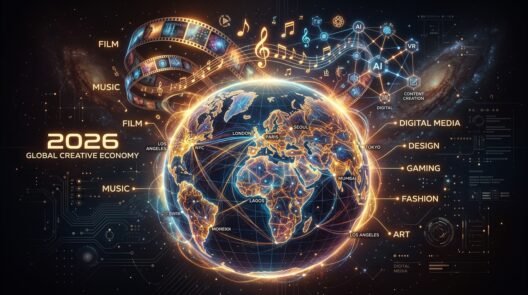
At its broadest, the creative economy encompasses all economic activity in which the primary input is human creativity and the primary output is intellectual property. The UN trade body UNCTAD, which has been tracking the field for over two decades, defines the creative industries as those that create, produce, and distribute goods and services that use creativity and intellectual capital as primary inputs. The list is longer than most people expect: advertising, architecture, arts and crafts, design, fashion, film, music, publishing, software, video games, television, radio, performing arts, research and development. These are not peripheral activities. They are, collectively, one of the fastest-growing sectors of the global economy.
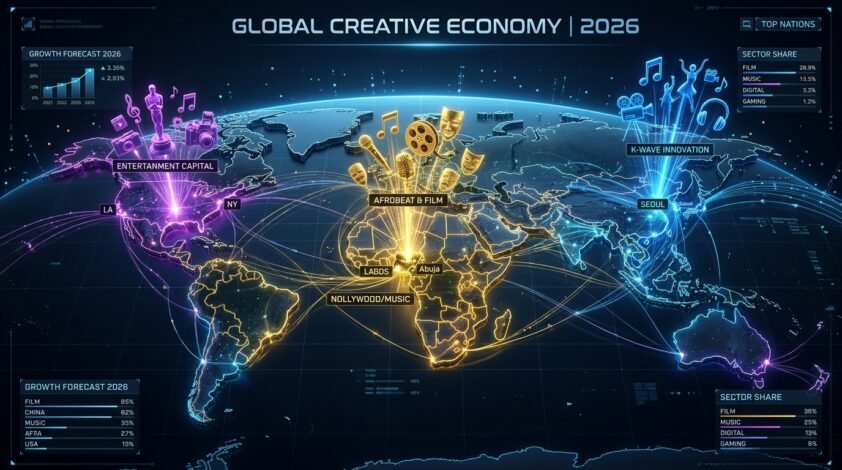
The creative economy now accounts for over 6 percent of global gross value added, and creative services exports reached a record $1.5 trillion in 2023, representing 19 percent of global services exports. That last figure deserves a moment of attention. Nearly one in five dollars earned from global services trade originates in the creative economy. The sector that many governments still file under “culture” rather than “economy” is generating export revenue at a scale that rivals the most strategically protected industries on earth.
The creative economy also has a geography, though not the one instinct might suggest. Creative goods exports reached $713 billion in 2022, a 19 percent increase from five years prior, while developing countries primarily export creative goods, whereas developed countries dominate creative services exports. What this tells you is that the value chain within the creative economy, like value chains elsewhere, tends to reward those closest to distribution infrastructure and intellectual property ownership. The artisan in Accra who makes the object and the platform in California that sells it globally are both part of the creative economy. They do not benefit from it in the same way.
What The Creative Economy Includes
The breadth of the creative economy is both its strength as a concept and, sometimes, a source of confusion. When economists and policymakers talk about the creative economy, they may be talking about very different things, and the gap between those things matters for how resources get allocated.
The narrower definition focuses on what might be called the cultural industries: film, music, publishing, the visual arts, performing arts, fashion, and design. This is the version most people recognise when they hear the term. It is also the version that tends to be most visible in the media, most discussed in cultural conversations, and most systematically underfunded in government budgets.
The broader definition, the one Howkins originally proposed and the one most development agencies now work with, includes software development, video games, architecture, and research and development alongside the cultural industries. This is important because software alone is now the dominant creative industry by economic value in most developed countries. IT, software and computing services is the largest creative industries subsector in the UK, accounting for 43 percent of creative industry jobs. When the UK government says its creative industries contributed £124 billion to the economy, it is counting code alongside cinema, which is the only honest way to count.
For countries building creative economy strategies, the definition they choose has practical consequences. A country that defines the creative economy narrowly, as arts and culture, will build one kind of infrastructure. A country that defines it broadly, as the full range of creativity-intensive industries, will build another. South Korea, which has arguably executed the most successful creative economy strategy of the twenty-first century so far, has always defined it broadly: music, drama, gaming, software, and the broader cultural export ecosystem are treated as a single integrated proposition. The results, measured in both economic output and global cultural influence, speak to the wisdom of that integration.
Where the Creative Economy Idea Came From
The creative economy did not arrive fully formed. It emerged from several parallel conversations happening simultaneously in different parts of the world, and understanding those conversations helps explain both the idea’s power and its persistent blind spots.
In Britain, the government’s Department for Culture, Media and Sport had been trying since 1998 to develop a language for the economic contribution of creative industries that would make the case for public investment in cultural infrastructure. The most common definition that emerged from this work described the creative economy as “those industries which have their origin in individual creativity, skill and talent and which have a potential for wealth and job creation through the generation and exploitation of intellectual property.” It was a deliberately broad definition, built to include as many economic actors as possible within the policy framework.
In the United States, the urban theorist Richard Florida was developing his concept of the creative class: the argument that cities and regions that attracted educated, mobile, creatively oriented workers would outperform those that did not. Florida’s framework was influential and also contested. Critics pointed out that it tended to describe the preferences of already-privileged urban professionals more than it prescribed genuine economic development strategies for everyone else. The creative class arrived in a city, property values rose, and the people who had been making the city’s culture often found themselves priced out of it. This tension between the creative economy as a framework for inclusive growth and the creative economy as a mechanism for urban gentrification has never been fully resolved.
In Latin America, a parallel conversation developed around what the Inter-American Development Bank called the naranja economy, or the orange economy, named for the colour associated with creativity and culture in the region. This framework was explicitly developmental: it positioned creative industries as a route to economic diversification, job creation, and poverty reduction for countries that had historically depended on commodity exports. The orange economy framing brought into the conversation a set of concerns about informality, access, intellectual property, and the relationship between culture and livelihood that the British and American frameworks had not fully engaged with.
Twenty years ago, the creative economy was seen primarily as a phenomenon of a few developed economies. More recently, processes including the World Conference on Creative Economy and the Orange Economy framework in Latin America have accelerated South-South and triangular cooperation. The map has changed. The conversation has changed with it, though not always fast enough.
Why It Is Important
The case for taking the creative economy seriously rests on several different arguments, and they are not all the same argument dressed differently. They need to be kept distinct.
The first is the economic argument. The creative economy is large, growing, and increasingly central to how countries compete internationally. Creative economy export trade growth averaged 7 percent between 2002 and 2015, often outpacing the growth rate for other industries. Creative industries tend to generate high-value jobs, are difficult to offshore in the way that manufacturing can be, and produce intellectual property that earns revenue across time and across borders. A song recorded today can earn royalties for decades. A software product built once can be sold to millions of customers. The economic case for investing in creative industries is not sentimental. It is structural.
The second is the development argument. For countries without the capital base to compete in heavy industry, without the existing infrastructure for advanced manufacturing, and with large young populations who are digitally connected and culturally prolific, the creative economy represents a form of comparative advantage that does not require starting from zero. Africa’s creator and digital content economy stands at approximately $5.1 billion today and is projected to grow to nearly $30 billion by 2032. Nigeria’s music industry already generates more than $600 million annually. Nollywood produces upward of 2,500 films a year, making it one of the world’s most prolific film industries by volume. These are not aspirational figures. They represent activity that is already happening, in many cases without adequate policy support, financing infrastructure, or intellectual property protection.
Sub-Saharan Africa’s creative sector has contributed nearly 4 percent of the region’s GDP and generated more than $58 billion in revenue, accounting for 8.2 percent of all jobs in the region, more than any other continent and greater than the global average. That last point tends to surprise people who do not follow the data. Africa’s creative sector is a larger employer, proportionally, than the creative sectors of Europe and North America. The production is happening. What is underbuilt is the infrastructure that turns production into sustainable economic development.
The third argument is the identity argument, and it is probably the most important for understanding why governments that might otherwise ignore the creative economy eventually pay attention to it. Creative industries are how cultures tell their own stories. The films a country makes, the music it exports, the fashion it produces, the architecture it builds, the games it designs: these are not merely economic products. They are representations of a society to itself and to the world. As developing nations generate and sell a wide variety of creative products, they contribute cultural wealth that can mobilise social change and provide jobs for young people. The soft power argument for creative industries is real and measurable. South Korea understood this earlier and more completely than most countries, and invested accordingly. The cultural influence that K-pop and K-drama now carry was not an accident. It was a policy outcome.
What Is Being Disrupted In The Creative Economy
The creative economy in 2026 faces a challenge that has no clear precedent. Artificial intelligence, and specifically generative AI, is inserting itself into creative production at every level simultaneously: generating images, writing text, composing music, scripting video, designing products, and producing in seconds work that would previously have taken skilled professionals days or weeks.
The scale of the disruption being predicted is significant. A survey commissioned by animation advocacy groups found that over 200,000 entertainment industry jobs were likely to be disrupted by 2026. The copyright frameworks that have historically allowed creative workers to earn from their work are being tested by AI systems trained on that work without consent or compensation. Analysis of the UK government’s 2025 consultation on AI and copyright, which drew over 11,500 responses, found 88 percent opposing expanded AI training rights, reflecting the depth of concern among creative workers about the terms on which this technology enters their industries.
What is less discussed is the asymmetry of this disruption across different parts of the world. In contexts where the creative economy is already well institutionalised, where intellectual property frameworks are functional, where creative workers have professional organisations and collective bargaining leverage, there are at least mechanisms for negotiating the terms of AI’s entry. In contexts where the creative economy is largely informal, where IP enforcement is weak, where individual creators have little institutional support, generative AI represents a different kind of threat. It can replicate the aesthetic outputs of an entire musical tradition, a visual culture, or a design heritage, without any mechanism for the originators of that culture to participate in the value it generates.
Research on AI and creative work in 2026 finds that Asia, Latin America, and the Middle East and Africa view AI primarily as an accelerant and competitive advantage, while Western markets show significantly higher concern about copyright, ethical guidelines, and industry standards moving too fast. This divergence is understandable. But it also obscures a more specific risk: the countries that are most enthusiastic about AI as an accelerant are often the ones with the least infrastructure to ensure that the benefits of that acceleration are captured by local creators rather than by the platforms and model owners based elsewhere.
Who It Leaves Out
The creative economy, for all its genuine breadth, still has a counting problem. The measurement frameworks that produce the headline figures, the trillions of dollars in global value added, and the hundreds of millions of jobs are built on data from formal economies. They capture registered businesses, employed workers, and taxable transactions. They are less good at capturing the informal creative economy, which is where a very large proportion of the world’s creative production actually lives.
The artisan economy alone, which includes the hundreds of millions of craftspeople, weavers, potters, embroiderers, jewellers, and makers who sit at the intersection of creative and informal work, is estimated to employ around 300 million people globally. Most of them do not appear in the statistics that drive creative economy policy. They are too small, too dispersed, and too removed from the formal infrastructure of the industries that get counted. Yet they are doing creative work, generating economic value, sustaining cultural practices, and in many cases providing the raw material, literally and figuratively, from which the formal creative economy draws.
Women are disproportionately present in this informal creative economy and disproportionately absent from the formal one. The leadership of major creative industries, the executives, the studio heads, the label owners, and the senior designers, remains predominantly male in most countries. The people doing the work that sustains those industries often are not. Gender inequality in the creative sector also manifests in cultural taboos that prohibit women from participating in some creative pursuits, such as weaving, carving, and sculpture. These are not peripheral concerns. They are structural features of the creative economy that limit its capacity to generate the inclusive growth its advocates promise.
Why It Matters, Still
The creative economy matters because it is growing, and will continue to grow, regardless of whether governments and institutions engage with it seriously. The question is not whether the creative economy will be significant. It already is. The question is whether its growth will be distributed in ways that benefit the people whose creativity drives it, or whether it will continue to reward most generously those who own the infrastructure through which creative work travels.
This is a policy question and a business question and a cultural question at the same time, which is part of what makes the creative economy difficult to govern and easy to undervalue. It does not fit neatly into the categories that economic ministries were built to handle. It belongs partly to culture departments and partly to trade departments and partly to technology departments and partly to education departments, and tends to fall between them.
What is changing, slowly but genuinely, is the recognition that this is not a problem to be managed at the edges of economic policy but one that sits near its centre. UNCTAD has argued that creative industries are strategic sectors that, if nurtured, can boost competitiveness, productivity, sustainable growth, employment, and export potential. The countries that have taken that argument seriously, that have built the infrastructure, the financing mechanisms, the IP frameworks, the educational investment, and the international trade relationships that allow creative industries to scale, are the ones collecting the returns. The countries that have treated the creative economy as decoration rather than strategy are still waiting to understand what they missed.
John Howkins noticed that Britain’s music industry was larger than its steel industry and asked what that meant for how an economy should organise itself. It was a question before its time. It is no longer before its time. It is, by most measures, overdue.