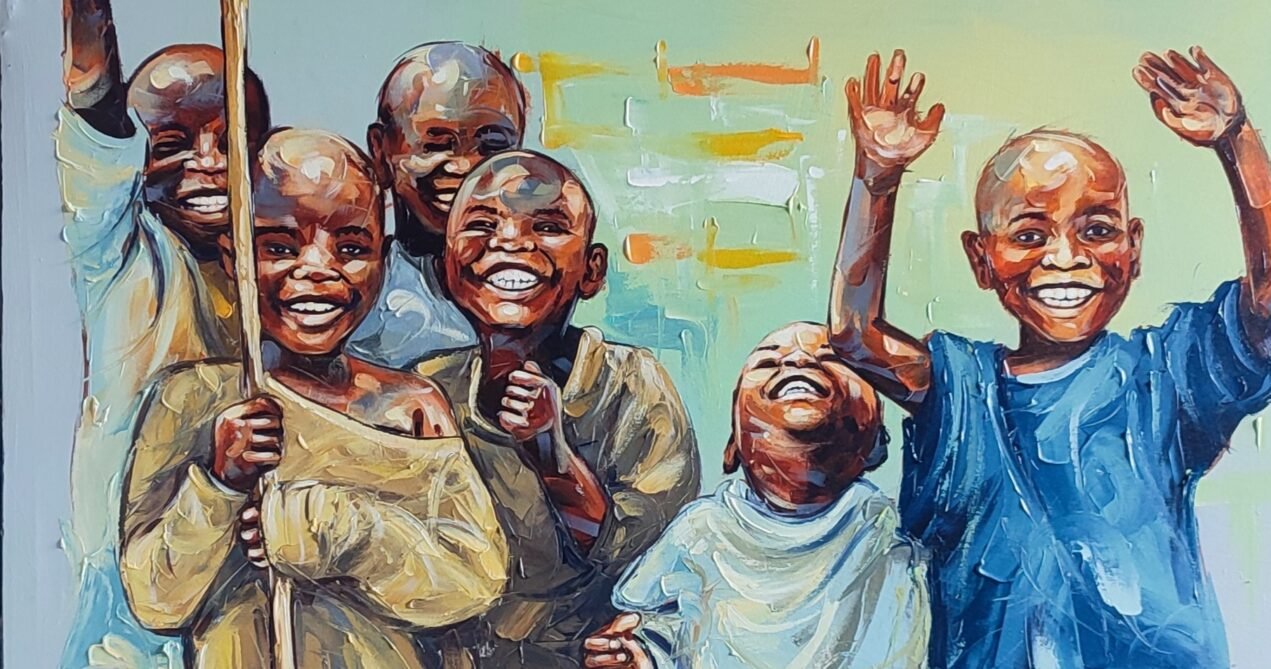
The fine-art world is bleeding behind closed doors. Every year, between 4 and 6 billion dollars’ worth of art vanishes, stolen from galleries, private collections, and even sacred spaces. Only 5 to 10 percent of those pieces ever find their way back. Meanwhile, the rise of generative AI is redefining what “art” even means. The global AI art market is expected to breach $5 billion in 2025. Some early experiments already show AI flooding marketplaces with images, driving down prices, confusing authenticity, and forcing human creators to fight for meaning. In that breach between creation and imitation, an artist has to choose: vanish quietly or push back loudly.
Ife Olowu chose the latter. Based in Lagos, he fuses paint, augmented reality, and Yoruba memory to build work that speaks across continents. At just twenty-something, Olowu has become a leading voice in a new creative vanguard rewriting Africa’s place in global art. He is the first Nigerian artist to integrate augmented reality into fine art, but beyond the headline, there’s a bigger story. His work arrives at a time when the art world is reeling from digital disruption.
In this turbulence, Olowu’s work stands as both anchor and frontier. He bridges ancestral memory with futuristic tools, proving that technology doesn’t erase heritage — it amplifies it. In this exclusive FAB L’Style interview, Olowu opens up about heartbreak, purpose, and what it really means to be an African artist in the age of digital imitation.
How Ife Olowu Is Reimagining African Art with Augmented Reality
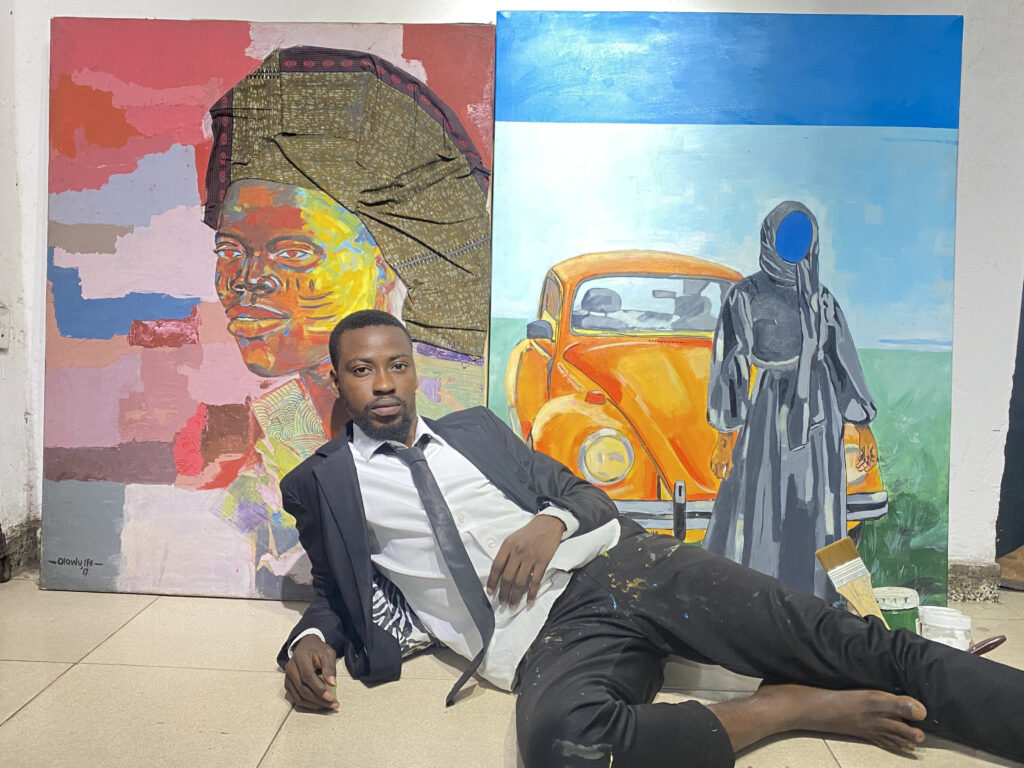
FAB: The last time you sat down for a big interview—with CNN—you were already being called the future of African art. It’s 2025 now, does that title still excite you, or has it started to feel like a burden?
Ife Olowu: It’s been about five years, and even though I don’t like to keep mentioning 2013, it always finds its way back into the conversation. In a few months, it’ll be 2026, and when I look around, it’s incredible to see how far technology has come. Look at what Meta just introduced—digital reflexes. The pace of change is insane.
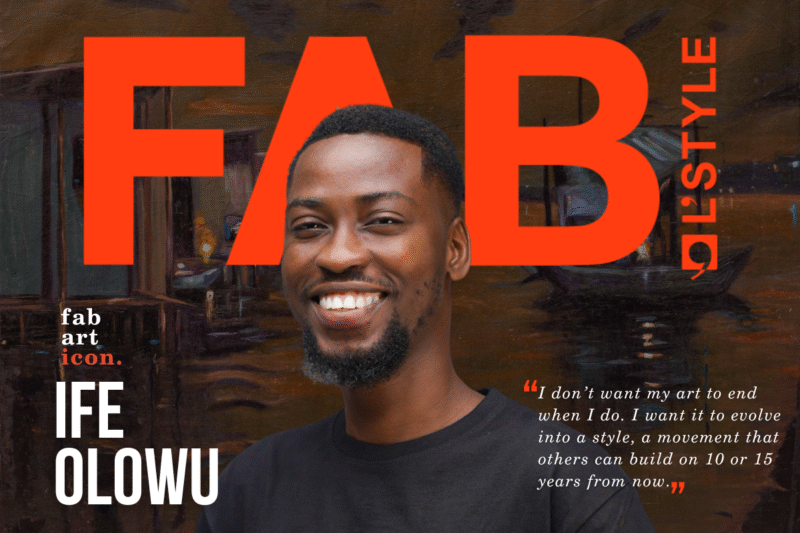
I’m proud to be part of the generation pushing Africa forward, not just locally but across Asia and the wider world. The recognition from CNN and BBC made me realize people are truly paying attention to my work. But for me, it’s not just about the attention—it’s about legacy. I want to create something that outlives me. I don’t want my art to end when I do. I want it to evolve into a style, a movement that others can build on 10 or 15 years from now.
Africa has always been a continent of movements—centuries ago, we had naturalism, spiritual art, symbolic storytelling. We kept evolving. I want my work to live in that tradition. The question I ask myself every day is: what can I add to push this movement further?
I don’t want my art to end when I do. I want it to evolve into a style, a movement that others can build on 10 or 15 years from now
Ife Olowu
Can AI Replace Artists? Ife Olowu Weighs In
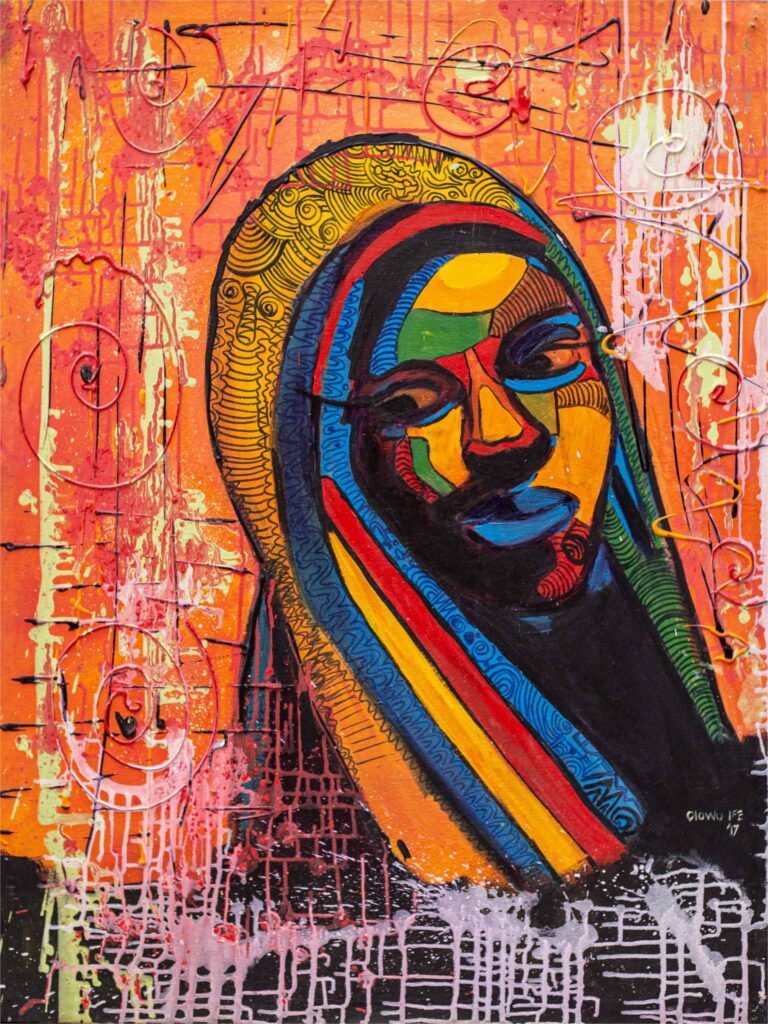
FAB: You mentioned how fast the world is evolving—AI, digital art, tech startups. Lagos especially feels like a city that never sleeps. But at the same time, there’s a rising “slow living” movement. As an artist, how do you find stillness in all this chaos?
Ife Olowu: I take breaks. Honestly, I disconnect when I need to. Social media can get overwhelming, and as creatives, it’s easy to lose yourself in that noise. Sometimes I log out completely, rest, then come back when I’m ready. Lagos never sleeps, but I try to protect my peace. In the end, you just have to find what works for you.
FAB: Fair enough. I’m not leaving tech anytime soon, though. Artificial intelligence is writing poetry, composing music, and even curating exhibitions. There’s a growing debate: are these “AI artists” real artists, or just machines mimicking creativity? Do you ever worry that technology could outpace the human artist—or do you believe machines will never touch the soul of creation?
Ife Olowu: Personally, I doubt machines can ever truly replace artists. I was painting long before technology became a part of my process. Tech may enhance what I do, but it doesn’t define it. Every piece I create starts from thought—what I want to say, the emotions I want people to feel.
AI works differently. It feeds on data. It collects fragments of what already exists—our works, our words, our histories—and reassembles them. That’s not the same as creation. It’s more like curation. It has its own market, yes. People buy AI-generated art. There’s space for that. But artists create from lived experience—from memory, emotion, and soul. That’s something AI can’t replicate.
At the same time, I don’t see AI as a threat. It’s a tool. Tomorrow, I might even use AI to expand my art—and that wouldn’t make me less of an artist. I see myself as a tech artist, someone who meditates on technology, who explores how it adds meaning to life, not how it replaces it.
AI doesn’t create; it curates. It collects fragments of what already exists — our works, our words, our histories — and reassembles them. That’s not the same as creation
FAB: I like that you’ve already begun describing yourself as a tech artist. The global art world loves to put labels on African artists. Some would say Afrofuturists, heritage-inspired, radical innovators. Do these words honor you, or do they box you in some way?
Ife Olowu: Honestly, I don’t think I’ve faced much of that. When CNN interviewed me, they called me a Nigerian artist, not a Yoruba artist. So, it didn’t feel limiting. It was more continental—more about representing my country. If another platform describes me as an African artist, that’s fine. It represents where I come from. I’m Yoruba, yes, but I’m also Nigerian, I’m African.
The issue comes when labels distort your identity or misrepresent your work. That’s when I push back. But so far, I think I’ve been described fairly. Like I said, I haven’t really experienced being boxed in.
FAB: Are you expecting that to happen at some point?
Ife Olowu: (Laughs) Maybe. But there’s a saying here—there’s no bad press. Controversy can sometimes work in your favor. It sparks conversation.
Take Slawn, for instance, when he created Three Yoruba Brothers. People argued over whether the title was “correct” Yoruba. But that debate introduced him to a wider audience. It made people curious about his art and what he stood for. That’s why I say—sometimes controversy helps you more than silence ever could.
FAB: I like that. Let’s stay with that theme of controversy. Take Uzo Njoku’s Owambe exhibition, for example. Some say it’s the wrong spelling. Others insist it disrespects Yoruba culture. There’s tension everywhere—Nigeria’s contradictions are exhausting and beautiful at the same time. Do you see your art as an escape, a rebellion, or documentation of the moment you’re living through?
Ife Olowu: That’s a tricky one. I try not to comment on issues that don’t concern me directly. We’ve learned our traditions—like prostrating to elders out of respect. Those things are part of who we are. But culture evolves. Technology changes how we express it.
I believe you can honour tradition and still innovate. That’s what I try to do. I respect the culture but I’m not afraid to explore new forms or ideas. So when I do something differently, it’s not rebellion—it’s evolution. And I’m always open to criticism.
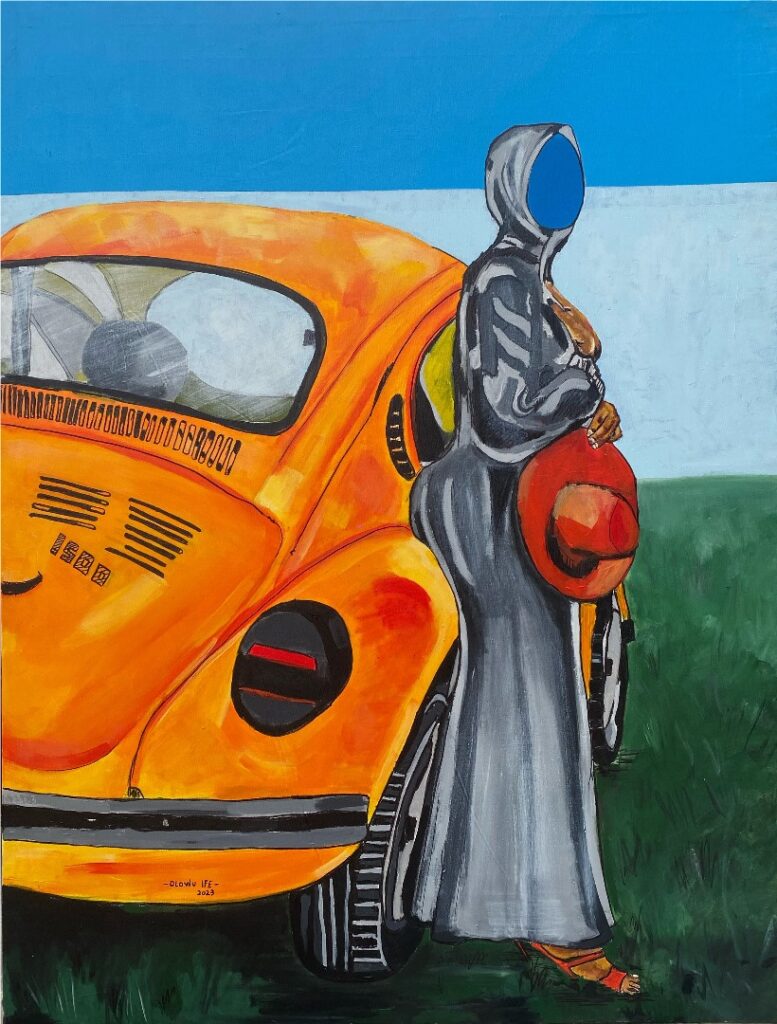
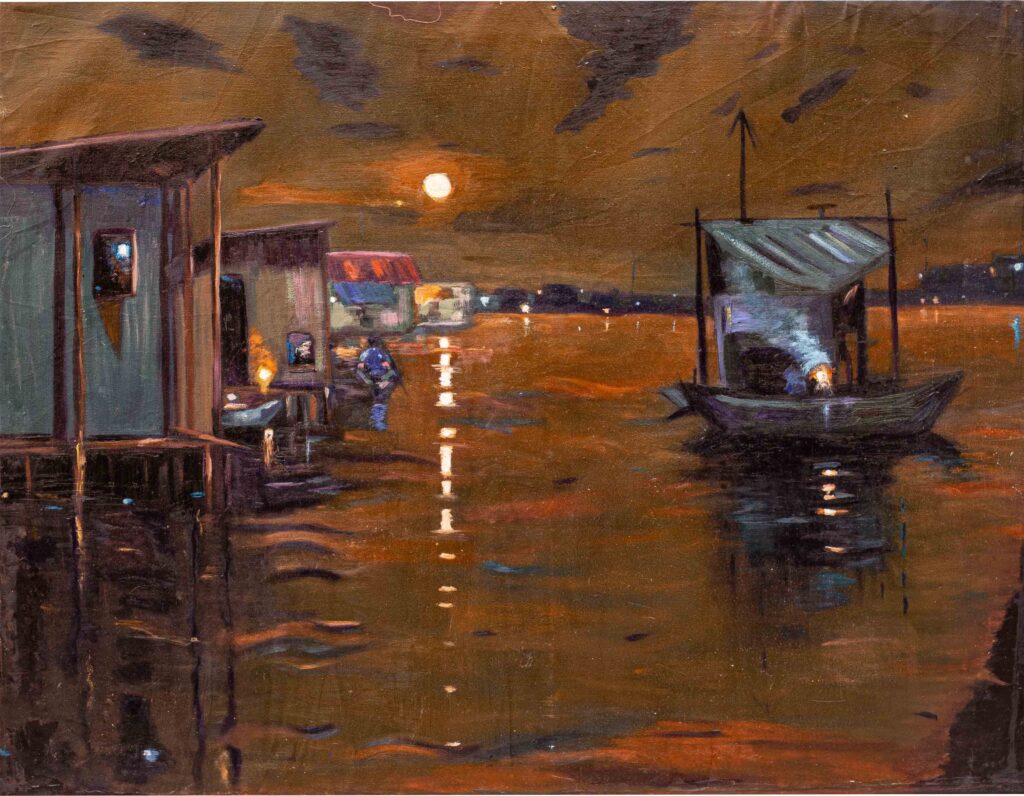
As for whether my art is an escape—it’s not. It’s about illumination. I’m using my work to tell stories, to clarify meaning. When you walk into a gallery, you might see a painting and wonder what it represents—one person says it’s Marco Polo, another says it’s something else entirely. With my work, I want to remove that ambiguity.
When you look at my paintings and hold up your smartphone, the augmented layer tells a story. It bridges the gap between what I intend and what the audience perceives. Even if I’m not physically present at an exhibition in London, I want people to feel where I’m coming from. My art isn’t about escaping reality—it’s about making it clearer.
FAB: You’ve seen the world. Right now, Afrobeats is unstoppable. We have the IJGBs — the I Just Got Backs — returning home and asking, “Where can I try jollof?” “Where can I experience this culture?” Along the way, they fall in love with Wizkid, Burna Boy, Asake — the full soundscape. It’s a good time to be an Afrobeats artist. And Nollywood too is crossing borders, with actors now appearing in Hollywood films.
But when it comes to visual art, the energy feels different. Outside Nigeria, galleries celebrate their artists like superstars. Here, not so much. Do you feel that visual artists are still lagging in terms of cultural recognition, both in Nigeria and across Africa? What’s holding us back?
Ife Olowu: That’s an interesting one — and honestly, it’s a conversation I’ve had often, even with friends. When we see musicians or actors celebrating wins — Burna Boy buying a new car, for instance — we’re happy for them. But visual artists rarely do that. We stay quiet, almost secretive.
We need to be more open about our success. People should know that artists are doing well — that we’re making money and gaining recognition both locally and abroad. But because we stay silent, people assume artists are broke or struggling. In reality, many of us are thriving.
FAB: Are you saying artists fear being “black-taxed”?
Ife Olowu: Not really. I don’t think it’s fear. If an artist sells a piece for £500,000, why should that be hidden? What’s there to be afraid of? Paying tax is normal — it’s part of doing business. Keeping quiet only keeps us invisible.
Right now, incredible African artists are being celebrated globally, but within Nigeria, only a few names break through. That’s not because talent is scarce — far from it. We have hundreds of skilled artists creating world-class work. Yet, people rarely hear about it. There are art sales worth £100,000 happening right here in Lagos, but no one talks about it. That secrecy hurts our visibility and collective progress.
FAB: Fair point. So if I asked you the highest you’ve ever sold a piece for?
Ife Olowu: (Laughs) It’s public. You can find it out there.
Why Collaboration Is Africa’s Next Creative Power Move
FAB: Good to know! Let’s talk about collaboration. Since the start of the year, that word has dominated every creative conference. At the Africa Creative Market, for example, collaboration came up again and again — locally, across Africa, and globally.
Yet, we rarely see visual artists partnering with furniture designers, shoemakers, or fashion houses. Why don’t we see artists like you collaborating with brands such as Ugo Monye or Mai Atafo?
Ife Olowu: Collaborations exist — but they’re rare. Personally, I’m big on them. I also partnered with a friend who runs a fashion brand called THEOs. I strongly believe in what happens when creative worlds collide. When two artists collaborate, they share audiences, expand reach, and amplify each other’s impact — not just in sales, but in storytelling.
The problem isn’t that collaboration doesn’t happen. It’s that it’s not visible enough. We need more of it — and more platforms celebrating when it does.
FAB: Do you think, as Africans—or more specifically as Nigerians—we struggle with collaboration? Is it a trust issue?
Ife Olowu: Collaboration can be tricky. Often, when people say they want to collaborate, what they really mean is that they want to benefit from your talent or skill. It stops being a partnership and becomes one-sided. You end up feeling like you’re doing most of the work while the other person rides on your effort.
That imbalance makes many artists hesitant. I’ve experienced it myself. There was this proposed collaboration—someone introduced me to a creative who seemed genuinely interested. She said we’d been in touch for a while, and we finally agreed to connect. But as soon as I realized my travel schedule would clash with our timeline, I postponed the call. In hindsight, I’m glad I did, because I noticed the arrangement leaned more in one direction. That’s how many “collaborations” turn out—one person gains much more than the other. So yes, trust and fairness are big issues.
FAB: Let’s talk about intellectual property. Have you seen any progress in protecting artists’ work—from when you were a student to now working professionally? I still see artworks printed on flex banners along the road or sold by street vendors. Has anything changed?
Ife Olowu: Honestly, IP theft has been a long-standing problem. It’s frustrating. People attend exhibitions, take photos of artworks, and later reproduce them without permission. You could be walking down the street and suddenly spot your own painting printed on a banner. It’s happened to me.
Even with intellectual property laws, enforcement is weak. The people doing this aren’t usually online—they don’t care about copyright. That’s why I think the solution must be collective. Artists, associations, and policymakers need to work together to enforce stricter penalties and awareness.
Personally, I’ve adapted. I rarely post high-resolution photos of my work online. When I do, it’s usually in a video format or with me standing beside the piece. That way, people can’t easily screenshot and reproduce it. Still, many artists share their work openly, and once someone screenshots and prints it, that’s it—you’ve lost control.
We probably need real enforcement—task forces that can track and penalize offenders. But lately, I’ve noticed something interesting: more people are turning to AI-generated art instead of stealing existing paintings. It’s not perfect, but maybe it means fewer people are copying our work directly. Slowly, we’re getting there.
Building a Sustainable Art Career in Nigeria
Ife Olowu: Exactly. There’s always that danger.
FAB: Someone once asked you why you focus so much on the future instead of the present. Now it’s 2025—after AI, the pandemic, and economic turbulence. Nigeria has gone through one election and is gearing up for another. If they asked you that question today, what would your answer be?
Ife Olowu: My answer would still be the same: we have to think about the future. The future doesn’t exist in isolation—it begins in the present. Every decision we make today shapes what’s next.
People often say, “focus on the now,” but even that involves planning—what to wear tomorrow, where to go next week, how to improve next year. We live in constant motion toward the future. So when I talk about the future, I’m not abandoning the present; I’m giving people something to anticipate, something to prepare for.
When people now see my art, they say, “Oh, this is what he was talking about years ago.” Back then, many didn’t understand it. When my first collection came out, some said it was “juju” or magic. Even during my first TV interview on NTA, people were skeptical. They didn’t realize I was working with technology—it was ahead of its time. But now, years later, they see it differently. They say, “Oh, it was technology. It was innovation.”
That’s what I mean when I say bringing the future into the present. My art reflects what’s coming next. So, to me, the present and the future are inseparable. My goal is to keep merging them—to make the future feel tangible today.
FAB: Let’s rewind a bit. You mentioned NTA, and as a Nigerian, I completely understand how conservative our environment can be—especially in educational spaces. I’m curious, how did your lecturers respond to your early ideas back in school?
Ife Olowu: Thankfully, I graduated in 2017—before I discovered this path. Back then, I was focused on learning the basics: sketching, clay modeling, design principles, all the traditional foundations. I wasn’t yet thinking about merging art with technology.
Looking back, I’m glad it happened that way. If I had tried to explore tech art in school, it might have been misunderstood—or even discouraged. At that point, I didn’t fully understand it myself. It was only after school that I started exploring computing and digital tools. I wasn’t a “tech person” at all until then. But once I left school, I found my direction. And that’s where everything truly began.
FAB: Interesting — you were never really a tech person. So, if you were to trace your journey, at what point did technology enter the picture?
Ife Olowu: The turning point came when I was trying to grow my business. Apart from being an artist, I was also creating designs and printing. That’s what I’d been doing since my school days.
FAB: You were hustling, doing “jama-jama.” Would it be wrong to assume you made the beautiful shirt you’re wearing right now?
Ife Olowu: Yes, exactly. That’s what I was doing. I wanted to improve my business because it was funding my art. Art was expensive — materials, films, everything cost a lot back then. So, the business paid for my studies and my supplies. I’ve never had a regular job. I’ve always been both an artist and an entrepreneur. Design is expensive, and I needed to sustain it.
FAB: Some would say that when you start earning early, school can start to feel secondary — especially when art is costly and you’re already making money. Did you ever feel tempted to drop art and just focus fully on the business side?
Ife Olowu: (laughs) Honestly, no. From the age of ten, I knew I wanted to be an artist. My mom was a textile artist and a civil servant at Yabatech, and that influenced me a lot. I used to visit the art department there — one of the biggest in Nigeria — and I’d watch people paint for hours. I knew right then, “This is what I want to do.”
The printing side came in 2013 during the ASUU strike. My mom suggested, “Why don’t you learn something new while you’re on break?” That’s how I got into printing. It wasn’t because I loved it; I just needed another skill to support my art. I even wrote UTME for the University of Lagos to study Fine Art — that’s where my heart was.
In my first year, I started taking small printing jobs from classmates — T-shirts, posters, that sort of thing. Since I didn’t own a machine, I outsourced most of the work to the machine market. Through school, I kept using printing to fund my art supplies. It was survival, not passion.
After graduation and NYSC, I continued doing both — art and printing. It’s been over ten years now. I’ve done a few other things along the way, but art has always been at the center of it all. If I could choose one thing to do forever, it would be to be a full-time studio artist.
FAB: We’re already touching on the business side of art—the sustainability of being an artist. If your art isn’t selling, how do you feed yourself?
Ife Olowu: (laughs) How do I feed? That’s the real question. What I tell people is this: doing art full-time is scary, especially in today’s world. If your works aren’t selling, how do you survive? How do you buy materials? It’s not easy. You have to find one or two other things to support yourself. Whether it’s crypto, printing, or any side hustle, you need another source of income to stay afloat—because even with exhibitions, sales don’t happen all the time.
So, I always tell young artists: find a balance. Look for something you can do alongside your art. I’m a living example. If I hadn’t started my printing business, I might still be struggling today. Maybe I’d even be working in a bank or somewhere else just to survive. The truth is, I needed money to keep creating.
Back in school, we thought selling a painting for ₦30,000, ₦80,000, or ₦100,000 was big money. But after graduation, reality hits—you start seeing how the real world works. There’s always a business side to art. I’ve always been a businessman, even before I left school. I understood pricing, quality, and positioning. You have to know your worth, the kind of company you keep, and which galleries to approach.
Some galleries take 70 percent and leave you 30. Others do 60-40 or 50-50 splits. That’s where negotiation comes in. You must learn how to position yourself and your work. I’ve mastered that over the years—and that’s why I’m still here, doing what I love, and why you’re talking to me today.
FAB: Every year, schools keep producing fresh graduates. Take Yabatech, for example—you’ll find so many promising young artists there. But the question is, what’s their future?
Ife Olowu: At least between 500 and 1,000 new graduates come out every year.
FAB: Exactly. So, does it make sense for visual art graduates to leave school and immediately say, “I want to be a full-time artist”? Do you think there’s a better path or perspective they should consider?
Ife Olowu: If I were speaking to undergraduates or recent graduates, I’d tell them to stay on the path of art—but be strategic about it. In the long run, it pays off, especially when you make the right connections and surround yourself with the right people. But here’s the truth: not everyone has to be a full-time studio artist.
Art is a broad field. You can be a curator, a gallery manager, an exhibition planner, or even work in art consultancy. In Nigeria, we have curators—but not enough. How many people can actually plan and execute a professional exhibition? Very few. That’s an opportunity right there.
So, I’d advise young artists to explore other areas within the art ecosystem. Ask yourself: What skills can I leverage in today’s creative economy? What gaps exist that I can fill? Your degree isn’t limited to a gallery wall or a bank job. There are so many possibilities within art itself.
You can also take online courses to expand your knowledge. For instance, we don’t really have structured curatorial programs for undergraduates here. If we have painting and sculpture departments, why can’t we have a department for curatorial studies too? Let’s teach students how to become curators, exhibition designers, or art handlers. We already have museums and galleries—why not prepare people for those roles locally?
Honestly, that’s a conversation I think we need to start having. If we can add Chinese to our curriculum, we can definitely add curatorial studies. We need to start building the ecosystem from within. That’s what I’d tell young artists: explore other areas of art that are still untapped. You can be a curator. You can build your own lane.
FAB: You’ve just highlighted how few curators we have in Nigeria. Do you think it’s because there aren’t enough professionals to teach curatorial practice locally—meaning people have to travel abroad to learn?
Ife Olowu: Exactly. You either travel or learn online. There’s definitely a scarcity. Most artists aren’t even thinking in that direction. Personally, I’ve developed my skills to the point where I can curate and manage exhibitions myself. Right now, I work as a project manager and exhibition coordinator for a gallery in London—even while still being based here.
I’ve learned to adapt because I think long-term. In 50 years, I may no longer be able to paint. So what happens then? Can I become an art historian? A mentor? I have to prepare for the future—keep evolving, stay relevant, and keep learning. That’s how I think.
I tell other artists the same thing: think beyond today. Think 20 years ahead. What will you be doing if painting stops selling? Will you still be part of the art world, or will you fade out? That’s why it’s important to upskill, embrace technology, and build versatility.
FAB: You’ve also mentioned that you’re a businessperson. Early in your career, you were honest enough to say, “I like money”—and that’s refreshing. Many artists feel the same way but fear being seen as less passionate. Some people still insist on art for art’s sake—art purely for passion. Does that still make sense in 2025, as we approach 2030?
Ife Olowu: Yes, it does—if the person already has another source of income.
FAB: So you actually believe in art for art’s sake?
Ife Olowu: I do. That’s what inspired me as a child. Back then, I didn’t even know art could make money. I just loved it. I’d draw on paper, sketch characters, design movie covers—this was when DVDs and CDs were still popular. I was obsessed with Supa Strikas and would try to recreate the characters from those comics. I just loved creating.
But over time, passion has to pay the bills too. You can love your craft deeply, but you must also find ways to make it sustainable. That balance between passion and practicality is what keeps an artist going.
FAB: So you’ve had to face that conversation around “doing it for passion.” People in music, for instance, have moved past that—no one wants to sing just for singing’s sake anymore. There’s always a commercial angle. Do visual artists face similar pressure now? In music, producers are always looking for a viral track. In film, directors want the next big hit. And now, with TikTok, everyone—from water sellers to tech founders—is suddenly a content creator. Does that pressure affect you?
Ife Olowu: Personally, I don’t see it as pressure. Like Davido once said, “I hawk my craft like pure water.” That’s exactly how I see it—I work hard and stay consistent. I’ve even said it in a past interview: you have to put your work in people’s faces. Flood the timeline. Be visible.
The last time I posted on Instagram was in September, and I just posted again today. I can do that now because I’ve built my brand to a level where I don’t need to post every day. But if you’re still building, you can’t afford to disappear. You have to keep showing up—keep creating, keep posting, keep proving you’re good at what you do.
Social media isn’t pressure; it’s opportunity. It’s a global stage that costs nothing. All you need is your phone and a good idea. Post it, and you never know who might see it. Someone in the U.S., Europe, or Asia could stumble on your work. Algorithms are unpredictable; one small post can change everything. So I see it as motivation, not pressure.
I even co-manage a friend of mine, Toby Shang—he’s a hype man. Back in school, we used to work together. He told me once that TikTok was paying him really well. I didn’t take it seriously at first until I saw the numbers. The guy earns in dollars. And now, hype is a full-blown business.
FAB: True. Who would have thought we’d live in a time where people get paid for hyping.
Ife Olowu: Exactly! We’ve seen his financials. We know how much he earns per show. He gets booked for gigs, people fly him out of Lagos, and he doesn’t travel alone—he goes with a cameraman and logistics team. It’s become that big. The hype industry will soon stand shoulder-to-shoulder with the music industry. You’ll see people booking hype men just like they book artists.
My philosophy is simple: whatever you’re doing, see the bigger picture. Whether you’re selling water or making art, keep pushing it. That reminds me of the young man who went viral for giving free water to inmates. He started by selling pure water, and now he’s a law graduate. That’s the power of social media. Just keep showing up. Keep creating. Keep going.
Why Ife Olowu Might Be the Future of African Art
FAB: What do you think the Nigerian government should focus on when it comes to the art business? Is art the new oil they’re yet to recognize?
Ife Olowu: It definitely is—alongside tourism. Once the government develops these sectors, Nigeria could become a global destination. We already have institutions like the National Gallery of Art, but when you visit some of their complexes in Lagos or other parts of the country, there’s hardly anything to write home about.
These are the bodies artists should be able to rely on for support—especially when organizing exhibitions. We should be able to reach out to them for assistance or to collaborate on government-backed projects. Unfortunately, that’s rarely the case.
From my personal experience, I’ve seen both sides. When I was serving in Kano, the National Gallery of Art supported my exhibitions because I was a corps member organizing art shows. I still had to pay for the venue and logistics out of my own pocket, while they only provided stands and display screens. That kind of support helps, but it’s not enough. They should be offering more—monetary sponsorship, free venues, or logistical support.
Imagine the National Gallery of Art not even having its own functioning gallery space. Why should artists rely solely on private galleries? We need government-owned spaces where artists can exhibit at subsidized rates. Even better, they could host monthly or bi-monthly exhibitions that spotlight emerging and professional artists—secondary school students, university students, and established creatives. Artists could simply submit through an open call and display their work for free. That kind of consistent exposure would transform the ecosystem.
If I were the Minister of Art, I’d approach things differently. Coming from a background as a struggling artist turned businessperson, I understand what needs to change. First, our budget for the arts must increase. There’s so much untapped potential in this industry.
Right now, art sales in Nigeria are almost impossible to track. There’s no taxation or income record system for art transactions. While I personally pay taxes, I believe there should be a structured framework that recognizes art as an economic sector. Art is the new oil block—just like tourism and music. People want to experience Nigerian art, they want to visit, to see, to feel. There’s real money in it, and those who understand the ecosystem know this.
If I were in charge, I’d also reform the educational system. Our art curriculum is outdated and needs to reflect global standards. We need better training, better tools, and modern equipment.
When I was in Spain and visited an art supply store, I was shocked by the difference in quality. Their brushes and materials were far superior to what we use in Nigeria. Why are we importing substandard products? Why aren’t these materials regulated?
That’s one of our biggest challenges—beyond the lack of grants and government support. We’re expected to create world-class work using poor-quality materials. Sometimes, after spending weeks on a painting, the canvas starts peeling. And people say, “Why didn’t you buy the expensive one?” But that’s not the point—why are substandard materials being sold here at all? These are the issues that need fixing if we want art to truly thrive in Nigeria.
FAB: You’re building an educational platform, from what I’ve read, to make tech-driven art more accessible. So, let’s be honest—how do you make it affordable and still run it as a business? How do you ensure it doesn’t end up as just another document or idea?
Ife Olowu: Like they say, good things don’t come cheap, right? But there’s always a price to pay—either on my side or the audience’s. Still, I want to be considerate because I know where I’m coming from. I struggled as an artist, so I understand what it means to lack access. When the platform launches, I’ll make sure it’s affordable and inclusive. I also plan to offer free classes to give people a taste of what’s possible.
Right now, I already do that in small ways—through workshops during my exhibitions and guest talks at creative events. It’s part of how I give back. So yes, when the platform goes live, it will be price-friendly—not something that “cuts people’s necks.” But good things still have value.
FAB: Are you already exploring partnerships with foundations, NGOs, or donors?
Ife Olowu: Definitely. Collaboration is key. Partnership is something every serious entrepreneur must embrace. I already work with a team I see as my partners because they share in what I’m creating and believe in the vision.
Last December, I partnered with an NGO called Arts for Health. The proceeds from our project went to support people battling cancer—especially breast cancer. I’m very open to more initiatives like that. In fact, on October 2nd, I’ll be speaking at Advocates for Health, where we’ll be giving back once again.
That’s my way of contributing to society—through partnerships that create real impact. Going forward, we plan to expand our reach across Africa and then globally. The goal is to build meaningful collaborations that help us scale this vision while giving back.
FAB: Beautiful. And if you could choose one painting or AR work to outlive you—say, in the next 200 years—what would you want it to say about Ife Olowu and about Nigeria?
Ife Olowu: I’d want it to say that Ife Olowu had a deep passion for his art. That he dared to be different—bold, innovative, and unafraid to carve out a new path for others to follow. And above all, that he loved—his craft, his country, and his people.
FAB: That’s a side people don’t really know. Are you a lover boy?
Ife Olowu: Yeah, I’m a lover boy—100%. You’ll see it in my paintings. Each one is either inspired by someone I loved or, maybe, by heartbreak—what we now call breakfast.
FAB: How many breakfasts have you been served?
Ife Olowu: [laughs] I’m still counting.
FAB: Geez, you’ve lost count already! Are you the one serving or receiving?
Ife Olowu: No, I don’t serve breakfast. I told you—I’m a lover boy. Maybe one or two heartbreaks, that’s all. I’m still young. But beyond that, I want people to look at my work and say, “This guy is phenomenal.” I want my art to inspire people, to make them think.
FAB: What’s a day like in the life of a lover boy–artist?
Ife Olowu: Honestly, I don’t always plan to paint—it just happens. My studio is right outside, so inspiration can hit anytime. Sometimes after my morning prayers, I just sit with my phone—checking messages, responding to business emails, reviewing my schedule. My phone is my golden tool.
After that, I hit the gym, come back, and officially start my day around noon. Mornings are for me—quiet, reflective. Some days I have meetings or errands. Other days, I just think. I think a lot—about life, about what’s next, about how to evolve.
I don’t paint every day. Some days I just rest or work on designs. Funny enough, an hour before you called, I was asleep. I’d been up all night finalizing designs for a project. I woke up, tidied up, came here, and after this, I’ll probably eat and sleep again. That’s me—living, creating, doing what I have to do.
FunZone: #FabFastFive
FAB: What is that one colour people would always find in your closet
Ife Olowu: White and black
FAB: What is that fragrance or scent that reminds you of your childhood?
Ife Olowu: Adire (Indigo Dye)
FAB: Shoes or Slippers?
Ife Olowu: Slippers
FAB: Short or Pants?
Ife Olowu: Pants
FAB: One food you can eat for the rest of your life?
Ife Olowu: Rice