
Algorithms can now predict fashion trends with over 90 percent accuracy, slash forecasting timelines from eighteen months to three, and generate thousands of new styles before a human designer picks up a pencil. The fashion industry calls this progress. A growing number of people inside it are no longer sure.
When Fashion Algorithms Become the Designer
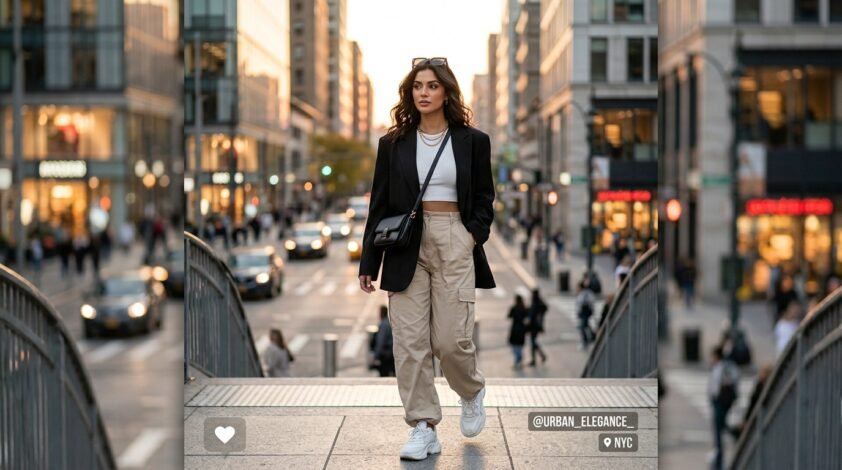
Open Instagram right now and scroll for sixty seconds. Something will happen that happens to almost everyone who does this in any city in any country: you will see the same shoes. The same silhouette. The same muted palette, or the same maximalist print, depending on which direction the algorithm decided the season was going. You will not know where you are. You will not need to. Social media has collapsed fashion into one global trend cycle, and the algorithm creates a singular aesthetic that reaches someone in São Paulo, Seoul, and Surat within seconds. The algorithm isn’t interested in context. It rewards replication.
This is the paradox at the centre of fashion in 2026. An industry built on the promise of self-expression, difference, and the new is increasingly powered by systems whose entire logic is the opposite: find what is already working, amplify it, and serve it to more people faster. AI-driven trend forecasting has moved from experimental buzz to industry-standard workflows, with platforms achieving over 90% accuracy and slashing prediction timelines from 18 months to just three. That is an extraordinary technical achievement. What it means for creativity is a harder and more uncomfortable conversation.
How Fashion Algorithms Work
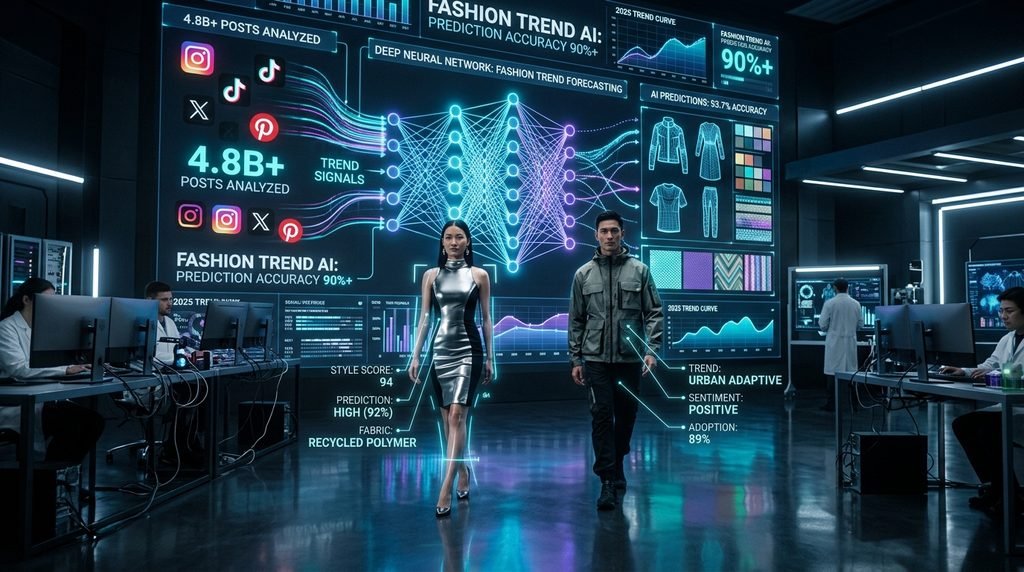
The mechanics are not complicated, even if the technology behind them is. By scanning billions of social media posts, search queries, and customer reviews, AI algorithms can spot emerging trends before they fully surface. The platforms being used by major fashion companies analyse visual signals from TikTok and Instagram, search behaviour from Google and Pinterest, early sales data from e-commerce platforms, and street style images from across the world, processing in hours what would have taken a team of human trend forecasters months. NPR reported in October 2025 that AI algorithms had successfully predicted several emerging trends, including dotted prints, flat-thong sandals, and the resurgence of yellow, before they appeared on major runways at Paris Fashion Week. These predictions were made months in advance based on social media signal analysis.
Enterprise brands are integrating AI forecasting into their merchandising and design calendars. Companies like PVH Corp, which owns Calvin Klein and Tommy Hilfiger, and Inditex, which owns Zara, use AI predictions to adjust production volumes in advance. The business case is obvious. Better forecasting means less unsold inventory, reduced waste, and faster response to consumer demand. These are not trivial benefits in an industry historically plagued by overproduction and waste.
But the technology has also generated a more troubling application. A lawsuit filed in California federal court accused Shein of using “selective algorithms” to identify fashion trends and reproduce the designs for its site. The complaint, brought by independent designers, described “a secretive algorithm that astonishingly determines nascent fashion trends, and by coupling it with a corporate structure perfectly executed to grease the wheels of the algorithm, including its unsavoury and illegal aspects.” In November 2024, a federal judge refused to dismiss RICO claims against Shein, signalling that courts may begin treating algorithmic, systematic IP theft as organised criminal conduct. The case ultimately settled in September 2025 on undisclosed terms.
The Shein case is extreme. But it illuminates something about the algorithmic logic that governs the whole industry, not just its most aggressive players. The algorithm does not distinguish between spotting a trend and consuming it. It simply identifies what is working and delivers more of it, faster, at lower cost. The ethical question of who made the original thing, and whether they benefit, is not a variable the system is built to consider.
The Homogenisation Problem Fashion Algorithms Create
A microtrend in Seoul or a student project in London reaches screens worldwide in seconds. As designs are liked, shared, and reposted, it becomes nearly impossible to trace who created them or why. The noise of the feed becomes their new context, replacing the individual hands and traditions that shaped them with homogenised, screen-sized squares.
The result is something fashion professionals discuss with increasing frequency and increasing unease: everything is starting to look the same.
The most popular designs get fed back into the system, reinforcing the same aesthetic patterns. It is like a visual feedback loop that gradually narrows creative possibilities. A colour or silhouette that performs well is amplified. The amplification brings more attention, more sales, more data confirming it works, which causes the algorithm to recommend more of it to more designers and more consumers simultaneously. The feedback loop rewards proven winners. It has no mechanism for rewarding the unproven, the unexpected, or the genuinely new.
Before social media, trends travelled slowly. Fashion weeks, magazines, and local retailers naturally filtered global trends through regional tastes. That filtering was not merely inefficiency. It was cultural translation. A trend originating in Tokyo passed through editors, buyers, and local retailers before reaching a consumer in Vienna or Nairobi, and in that passage it was interpreted, adapted, and made relevant to a specific place and person. The algorithm has removed the interpreter. It doesn’t account for climate, infrastructure, culture, or even the way cities function. It simply serves the same aesthetic to millions of people, regardless of where they are watching from.
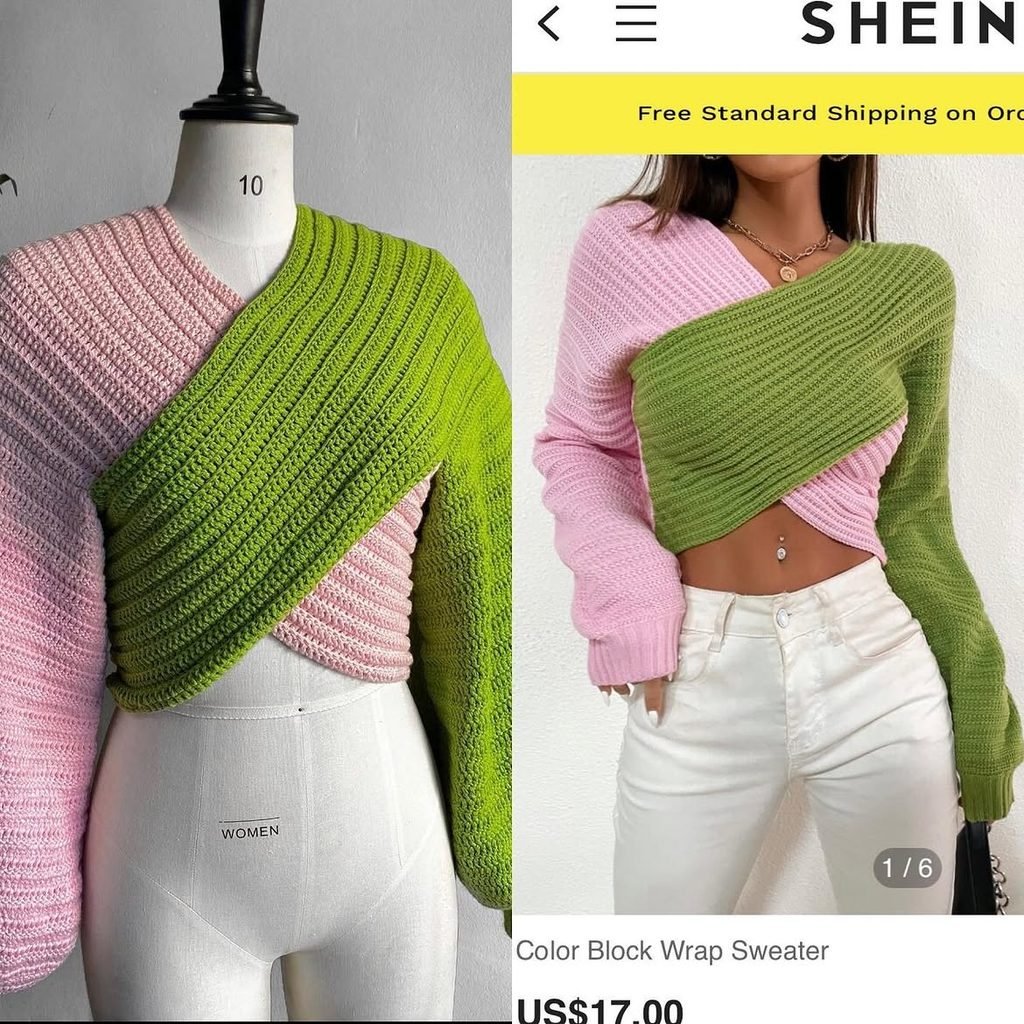
Nigerian designer Elyon Adebe experienced this logic at its most personal. She found a replica of one of her crochet sweaters on Shein. The handmade garment was priced at $330. The version on the e-commerce platform was $17. The copied sweater was removed from Shein’s website only after Adebe posted about it on social media. Her case is one of hundreds. It illustrates precisely what the algorithm optimises for: the identification and rapid reproduction of creative work that has already been validated, without reference to the person who created it.
What Fashion Algorithms Cannot Replace
The case against algorithmic dependency in fashion is not simply about aesthetics, though aesthetics matter. It is about what drives creative innovation in the first place, and whether the current system is capable of producing the conditions in which genuine originality can survive.
We are losing obscurity, and without obscurity, culture cannot thicken into something meaningful. This is a precise diagnosis of a specific problem. Fashion has historically drawn its energy from subcultures, from margins, from the places the mainstream had not yet reached. Punk emerged from a particular kind of London poverty and alienation. Hip-hop fashion came from a specific economic and cultural reality in New York. The Sapeur tradition in Kinshasa developed in deliberate, defiant contrast to political oppression. These movements were possible partly because they existed below the threshold of immediate commercial visibility. They had time to develop before they were consumed.
The algorithm collapses that time. We can look at the boom of micro-trends as the result of two things: a form of escapism, and an identity-seeking exercise. Much like how someone chronically online inevitably starts using TikTok slang, wardrobes have become reflective of online engagement. A subculture that once had years to develop coherence and depth now has months, sometimes weeks, before it is identified, packaged, and sold back to the people who created it, and then to everyone else simultaneously.
The micro-trend cycle, in which a specific aesthetic surfaces on TikTok, is named and categorised by media, attracts commercial imitation, and is declared over, all within a single season, is not a natural rhythm of fashion culture. It is an artificial one, generated by systems that benefit from constant novelty while systematically preventing the slow development of anything genuinely new.
Recommended For You
Fashion Algorithms and the Stakes for African Designers
As African designers continue expanding into the Western market, the priority is to ensure these creatives are not exploited or stolen from. “Our key thing is cultural ownership,” says Sana Ahmed, founder of The Fashion Law Africa Summit.
This is not an abstract legal concern. The Fashion Law Africa Summit is dedicated to protecting Africa’s fashion industry by providing resources, education, and legal tools to safeguard creations and cultural identity, helping creatives know how to protect themselves when entering international markets, especially when it comes to IP, trademark, copyright, and scaling efficiently.
The specific risk for African designers in an algorithm-driven fashion environment is layered. First, the same mechanism that makes trends travel fast also makes cultural designs travel fast, without attribution, without compensation, and without the context that gives them meaning. A print pattern rooted in specific Yoruba or Kente or Maasai visual tradition can become a global trend and then a mass-produced product before the community that developed it has any opportunity to participate in the commercial value it generates. The algorithm has no field for cultural provenance. It has a field for engagement.
Second, the core of most African brands is the desire to tell African stories in a way that builds and uplifts the culture, with design based on the context of giving authentic identity. This orientation is structurally at odds with algorithmic trend logic, which decontextualises aesthetic elements from the stories and communities they come from in order to make them universally marketable. The aesthetic travels. The story does not.
Third, the algorithmic trend cycle rewards speed and volume in ways that disadvantage smaller producers working with handcraft techniques, traditional textiles, and community-rooted production models. Designers rooted in the African diaspora, like Tolu Coker, Tokyo James, and Foday Dumbuya of Labrum, used the Paris Fashion Week Fall/Winter 2026 runway not just to present clothing, but to assert narrative control, moving beyond aesthetics of struggle into an era of mastery. But this kind of deliberate, culturally grounded resistance requires the platform, the audience, and the institutional support to make it visible. For the majority of African designers who have none of those things yet, the algorithm’s indifference to context is not an aesthetic problem. It is an economic one.
The Other Argument
The counter-case deserves honest engagement, because it is not without substance.
AI-driven forecasting, at its best, reduces overproduction. If a brand produces closer to what consumers will actually buy, it produces less waste. In an industry responsible for an estimated 10 percent of global carbon emissions and billions of unsold garments annually, better demand forecasting is not a trivial improvement. AI enables accurate predictions and strengthens customer engagement through personalised shopping experiences, helping brands bring styles to market faster.
The technology also creates genuine access for independent designers. Smaller labels that previously could not afford professional trend forecasting services can now use AI tools to understand market direction and make better-informed production decisions. Independent designers have shared stories of scaling from concepts to campaigns without photoshoots, achieving five times faster time-to-market. For a small brand without capital for a full campaign infrastructure, this is a meaningful democratisation of tools that were previously available only to large companies.
And the strongest version of the pro-algorithm argument is simply this: the system surfaces what consumers actually want, rather than what a small number of editors and creative directors decide they should want. Fashion has never been a purely democratic form. Its gatekeeping has always been exercised by powerful institutions with their own interests and their own blind spots. If algorithms have disrupted that gatekeeping, at least some of what was disrupted deserved to go.
The Question Nobody Has Answered
The goal is not to outsource fashion and creative direction to algorithms. It is to make better-informed decisions about which creative risks to take. This is how the technology’s advocates frame the relationship between AI and human creativity. It is a reasonable framing. It is also, in practice, not how the relationship tends to work.
When the algorithm tells a buying team that a particular silhouette is trending in six markets simultaneously, the buying team orders it. When the forecasting tool identifies a colour as emergent across social media, the design team works with it. The decisions are still made by humans. But the range of options those humans are choosing between has been narrowed, in advance, by a system that defines possibility in terms of what has already performed.
In 2025 and 2026, generative AI is collapsing the gap between trend detection and design output into a single automated pipeline. The pipeline is efficient. What it may be producing, at scale and across the industry simultaneously, is a version of fashion that is very good at giving people what they already wanted, and structurally unable to show them something they have never seen before.
Fashion has always had a tension between commerce and culture, between the sellable and the new. That tension is productive. It generates the friction from which interesting things emerge. The algorithm does not resolve that tension. It removes it. And a fashion industry without productive tension is one that has optimised its way out of the thing that made it matter.
The woman dressing in Lagos, the designer sourcing fabric in Vienna, the buyer making decisions in Seoul: all of them are navigating a system that is increasingly deciding what they see before they have a chance to decide what they want. Whether that constitutes progress depends entirely on what you think fashion is for. That question, at least, has not yet been automated.