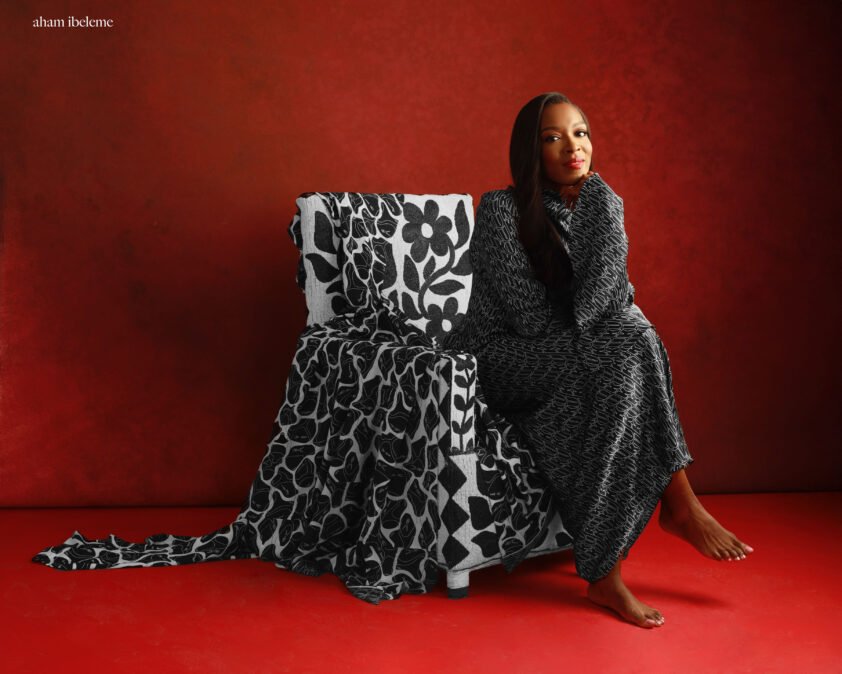
For her Spring/Summer 2027 collection, the British-Nigerian designer, Banke Kuku, draws on motherhood and the natural cycle of renewal. But beneath its celebration of abundance is a more demanding design exercise: how to introduce new ideas without losing the identity of a fashion house.
Banke Kuku does not begin a collection with a sketch. She begins with a feeling. For Earth & Sky, her Spring/Summer 2027 collection, that feeling was abundance. The designer became a mother for the first time this year, an experience that changed how she viewed the world around her. She found a connection between the fullness of new motherhood and the natural world, where rain feeds the earth, flowers bloom and water returns to the sky.
The result is a collection built around a cycle of giving and renewal. Yet the idea extends beyond a set of floral and sky-inspired prints. It also offers a useful way to understand where the Banke Kuku brand stands today. After building recognition through expressive prints, relaxed silhouettes and nature-led textiles, the label is moving into more formal dressing. The challenge is to make that expansion feel like a natural development rather than a departure from its identity.
During a virtual press conference ahead of the November 11 presentation in Lagos, Kuku spoke about the decisions behind the collection. Her account revealed that the most difficult part was not finding inspiration. It was deciding how much of that inspiration each garment could carry.
“There were probably about 10 that kept me up at night,” she said when asked whether a particular garment had challenged her creatively. The difficulty came from combining new prints with new silhouettes. A print that works well on its own may not work on a particular garment. A strong silhouette can also lose its effect when paired with the wrong pattern. Both elements must work together.
This tension became more pronounced as the brand introduced more occasion pieces. Kuku said the new direction challenged her and her team because it required them to work beyond familiar forms. Some designs initially carried too much detail. In those cases, the team had to remove elements, reduce embellishment or reconsider a sleeve.
Her explanation offered one of the clearest insights into the design philosophy behind Earth & Sky: the garment must not compete with the person wearing it. “We’re not trying to outwear the wearer,” she said. It is a simple principle, but an important one for a brand whose prints and embellishments can command attention. The work, in this case, is not only about adding detail. It is also about knowing when to stop.
Three elements, one visual language
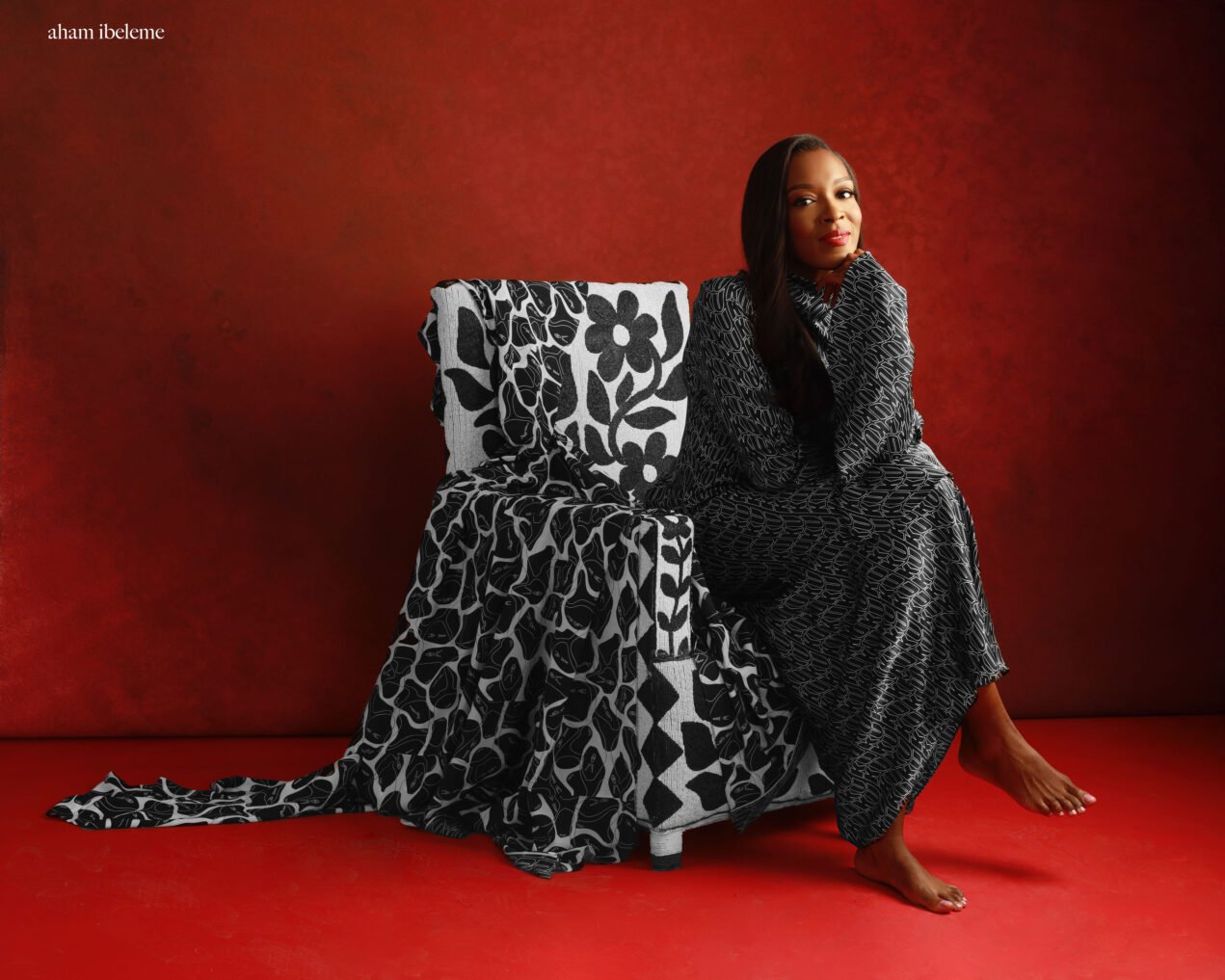
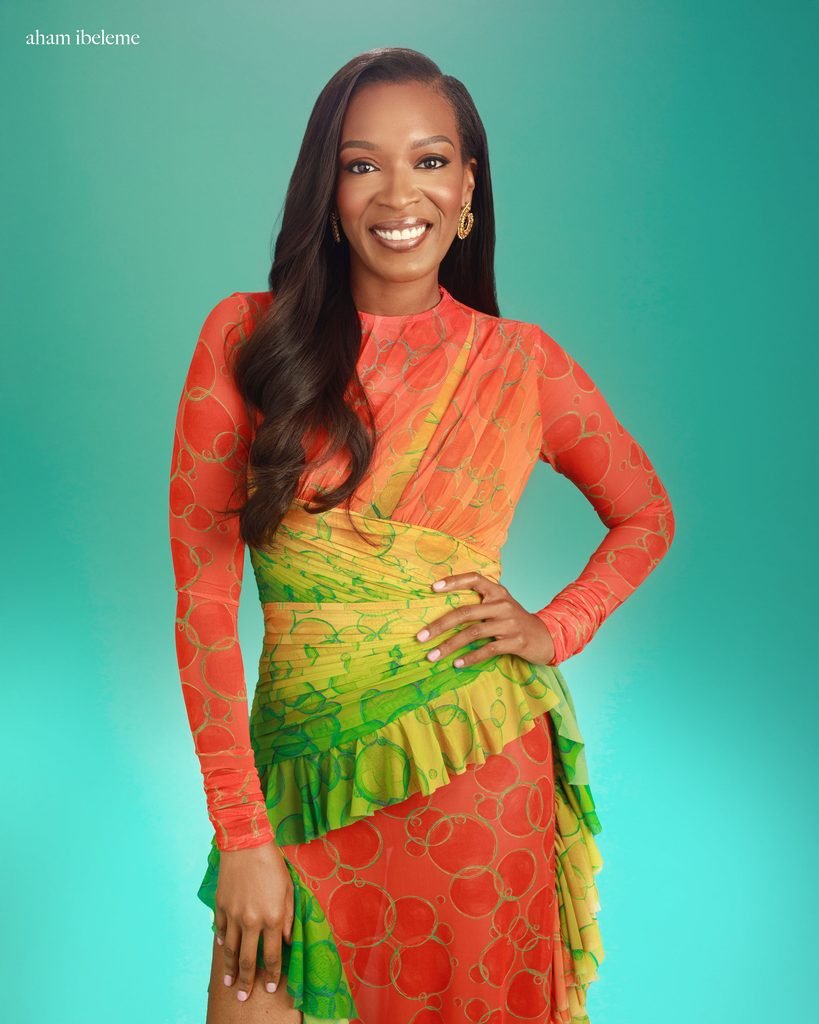
The collection contains seven prints arranged across three families: Sky, Earth and Rain. Bougainvillea Sky is the central print in the Sky family. It places watercolour flowers, bees, butterflies and birds against a turquoise ground. Dove Sky and Daybreak Sky complete the group. The Earth family draws on Yellow Trumpet and Flower Bud, with references to flowering plants found in Nigeria. Raindrop forms the Rain family, alongside new colourways of the Kuku Monogram.
Rain provides the link between the three groups. It connects the sky to the earth and makes the collection’s central idea visible. Kuku also takes the relationship further by bringing the three print families together in a single design. She described this as the first time the brand’s prints have interacted in this way, with layers of earth, sky and rain appearing within one print.
The choice of colour also challenges familiar expectations of how African landscapes should appear in fashion. Kuku noted that African-inspired palettes often return to terracotta, red and sandy yellow. For this collection, she wanted to draw attention to another part of the Nigerian environment: its flowering plants. Bougainvillea and the yellow trumpet flower provide the visual references. The result moves away from the expected image of dry earth and towards a more colourful account of the country’s natural environment.
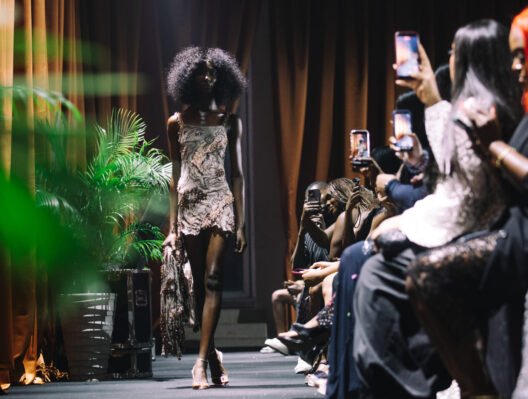
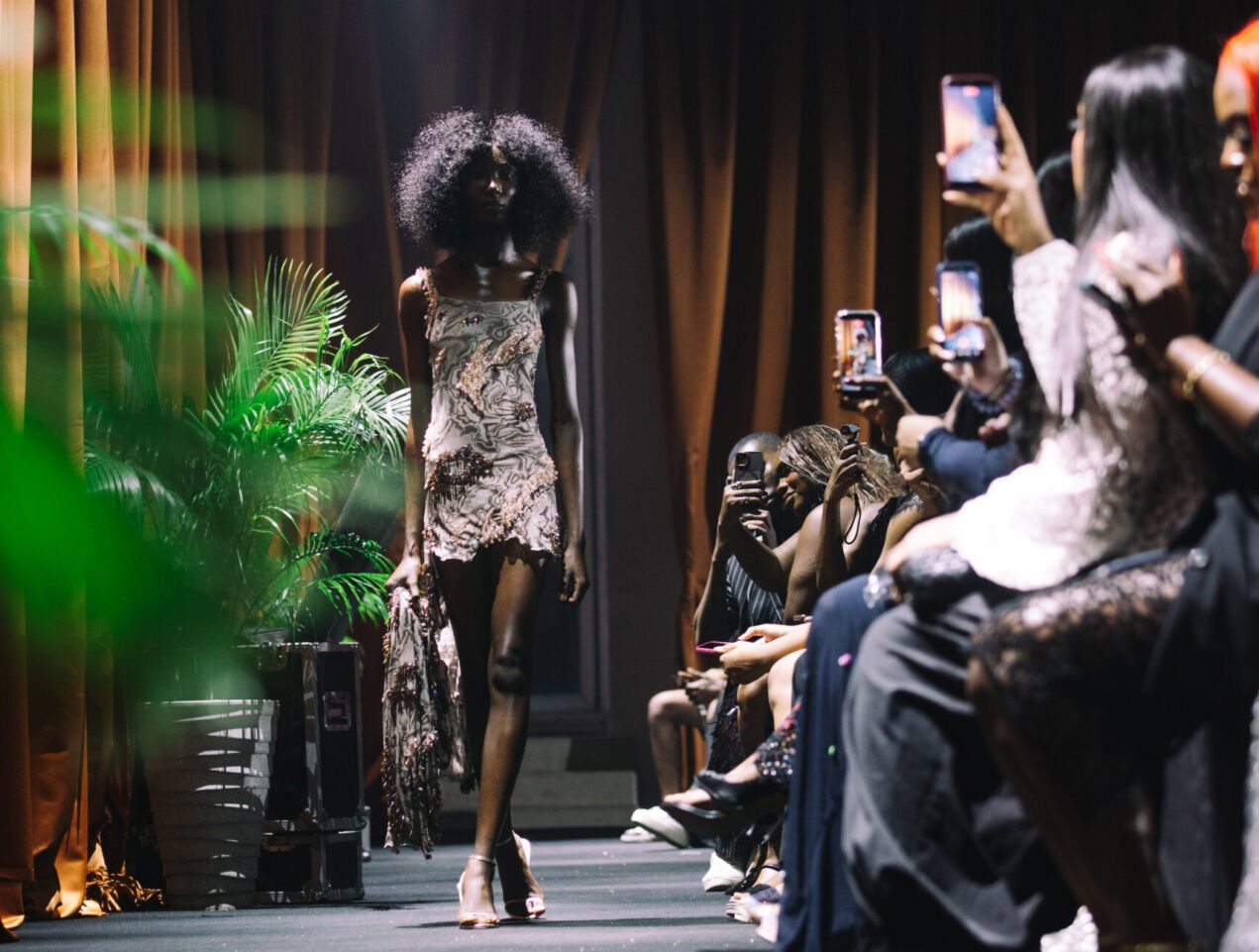
Hand embroidery adds another layer to the prints. Clouds and raindrops appear on flowing kaftans and kimono robes, while crystal details, embellished insects and floral elements give some garments a three-dimensional quality. The collection also uses foil prints and a wider range of textures. These choices are not separate decorative gestures. They help Kuku translate the same subject into different visual and material forms.
Recognition without repetition
A recognisable design identity can become a commercial advantage. It gives customers a reason to return and helps a brand build a clear place in the market. But it can also create a problem. Once customers know what to expect, a designer must find ways to maintain that recognition without producing the same work each season.
Kuku’s answer is to treat nature as an open field of ideas rather than a fixed aesthetic. “Nature is so vast,” she said. A collection can explore the sky, while another can turn to flamingos, insects or other parts of the natural world. The subject remains connected to the brand, but the designer can approach it from a different direction.
She also described a deliberate approach to colour. Rather than repeat a palette too soon, she gives certain colours time before bringing them back into a collection. Print scale, placement and imagery also change. She used Savannah, the previous collection, as an example. That season featured flamingos placed around garment hemlines. Earth & Sky takes a different approach, with wider compositions that create the impression of being surrounded by the sky.
This is more than a question of visual variation. Kuku has customers who buy from the brand season after season. She wants each collection to give them a new reason to return, rather than make them feel that they are buying an updated version of something they already own. Her approach suggests that brand consistency does not require repetition. It requires a stable point of view and the ability to express it in new ways.
When asked about the design decision that was fundamental to understanding Earth & Sky, even if it might not be immediately obvious, Kuku returned to that principle. The brand has introduced new ideas, but it has not abandoned its identity to follow a trend. “We set the trend,” she said. “We don’t follow the trend.”
That position is important as the label moves beyond the loungewear category in which it began. The brand started during the COVID-19 period, when staying at home made relaxed clothing a practical choice. Its caftans and other comfortable pieces became part of that moment. As fashion and social life reopened, the business saw an opportunity to develop a wider range of garments.
For Earth & Sky, this means more occasion-led pieces, including designs that can move from relaxed dressing to formal events and the red carpet. Kuku described them as an extension of the brand’s loungewear identity, not a replacement for it. The new silhouettes and stronger embellishment are therefore part of a wider business decision: to give customers more ways to wear the brand while keeping its original character.
Recommended For You
Abundance and responsibility
The collection’s natural cycle also carries a message about production. The press release describes the brand’s no-waste policy, its use of offcuts, its seasonless approach to design and its use of digital printing, which requires less heat and water than conventional printing methods. The brand also says it is working to reduce its use of man-made fabrics and supports environmental work through the Nigerian Conservation Foundation and its Re-Green Movement.
These commitments give the collection’s message a practical dimension. If the earth provides the resources that make fashion possible, then the industry must consider what happens to those resources after production. A message about nature is more meaningful when it is reflected in decisions about materials, waste and the life of a garment.
There is still a wider question for fashion businesses. Sustainability claims need clear evidence, measurable progress and consistent practice. A no-waste policy, for example, raises questions about how much material is recovered, how offcuts are used and what proportion of production they represent. Digital printing may reduce certain environmental impacts, but it does not remove the need to examine fabric sourcing, production volumes and the full life of a garment. These are important measures as consumers and the wider industry ask brands to explain what responsible production means in practice.
Kuku’s own account of the design process points to another form of responsibility: the relationship between the designer, the garment and the person who wears it. Her insistence on removing unnecessary details is a reminder that a garment does not become more valuable simply because it carries more embellishment. It must still serve the person wearing it.
A Lagos presentation
Earth & Sky will be presented on November 11 at Oasis, The Glass Marquee, on Victoria Island, Lagos. The show will bring the collection’s prints, new silhouettes and embellishment together for a live presentation. The pieces are expected to go on sale in December at the Banke Kuku flagship store in Victoria Island and through the brand’s global stockists.
The event also reflects the commercial network behind the label. Air Peace is supporting travel for international press guests, while Hybrid Motors will provide transport during their stay in Lagos. Other partners include Moët & Chandon, Linda Farrow, Essenza Beauty, Blue Rock Residences, Kat Maconie, Polo Avenue and Acely. Kuku also confirmed that the brand will announce its presence at Polo Avenue’s Dubai store during the event.
For Kuku, however, the central measure of the collection may be less about the scale of the event than the feeling it leaves with the wearer. She wants people to experience the joy, gratitude and abundance that informed its creation. That intention connects the personal story of becoming a mother to the larger design choices in the collection.