

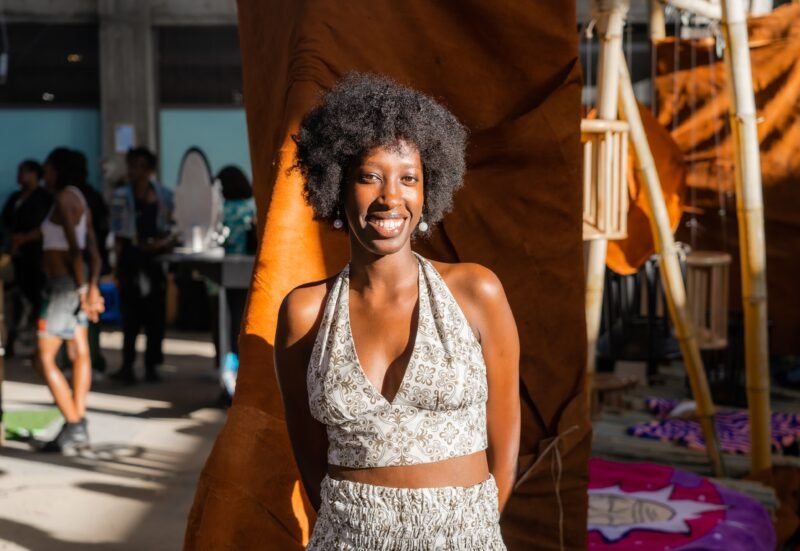
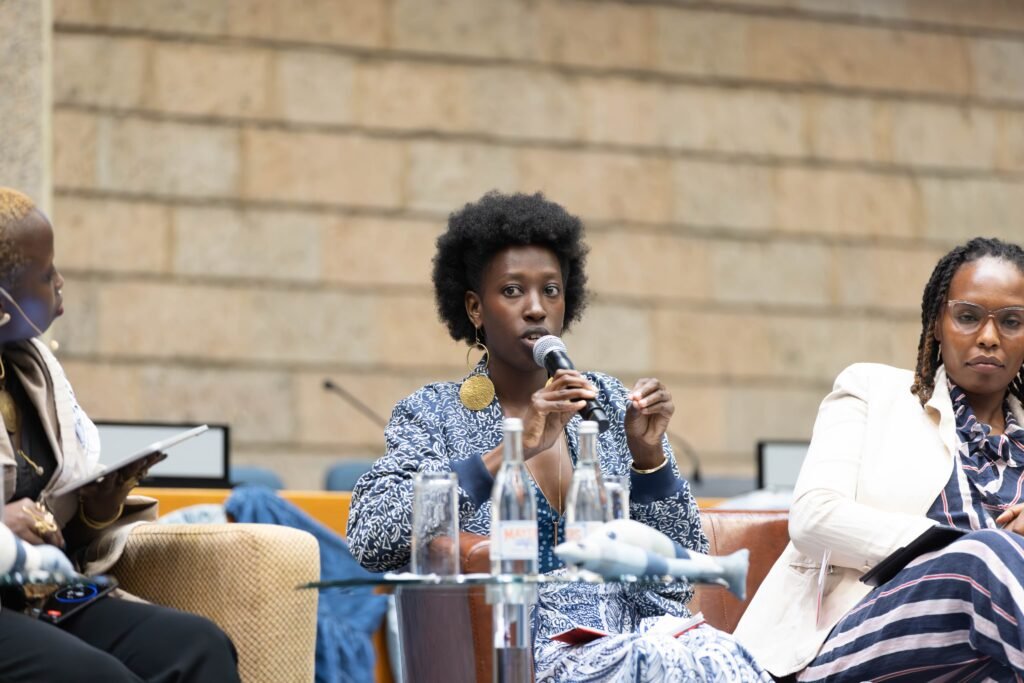
Janet Chemitei is an environmentalist and slow fashion educator passionate about social and climate justice, with experience in environmental education and sustainable waste management. She uses her social media platforms to highlight the impact of the fashion industry in Kenya, encouraging mindful clothing habits. She also serves as the youth chairperson of Clean Up Kenya and is the Africa Regional Coordinator for Threading Change.
FAB: If your wardrobe could talk, what would it say about your values, creativity and relationship with the planet?
Janet Chemitei: My wardrobe would reflect that I am quite mindful. Most of my clothes are second-hand pieces that I have bought either in Nairobi or in my hometown, Kitale. In the past, I used to buy clothes without much thought, but in recent years, I have become more conscious about my choices.
Now, when I shop, beyond the beauty of a piece, I pay close attention to the material composition. I deliberately choose fabrics that are durable and long-lasting. I also consider what will happen when I’m done wearing them — I prefer natural fibres because, if they eventually end up in a landfill, they will decompose faster compared to synthetic materials.
Some of my clothes are tailor-made using Kenyan or African fabrics, most of which are cotton-based. I use these to create unique pieces that feel personal and sustainable. More recently, I’ve been fortunate to partner with sustainable brands, and I now own a few pieces sourced both locally and globally.
FAB: Do you have a go-to piece that always makes you feel like your most authentic self?
Janet Chemitei: I would say yes, but unfortunately, my go-to piece isn’t a basic item that I can wear all the time or easily pair with many things. However, I do have these two pairs of pants made from Ankara fabric.
FAB: In a world of fast fashion, what’s your favourite way to stand out?
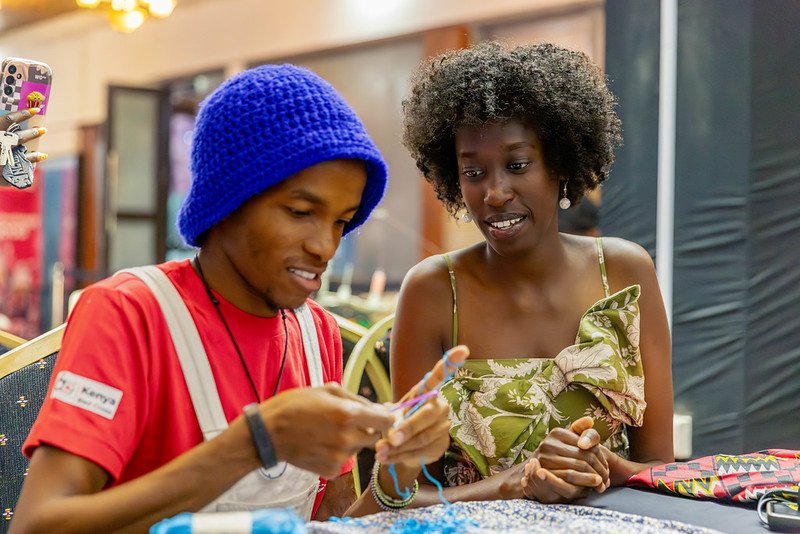
Janet Chemitei: Apart from buying second-hand clothes, which I’ve already mentioned, I also incorporate crocheting — a skill my mum and aunts taught me. Through it, I’ve discovered new ways of revamping and personalizing my clothes.
If you’re starting your journey toward a more sustainable wardrobe, begin by being more mindful about what you buy. You don’t need to rush to get new styles or designer pieces just for the sake of it. The clothes you already own are sustainable because they’re already in your possession.
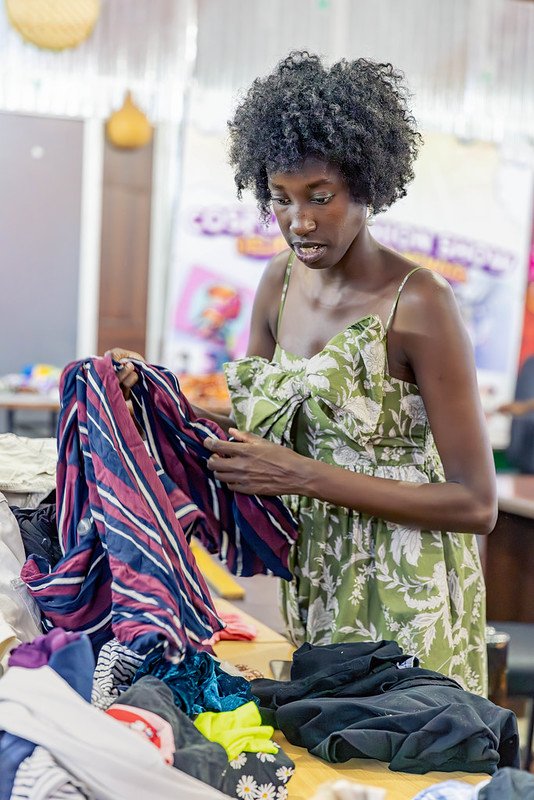
When you feel the need to declutter, do a closet audit. Sort your clothes into different piles: the ones you want to keep, the ones you’re unsure about, and the ones you’re ready to let go of. For the clothes you’re letting go, separate them again — those in great condition that can be donated and those that are too worn out. After that, you can decide where to donate or repurpose the good-condition items.
Building a sustainable wardrobe is about being intentional — not buying clothes just because you can, but making conscious choices to create a wardrobe that reflects both your style and your values.
Recommended For You
Slow Fashion: How To Start From Your Little Space
Okrika, Mitumba, Second-Hand Clothing, and the Dumping Debate
FAB: What inspired you to focus on sustainable fashion?
Janet Chemitei: I’ve always had a deep love for clothes, and my earliest introduction to fashion came from my mother, who sold second-hand clothing. I remember trying on the clothes and shoes she brought home, sparking my fascination with style. My parents also bought a lot of magazines, many of which had fashion pullouts and features on clothing brands, further fuelling my interest.
When I was about nine, my aunt and mother taught me how to crochet—a form of slow fashion—while my dad emphasized the importance of mending our own clothes. He would often fix them himself or take them to a tailor for repairs. As I grew older, my passion for fashion deepened. I became obsessed with fashion-related content, watching shows like Style, which broadened my perspective on the industry.
When I joined university, I pursued a degree in environmental planning. In my second year, I became involved with the university’s environmental club, which introduced me to various environmental organizations. I later started volunteering with Greenpeace Africa, where I participated in a campaign on plastic pollution. This campaign connected environmental concerns to different industries, including fashion, leading me to discover Fashion Revolution.
During that time, I watched The True Cost, a documentary that exposed the harsh realities of the fashion industry. It completely shifted my perception of fashion, making me realize that clothing is more than just aesthetics—it carries significant social and environmental implications. This realization ignited a passion in me to educate others about the true impact of the fashion industry and to advocate for more conscious, sustainable choices.

FAB: What do you see as the biggest sustainability challenges facing the fashion industry at the moment?
Janet Chemitei: There are numerous challenges in the fashion industry, and I don’t want to downplay the significance of any of them. As someone living in the Global South, I see firsthand the influx of second-hand clothing—in 2019 alone, we received 185,000 tonnes of it.
Fashion is one of the largest contributors to global emissions, second only to the oil and gas industry. The industry continues to overproduce clothing, and, unfortunately, consumers are over-consuming. This has led to an oversupply of poorly designed garments, with little thought given to their end-of-life. As a result, textile waste is rampant, with discarded clothing piling up in places like the Atacama Desert or polluting our rivers.
A major shift in design is necessary to ensure that garments are created with longevity and sustainability in mind. If designers considered a product’s full lifecycle, we wouldn’t see so much waste ending up in landfills and waterways. Moreover, we need to change our mindset about clothing—not treating it as a disposable commodity but as something to be cherished and cared for. By moving away from the culture of disposability, we can not only protect the planet but also ourselves, as our well-being is deeply connected to the health of our environment.
FAB: What are the common misconceptions about sustainable fashion?
Janet Chemitei: If I had a coin for every time someone told me that sustainable fashion is only for the rich, I’d have quite a collection. This is a widely held misconception. Many people don’t realize that sustainable fashion comes in different forms—it’s not just one thing.
It could mean buying from a brand that uses eco-friendly materials like plant-based cotton or one that prioritizes ethical production, ensuring workers are paid fair wages and work in safe conditions. While some of these brands may be expensive, sustainability isn’t limited to high-end fashion. Other forms include slow fashion, which focuses on timeless designs and well-made garments designed to last. Vintage clothing also falls under this category, as these pieces are carefully crafted, well-stitched, and made from durable materials. Many of these can be found in the second-hand market. Sustainable fashion also includes options like renting, swapping clothes, or having garments custom-made to suit your needs. There are many ways to embrace sustainability without breaking the bank—it’s all about making mindful choices.
FAB: Do you see policy changes or government regulations playing a bigger role in promoting sustainability?
Janet Chemitei: There is significant potential for policy changes and government regulations to promote sustainability in Kenya, especially given the strong global influence in this area. While there are well-established regulations in place, the challenge lies in effectively translating them into practical solutions that work for Kenya. It is crucial to find ways to align local policies with global industry standards while ensuring they address the country’s unique needs.
One of the main obstacles is the lack of industry experts in decision-making roles. To implement these regulations effectively, we need fashion experts in high-level positions who understand the sector and can guide policies in a way that fosters sustainable growth.
FAB: How do you address skeptics who don’t believe sustainable fashion can be truly ethical and eco-friendly?
Janet Chemitei: Like any significant change, transforming the fashion industry is challenging and cannot happen overnight. It requires continuous effort and persistence. One of the biggest challenges I face is skepticism—many people see me as just Chemitei and underestimate my ability to drive change. However, this movement is much bigger than just me. There are countless individuals, both online and offline, who are contributing in their own ways to shift the industry toward sustainability.
Many people and organizations share the same mission and are working with the same passion and determination. While change may seem like an individual effort, it is actually a collective one. The more we push forward, the more others are inspired to join, turning it into a global movement. Today, more brands are embracing ethical and sustainable fashion, a shift worth highlighting, as it will create a ripple effect that gradually transforms the industry. Change has to start somewhere.
FAB: Mitumba is both an economic lifeline and an environmental debate. What are your thoughts on this, and how can we reimagine its future?
Janet Chemitei: It’s almost a balance of both because, globally, we have a serious problem of overconsumption — and that trickles down even to second-hand clothing. We can see how much clothing already exists, yet more continues to be produced, creating a growing crisis.
In many Global South countries like Kenya, Ghana, and Uganda, a huge percentage of second-hand clothing ends up as waste. This impacts the planet in several ways, particularly through pollution and biodiversity loss. Many of the fibres used — such as polyester, nylon, and acrylic — are synthetic and have little regard for environmental sustainability. Moreover, the chemicals used in manufacturing these fabrics often leach into ecosystems, like rivers, contributing significantly to toxicity and environmental degradation.
Interview By: Harriet James