

The fashion industry celebrates global talent. The visa system that governs its movement was not built with that talent in mind. For designers, models, and creative professionals holding African passports, the barriers to the industry’s most important rooms are not always about ability. Often, they are about paperwork.
She had prepared the application over three weeks. Bank statements going back six months. A letter from her employer. A hotel booking, a return flight, and proof of registration for the trade event in Milan. Evidence, in other words, of every kind of good faith the consulate had asked for and several kinds it had not. She had paid the ninety-euro fee, non-refundable regardless of the outcome, at a time when Nigeria’s minimum wage sat at roughly 35 euros a month. She had taken a day off work to attend the interview, which lasted, by her account, less than four minutes. The rejection letter cited insufficient ties to her country of residence.
She is a Lagos-based textile designer with a studio, a staff of six, and a client list that includes buyers in three countries. She had never overstayed a visa. She had never held a visa at all, because she had never been granted one. This was her second application for the Schengen Area. It would not be her last, but something changed after that second letter. She stopped applying for the shows in Milan and Paris and began investing the money she had been setting aside for travel into her production instead. The decision was practical. It was also a form of defeat that she does not describe in those terms, because she has learnt, as many of her peers have, to describe it as a choice.
It was not entirely a choice. And the industry that would have benefited from her presence in those rooms has not, in any serious way, reckoned with what it loses by making them so difficult to enter.
The Architecture of Exclusion
To understand how passport privilege operates in fashion, it helps to begin with a number. On the 2025 Henley Passport Index, which ranks the world’s 199 passports by the number of destinations their holders can access without a prior visa, a German citizen can travel to 192 countries freely. A French citizen, the same. An Italian. An Austrian. These are the passports of the people who, disproportionately, run the fashion industry’s most powerful institutions, sit on its award committees, and decide which designers gain access to the platforms that generate international recognition.

A Nigerian citizen can access approximately forty-six destinations without a prior visa. A Ghanaian, roughly fifty. A Kenyan, around sixty. The gap is not marginal. It is structural, and it determines, in ways the industry rarely discusses directly, who gets to show up and who sends their work without being present to advocate for it, without meeting the buyers face to face, without walking into the rooms where the decisions that shape careers are made.
The Schengen Area data makes the asymmetry concrete. In 2022, Africa accounted for 7 of the 10 countries with the highest Schengen visa rejection rates globally. Nigeria’s rejection rate that year was 45.1 percent. Ghana’s was 43.6 percent. Algeria, 45.8 percent. In the same period, one in twenty-five applicants from the United States, Canada, or the United Kingdom was rejected. The gap between those numbers is not explained by individual financial profiles or travel histories. It is explained by where people are from, which is to say, by the residue of a geopolitical order that continues to treat mobility as a privilege allocated by geography rather than a right distributed by human dignity.
The financial cost of this system falls entirely on the people it refuses. In 2024, African countries collectively lost sixty million euros in rejected Schengen visa fees, according to analysis by the LAGO Collective, the London-based research and arts organisation that has been tracking this data since 2022. Nigeria alone accounted for 4.5 million euros. Every one of those euros was paid by someone who received nothing in return except a form letter citing, in language deliberately vague enough to be unanswerable, the inadequacy of their application. The poorest countries in the world, as the LAGO Collective has stated with a precision the official discourse prefers to avoid, are paying the richest countries in the world money for not getting visas.
In fashion, this is not a peripheral issue. It is the industry’s mobility problem, hidden in the language of bureaucracy and treated, when it is treated at all, as an individual administrative challenge rather than a structural one.
What the Industry Requires
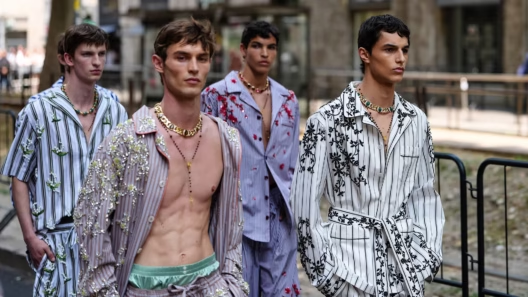
Fashion is a physically mobile industry by design. Its calendar is built around events that require presence: the fashion weeks in New York, London, Milan, and Paris that set the global agenda four times a year; the trade fairs in Florence and Berlin where buyers make the decisions that determine which collections reach shelves; the award ceremonies, residencies, and international collaborations that generate the kind of institutional recognition that builds careers. The industry’s global narrative is one of creative exchange, of ideas moving freely across cultures and continents, of talent discovered and elevated regardless of origin.
The infrastructure that governs the physical movement of the people who create that narrative was not designed with them in mind.
For a designer holding a German passport, attending Paris Fashion Week requires a train ticket. For a designer holding a Nigerian passport, it requires an application process that takes weeks, carries a fee that represents a significant proportion of monthly income in many cases, and is, in Nigeria’s case, almost as likely to end in rejection as in approval. The time and money spent on that application could have been spent on the collection itself. The rejection, when it comes, does not come with an appeal process that functions. It comes with a form.
The UK has developed a partial response to this in the form of the Global Talent visa, a dedicated immigration route for exceptional creatives that allows fashion designers to apply for long-term permission to live and work in Britain. The British Fashion Council, funded roughly two million pounds annually by the Department for Culture, Media and Sport, endorses applications on the Home Office’s behalf. Between 2019 and 2024, Nigerians submitted 291 applications under this route, more than any other nationality, with endorsements rising sharply from three in 2019 to 145 in 2024. By 2024, the BFC had endorsed more Nigerian designers than those of any other country.
This is a genuine development, and it matters. It represents an institutional acknowledgement that Nigerian fashion talent exists at the level that immigration policy should accommodate. But the pathway has structural ironies that are worth examining carefully, because they reveal how mobility barriers reproduce themselves even when the gates are nominally opened.
To qualify for the Global Talent visa, an applicant must demonstrate exceptional ability, including, among other things, evidence of international recognition, proof of sales and distribution across markets, and the endorsement of figures already established in the global fashion scene. The application process is rigorous, the documentation requirements extensive, and the guidance provided, even with the BFC’s support, assumes a level of familiarity with how British institutions assess credibility that is not uniformly distributed across applicants from different educational and professional backgrounds.
The problem is circular in a way that policy documents rarely acknowledge. International recognition is one of the primary criteria for a visa route designed to enable international participation. The designer who has not yet attended the shows, not yet built the international press coverage, not yet accessed the global distribution networks that generate the evidence of international reach, is competing for the opportunity to do those things against a standard that assumes they have already done them. The requirement for international recognition is enforced at the point before the designer has had the chance to acquire it. Getting there requires already being there, at least partially. For some this is navigable. For many it is not.
The Parallel System
The fashion industry, when confronted with the mobility problem directly, tends to offer two responses. The first is to celebrate the African fashion weeks and regional platforms that have grown in scale and international prominence over the past two decades. The second is to point to the growing number of African designers successfully present in global markets as evidence that the system works for those with the talent to navigate it. Both responses are true, and neither addresses the structural question.
Arise Fashion Week in Lagos, now in its twentieth-plus year, has over its history brought Naomi Campbell, Liya Kebede, Anna Wintour, and a range of international press and buyers to Nigeria. It is a genuinely significant platform that has demonstrated, repeatedly, the depth and quality of African design talent to an audience that had previously absorbed that talent primarily through the distorting lens of trend reports and appropriation. When Naomi Campbell walked the runway for Kenneth Ize in Lagos in 2019, and when Anna Wintour sent a video message to the 2020 edition praising its contribution to global fashion, these were not merely ceremonial gestures. They were endorsements from the industry’s highest levels of the proposition that Lagos is a creative capital whose designers deserve the same access to global platforms that designers in Paris and London take for granted.
The endorsement and the access are not the same thing. The designer endorsed by the fashion world’s most powerful voices still needs a visa to attend the show in Milan that would generate the press coverage that would build the international profile that would help them qualify for the talent route that would give them the right to be physically present in the rooms where careers are confirmed. The celebration of African fashion’s global relevance and the maintenance of a visa system that makes it systematically difficult for African fashion professionals to participate globally are not contradictions that the industry has been asked, with any consistency, to resolve.
There is a version of this conversation in which the fashion capitals take their celebration of African creative talent seriously enough to lobby for the mobility infrastructure that would make that celebration mean something. That conversation has not yet happened at the scale the situation requires.
The Cost of Absence
There are things that do not happen when the room excludes the people who should be in it, and they are harder to count than visa fees.
The Nigerian textile designer who stopped applying for Schengen visas and redirected the money into her production has built something real in Lagos. Her business is growing. Her clients are international, reached through digital channels that do not require her presence anywhere she is not welcome. The pivot was, she will say, a kind of liberation: she stopped spending energy on a process that treated her as a suspect and started spending it on work. This is the adaptation that many creative professionals across Africa have made, and it is not without its own kind of success.
But the industry in which she works lost something when she stopped being physically present in its international spaces. It lost her eye, her conversation, and her ability to encounter ideas and materials and collaborators that exist only in those rooms. It lost the influence she might have had on the directions that global fashion takes, the references it draws on, the questions it asks about what is beautiful and for whom. The industry that prides itself on the circulation of creative ideas is less interesting, less accurate, and less honest about the range of human creativity it claims to represent for every voice that the visa queue has discouraged into staying home.
This is not sentimental. It is a creative argument. The fashion industry’s most significant periods of renewal have come from the collision of perspectives that were previously separated, from the introduction of references, aesthetics, and ways of thinking about dress that the dominant tradition had not previously incorporated. Every structural barrier that prevents African creative professionals from being physically present in the global fashion conversation is a structural limitation on that conversation’s capacity to be genuinely global. The shows in Paris and Milan and New York are poorer for the absence of people whose passports make those cities harder to reach. The industry knows this, at some level, and continues to celebrate the idea of global diversity while leaving the infrastructure of its actual production largely unchanged.
Recommended For You
You Didn’t Lose Yourself, You Gave Yourself Away
Building One of East Africa’s Most Trusted Human Hair Brands
What Honest Reform Looks Like
The UK’s Global Talent fashion visa is the most developed institutional response to this problem currently in operation. Its limitations, as described above, are real. But its existence is evidence that policy instruments can be designed to treat exceptional creative talent as a category that immigration systems should accommodate, rather than suspect. The BFC’s endorsement role and its explicitly stated commitment to diversity since 2020 represent an institutional posture that other national fashion bodies have not yet adopted with comparable seriousness.
The next step that reform requires, in the UK and across European systems, is a reckoning with the self-reinforcing logic of evidence requirements. International recognition cannot simultaneously be the criterion for access and the reward for access granted. The designer who has not yet appeared on international runways, not yet achieved press coverage in European publications, not yet built the distribution network that generates provable global reach, is not a designer without talent. They are, frequently, a designer without the mobility infrastructure that makes those things possible. Assessing talent visas against a standard that encodes the advantages of prior access as the definition of merit is not a neutral process. It is a process that favours the already-advantaged.
Broader Schengen reform on the scale that the LAGO Collective and other advocacy organisations have been calling for, specifically a recalibration of how African applicants are assessed that does not begin from the premise of likely non-compliance, is a political question as much as a bureaucratic one. It is also a cultural one. The assumptions built into a visa system that rejects nearly half of Nigerian applications while admitting all but four percent of American ones reflect a set of beliefs about whose presence is trustworthy and whose requires evidence, beliefs that the fashion industry’s rhetoric of global creativity directly contradicts and its institutional behaviour largely sustains.
The designers who navigate the current system and build international careers are not evidence that the system works. They are evidence that enough talent exists to overcome barriers that should not be there. The talent is not the variable. The barrier is.
Who the Industry Is Really For
There is a final question that the passport privilege problem in fashion forces into view, and it is the one the industry finds most uncomfortable to sit with. If the global fashion system is genuinely interested in the creative talent that Africa’s designers, models, photographers, stylists, and makers represent, then the question of who can physically access the rooms where that system operates is not a peripheral inconvenience. It is a test of the claim. The test, right now, is not being passed.
Not because the industry lacks the capacity to advocate for change. Fashion has demonstrated, when commercial or reputational interests required it, that it can move quickly. Designers have been flown in, obstacles removed, exceptions made, when the person being accommodated was sufficiently famous or commercially important to warrant the effort. The infrastructure of privilege bends for those who have already cleared enough of its hurdles to become undeniable.
For the designer still at the beginning, still building, still three weeks into preparing an application that will be decided in four minutes, the industry’s advocacy has not arrived. The celebration of African creativity happens comfortably in London and New York and Paris, in museums and trend reports and runway acknowledgements of the moment’s African inspiration. What would be less comfortable, and considerably more consequential, is for the same institutions that run those rooms to use their influence to change who is allowed to walk into them.
The passport in her drawer is not a statement about her talent. It is a statement about the geography she was born into, which the fashion industry celebrates when it can appropriate its aesthetics and ignores when it is asked to share its platforms. She is still designing. The collections are extraordinary. One day, perhaps, the system will be less afraid of her.