
Moving between South London grit, Nigerian identity and the romance of another era, Ky Vinci is finding freedom in making music without deciding exactly where it belongs. There’s a contradiction at the centre of Ky Vinci’s music. It can feel nostalgic without belonging to the past, romantic without becoming overly sentimental, and rooted in both South London and Nigeria while resisting the expectation to sound like either.
For Ky Vinci, those contradictions aren’t something that need resolving. They are increasingly the point. “I don’t think I’m capable of being somebody who’s only going to do this one thing,” he tells FAB L’Style. It’s a philosophy that extends beyond music. Ky is a singer, songwriter and producer, but also a painter, a father and someone with a longstanding interest in fashion, having studied textiles in college.
Ask him to describe himself away from the music and the answer is considerably less elaborate. “I’d like to say I’m a simple man. I’m not too complicated. I just take every day as it comes.” His music, however, is becoming harder to define so simply.
From South London to Nigeria

Ky Vinci grew up in South East London, and there’s a certain pride with which he talks about it. “People from South are very patriotic about where we come from,” he says. “You can hear it in the way we speak and see it in how we engage with each other.”
That sense of place matters particularly when it comes to his voice. In a genre where British singers have historically sometimes softened their accents or adopted American inflections, Ky has little interest in disguising where he comes from. “With me, you’re going to hear where I’m from.” “I want people here to be able to relate to it,” he explains. “I already know that people outside England can connect with the music, but I want people from here to feel like they can claim it.”
His Nigerian identity sits alongside it just as naturally. Yoruba is the language he speaks with his parents and friends, and during his years as a rapper, it would occasionally enter his lyrics. Elsewhere, Nigeria appears through instrumentation, subject matter or something as intimate as a conversation with his father. But identity, for Ky, is a source rather than an instruction.
As Nigerian music has become increasingly visible internationally, African artists are often still categorised through a surprisingly narrow vocabulary. For Ky Vinci, being Nigerian doesn’t automatically mean making Afrobeats. “Because I’m Nigerian doesn’t mean the way I create has to be linear to one particular sound,” he says. “Music is a universal language.” Then he offers perhaps the simplest challenge to the categorisation: “You could still say it’s Nigerian music because I’m Nigerian and I’m making it.”
Looking Back to Move Forward
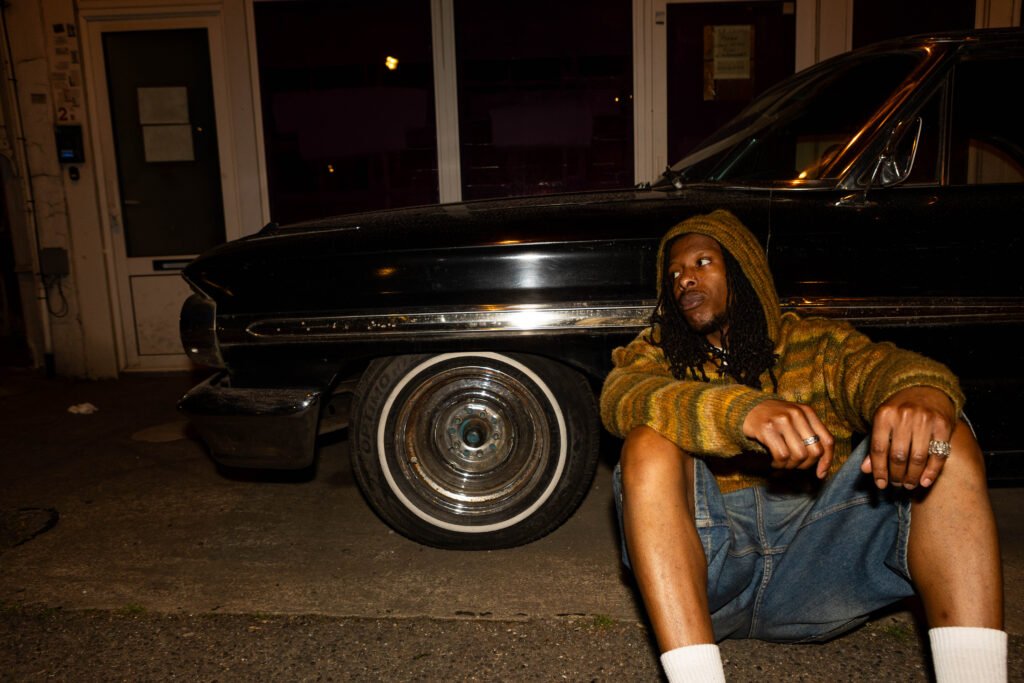
Ky Vinci wasn’t always making R&B. Until relatively recently, he primarily considered himself a rapper. Moving away from that identity wasn’t necessarily part of some carefully planned reinvention. It came from allowing himself to follow whatever sounded right.
“I was somebody who loved music and wanted to make what I loved,” he says. “However I’m feeling at a certain point in time, I want to translate that through music.” That could mean funk, soul, R&B, rap, perhaps Afrobeats tomorrow. The records emerging from that freedom carry an unmistakable affection for older music.
His recent singles “The Plug” and “Loverz & Friendz” could comfortably soundtrack scenes from another era. Ky knows this. On social media, he sometimes places his music over old film clips, allowing the records to momentarily inhabit the world they reference.
But nostalgia can become a trap. Ky isn’t interested in cosplay. “If you try too hard to recreate a period, people are automatically going to compare what you’re doing to that period,” he says. “And it will never actually be that. Those eras were what they were. You can’t recreate them.”
Instead, he wants the recognition to work in both directions. His aunties, now in their fifties and sixties, hear elements of the music they grew up around when he plays them his new material. Someone decades younger should be able to hear exactly the same record without needing that reference point at all. The past becomes vocabulary rather than destination.
Where Did the Romance Go?
“Loverz & Friendz” reveals another side of what Ky is searching for. It isn’t exactly a record about a particular relationship. It’s about the absence of one, or more specifically, the disappearance of a type of romance he feels should exist.
Ky Vinci describes himself as someone who fantasises. He imagines situations, relationships and versions of the life he might eventually have. That tendency stretches back to secondary school. “I envision what I would want my life to be like,” he explains.
When he looks around some of the spaces he occupies today, though, he feels something is missing. “You go to these events and hear slow jams, lovers rock and all these romantic songs, but you don’t really see people falling in love on the dance floor anymore.” There are songs about intimacy playing through the speakers, yet the intimacy itself isn’t necessarily happening. “You don’t see two people dancing together and genuinely sharing that moment.”
He pauses on the thought. “That’s something I crave.” Suddenly the nostalgia within his music feels less aesthetic. Maybe he’s not trying to recreate how the ’90s sounded at all. Maybe he’s searching for something he imagines people felt.
Building It Himself
Being a producer gives Ky unusual control over that search. There isn’t one formula for how his records begin. Heartbreak can arrive before a melody, a sample can lead him somewhere unexpected, and sometimes a melody appears before he understands what he’s trying to say. Other times, the story isn’t his at all. “I might hear somebody else’s story, put myself in their shoes and write from their perspective.”
Production allows those impulses to travel from his head to the record without waiting for someone else to interpret them. Recently, he’s also begun showing more of that process publicly: breaking down samples, deconstructing records and letting listeners see what existed before the finished song.
For an artist accustomed to working internally, opening that door has been unexpectedly rewarding. “What you do feels normal to you because you do it all the time,” he explains. “Then someone sees the process and says, ‘How did you even get from this to that?’” It has changed how he sees his own ability.
“I already love my music, I’m the biggest fan of myself, but letting people into my world is something I didn’t do very often before.”
Artist or Content Creator?
That openness comes with a contradiction of its own. Emerging in 2026 means being an artist at a moment when musicians are expected to be perpetually visible. Make the record, film the process, post the snippet, feed the algorithm, release it, start again.
Ky Vinci knows the game. He just doesn’t want it deciding what he creates. His experience in rap made that pressure particularly apparent. “It felt like you constantly needed to release, and the more you released, the more content you then needed to make around it.”
Moving into his current sound has allowed him to reconsider what consistency actually means. For him, consistent output doesn’t necessarily mean Spotify releases every few weeks. It means continuing to create.
There’s also a practical reality behind that philosophy. Ky Vinci isn’t working with unlimited budgets or a giant infrastructure. Being able to write and produce independently means concentrating his resources where he believes they matter most: the music.
“You can’t cater too much to what people want,” he says. “You should listen and be attentive, but the second you give the audience complete power, they’ll always have that power.” The danger is subtle. Eventually an artist stops discovering what they want to make and starts predicting what their audience wants to receive. “Then you’re creating to please them rather than yourself.”
The Fine Line
Fashion presents Ky Vinci with almost exactly the same problem. When he began leaning further into vintage-influenced R&B, advice arrived quickly. Some people wanted silk suits and a fully realised throwback character. Others suggested the opposite: make nostalgic music while dressing completely contemporary and let the contrast become the identity.
Ky wasn’t convinced by either. “Honestly, I just like to dress well.” He laughs, but there’s something quite revealing underneath the simplicity. Ky studied textiles in college and genuinely cares about clothes. What he doesn’t want is a uniform.
“The way I dress is like the way I make music: I dress how I feel.” He understands the marketing argument. Recognisable artists usually have recognisable worlds. If everything changes constantly, versatility can easily become confusion.
Ky Vinci puts the dilemma better himself: “There’s a very fine line between somebody who likes doing lots of different things and somebody who looks like they don’t know what they’re doing.” Finding his visual identity isn’t therefore about narrowing himself down. It’s about making the breadth feel intentional.
“I want to look like somebody who knows exactly what he’s doing, but likes doing lots of different things.” That may be the clearest description of Ky Vinci right now.
Serious Music, Unserious Person
Listen to the records before meeting him and you might construct a different person. Perhaps quieter, more intensely romantic, maybe even slightly mysterious. Ky finds that amusing.
“I take music very seriously, but as a person, I don’t take myself too seriously,” he says. “I’m actually a very unserious person.” He’s also shy. That surprises people more. Around friends, the personality becomes considerably bigger, while in unfamiliar spaces, he can retreat inward, overthink and remain mostly to himself.
It’s another small contradiction between the artist people encounter through headphones and the person who actually made the records. And Ky seems comfortable leaving some distance between the two.
For all his talk about refusing limitations, his ambitions aren’t small. Ask where he wants this to go and his immediate response is ridiculous enough to make both of us laugh. “I want to be the next Michael Jackson.”
Then comes the correction. “Obviously there’s only one Michael Jackson. Even in my wildest dreams, if it were somehow possible to be bigger than Michael Jackson, I wouldn’t want to be. Let him stay there. He’s Michael fucking Jackson.” Beneath the joke is a much more grounded ambition.
Ky Vinci wants festivals. He wants touring. He wants more people to encounter the music. He’d happily open for artists he admires rather than needing to immediately occupy the centre of the poster. More importantly, he wants whatever success arrives to extend beyond himself. “I want to be able to create opportunities for the people around me too.”
For an artist still being discovered, there is understandably plenty that hasn’t been resolved yet. The sound is developing, the visual language is developing, and Ky himself is figuring out how all the different pieces of his identity can coexist without being reduced to one of them. Perhaps they don’t need resolving.
South London and Nigeria. Rap and soul. Nostalgia and the present. Fashion and music. Seriousness and humour. For now, Ky Vinci seems more interested in learning how to hold all of it at once. And maybe that’s where his identity is beginning to emerge, not from choosing between worlds, but from refusing to.