
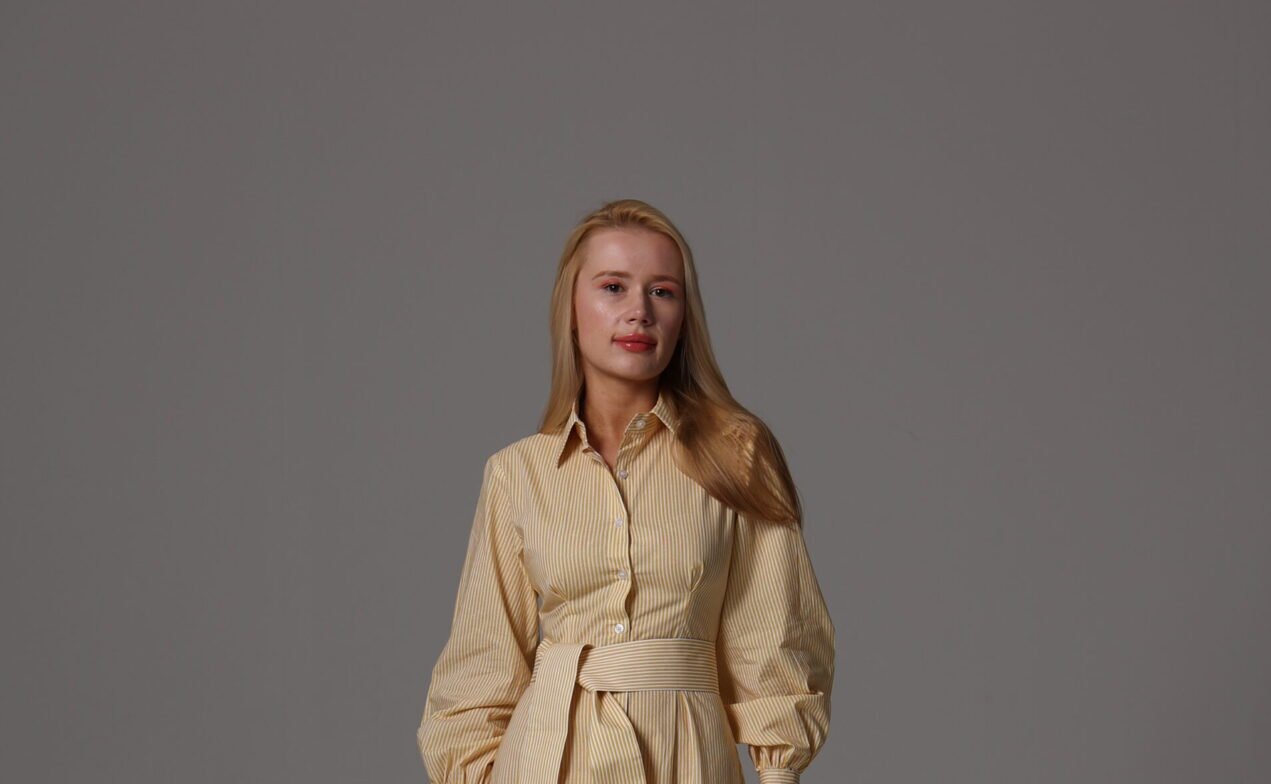

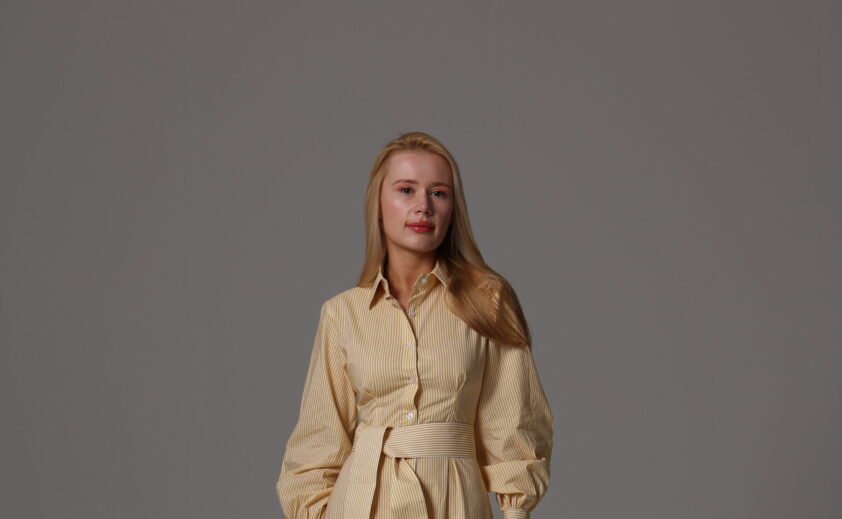
Fashion has become very good at selling us the feeling of a beautiful purchase. The fabric composition? That is another story. A polished campaign, an impressive price tag and a sustainability claim can make a garment look like a worthwhile investment, but what is actually touching your skin? Anastasia Tyuleneva wants women to start asking that question before they reach for their wallets. The founder of LOVESKIN believes that consumers deserve to know exactly what their clothes are made of, without having to decode a label or take a brand’s word for it.
Her route into fashion was hardly conventional. After seven years in finance, including investment banking, corporate finance, private banking and wealth management, Tyuleneva turned her attention to a problem she had experienced herself: finding elegant, well-made clothes in natural materials without paying ultra-luxury prices. When she sat down with FAB L’Style, she spoke about leaving finance, finding a gap in the market, building a fashion business around natural materials and why, as she puts it, “It’s really time for fashion to be kind again.”
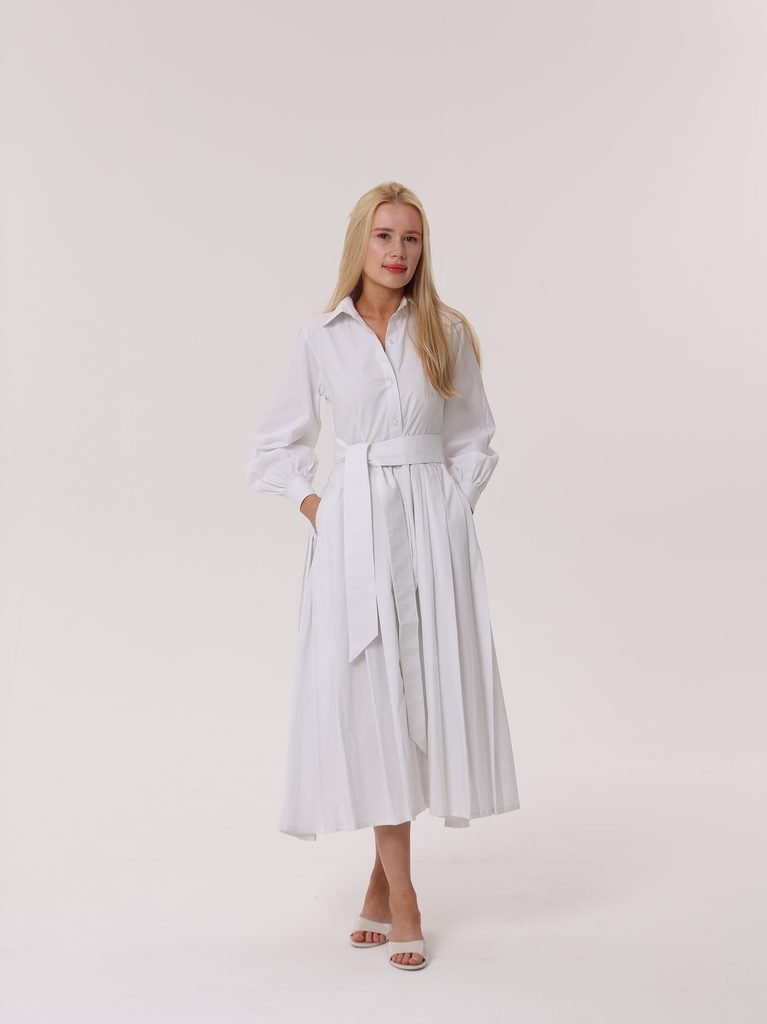
FAB: Let’s start with your brand name; you started as Souverain. You combined ‘souverain’, meaning ‘sovereign’, and reine, the French word for queen. But particularly, who was the woman you had in your head when you invented that name? That very particular person?
Anastasia Tyuleneva: I think my background in private banking and wealth management has a lot to do with it. Since I stepped into the working world, I have been in that industry. What fascinated me was seeing how many women were around me. In Austria, I worked in teams that were heavily dominated by women. You could have a team of 30 people, and 90% would be women.
The same thing happened here in Abu Dhabi. When I moved into wealth management, our relationship management team had about 12 people, and 11 of them were women. So, in a way, those women became the woman I had in mind.
I was also experiencing a gap myself. I had difficulty finding appropriate clothes for the professional environment and beyond. So, essentially, that was the woman I wanted to speak to. She was the woman around me, and she was also me.
FAB: Now your brand name has changed to Loveskin. What birthed the change and rebranding?
Anastasia Tyuleneva: We wanted to make our purpose and positioning crystal clear and to really reflect that we believe everyone should care about what they dress in, therefore choosing natural fabrics, for the love of one’s skin, which is the biggest part of us.
From Moscow to Vienna
FAB: What was it like growing up?
Anastasia Tyuleneva: I was born in Moscow, Russia, but I was two and a half when my parents moved to Vienna, Austria. The plan was for it to be temporary, maybe four years. But my parents had already travelled a lot and seen much of the world. When they arrived in Austria, they thought, “Okay, that’s the place to be. We’re going to stay here now.” And that is how we stayed.
I grew up in Vienna and went through kindergarten, school and university there. I left in March 2025 because I was offered a position in Abu Dhabi. It was one of those offers you could not refuse, so I thought, why not?
Funnily enough, I ended up leaving banking and finance altogether. But I do not think any of this would have happened if I had stayed in Austria. So, I am very happy to call Austria home, but I am also very happy to be exploring a completely different part of the world now.
Leaving Home
FAB: Speaking about that home, leaving Austria, which for the longest time had been your home, and moving to a completely different environment with a different culture, tell us about that transition.
Anastasia Tyuleneva: I would say it was quite a bold move because, before deciding to move here, I had never been to the UAE. I had never been to the Middle East. I did not know anybody. I had absolutely no idea what I was signing myself up for, but I somehow felt that it was right.
Of course, it is great to be in Austria, but I feel that sometimes we can become too comfortable when we stay where we grew up. If you stay where everything is familiar, you can limit yourself from exploring different things, different sides of yourself and even different perspectives on the same things.
That is precisely what happened to me. I saw a completely new perspective on life here compared with Europe or anywhere else I had been. So, it was an adjustment, but honestly, it was surprisingly easy.
Everybody told me that there are a lot of expats here. The majority of people living in the UAE are expats, and I was told that it is quite easy to find friends but harder to keep them. Somehow, I got very lucky because I met my husband literally in the first week after I moved here. It was completely coincidental, but I was very lucky.
I also made some great friends very quickly. Then we started a community, which was basically a social padel community. We organised events every week that were not about traditional networking or after-work drinks. Instead, you would play padel, rotate, meet new people and do all of it to great music. It was a lot of fun.
That was my first project here, and it gave me the confidence to start the brand. I would say the cultural adjustment was quite easy because everybody here is very open. There is always something going on. People are entrepreneurial, full of initiative and full of life. They really want to do things, and they are open to new ideas. So, overall, it was a very smooth experience.
Finding the Gap
FAB: You came from banking into fashion, and you have mentioned seeing people while working in private banking. But it is one thing to see a group of enthusiasts and another to identify the right clientele who are willing and able to pay for the product. What happened between those two points that made you look at a woman’s wardrobe and think, there is a business here that needs to exist?
Anastasia Tyuleneva: It is actually a very good question because I recently read a quote that really resonated with me. It said that, ultimately, all roles lead back to the interests you had as a child.
A lot of people say, “It was always my dream to do this,” or “It was always my dream to work in fashion.” For me, it was always my dream to build a business. I just never thought there was something in fashion that I could do better or that had not already been done in some shape or form.
I did not even allow myself to think about creating a fashion brand. I thought there was already too much out there, and to be honest, there is. Then I saw a gap, but I did not just see it. I experienced it myself and saw it in other people. I started testing the market and doing a lot of research. I wanted to approach the idea not only emotionally, but also rationally. I wanted to understand the market as a whole and ask, “Why is nobody else doing this?”
By that, I mean that we are moving away from natural fabrics while prices are becoming increasingly inflated.
When I moved here, I had literally one suitcase because I was convinced I would find everything I needed for my wardrobe here.
I went to a lot of fast-fashion stores because I used to be quite obsessed with fast fashion. I loved going to Zara, Massimo Dutti and COS, which I still consider part of that category. I would not really think about what I was buying or how much it cost. If it looked nice, I would buy it. I bought too much and did not wear things often enough.
Here, things felt different. I remember looking at a blazer with a price tag of 800 dirhams. At first, I thought there had been some kind of conversion error. Then I converted it into euros and realised it was about 200 euros. The markups here in the Middle East can be quite high, and some brands charge much more than they do in Europe.
A blazer that might cost you 100 euros in Austria or Spain could cost twice as much here, even though it is the same blazer. That was the first time in my life that I really started looking at fabric composition.
Then I realised that almost everything was synthetic. My grandmother had always told me off for constantly buying synthetic fabrics, but I never really cared. In my early twenties, I thought more was more. I did not think too much about it because it was cheap and cheerful.
Then I realised that people like me were part of the problem.
At the same time, I was trying to find something that I could wear to the office and that also fitted the local culture, where clothing is generally more modest. It felt like a mission impossible. On one side, there were brands such as H&M and Zara. On the other, there were ultra-luxury brands such as Hermès and Chanel. I could not really find much in between.
So, I stopped buying clothes completely and started making my own. Originally, it was not supposed to become a business. I simply did it because I could not find what I wanted.
Through that process, I realised this was not just a gap I had invented because I wanted to start a fashion brand. It was a real and common problem.
Recommended For You
The Cost of Conviction
FAB: You say natural fabrics are not simply a marketing position for Loveskin. What are you prepared to sacrifice commercially in order to remain faithful to that conviction?
Anastasia Tyuleneva: I think the collection really shows what that conviction costs. The amount of time I have spent sourcing fabrics and speaking to manufacturers has been insane. It took us almost a year to find an appropriate manufacturer who actually understood what I meant when I said we are a non-toxic brand, we do not use blends or synthetics, and we want to use only specific natural materials.
That even applies to things such as buttons. I feel that using natural materials throughout a garment is not really the norm anymore. Manufacturers would say yes, then come back with suggestions that completely defeated the purpose. That cost us money, time and a lot of stress, but it was important to me.
Take a structured blazer, for example. You have the outer fabric, the lining and something in between called fusing. That is usually made from synthetic material, essentially plastic. Finding an alternative is difficult. Custom-made suits can use horsehair, but that is extremely expensive and often requires hand-sewing. You can quickly reach a price point of around $10,000.
So I was asking myself, how do we give a garment structure without losing our identity by using plastic? `So we found a latent alternative even for that, which is cotton fusing.
It has definitely not been easy. But that is also why it is a conviction. We have made quite a few sacrifices to make sure we do not drift away from it.
Growing Without Overproduction
FAB: You mentioned earlier that fashion has spent years teaching consumers to want more: more collections, more drops, and more novelty. Your brand takes almost the opposite position, with small batches and limited drops. Can a young fashion business grow without eventually becoming trapped by the economics of overproduction?
Anastasia Tyuleneva: With our upcoming drop we are releasing a very limited amount of dresses across 3 styles and 5 sizes. In total it will be 150 pieces only. This decision was made with intention, as we are testing what works. As we grow, we will monitor which items perform, including colours and sizes, and then adjust production with our manufacturer, which is now local as well.
Being close to production makes things much easier to manage. If we sell out of 50 dresses and need another 50, that is manageable. We do not have to order 1,000 pieces in advance and wait three months for them to arrive. We can be much more nimble, and that is a core principle of the brand.
Ultimately, I think pre-orders are one of the best ways to avoid falling into the economics of fast fashion. They allow you to produce according to actual demand rather than guessing what people might buy.
Making Better Clothes Accessible
FAB: You mentioned earlier that the markups for some of the brands you encountered in Abu Dhabi can be significantly higher than in Europe. Natural fabrics have historically been associated with craftsmanship and luxury, but they can also be expensive. How are you thinking about the tension between making genuinely better clothing and keeping Loveskin accessible enough for the woman who cannot spend luxury prices on every piece?
Anastasia Tyuleneva: This is also a core principle for us. It is one of the reasons we moved away from silk. We were initially using mulberry silk sourced from Japan and Korea, so we were choosing the highest grade available. It was beautiful, but there is a limit to what a business can absorb. Silk simply costs what it costs.
We moved to organic cotton because it is better for our approach to health and the environment, but it also gives us more room to speak to the customer we are trying to reach without every purchase becoming a major investment.
I do believe it is important to properly invest in your wardrobe. I experienced the opposite myself. I used to buy clothes all the time. Now, I can go a year without buying anything and then allow myself to properly invest in pieces that I love and will wear again and again.
That is a mentality shift, and it takes time. It also requires education and awareness about a problem that has become much bigger than we often acknowledge. Fashion is beautiful, but it is also becoming a serious problem.
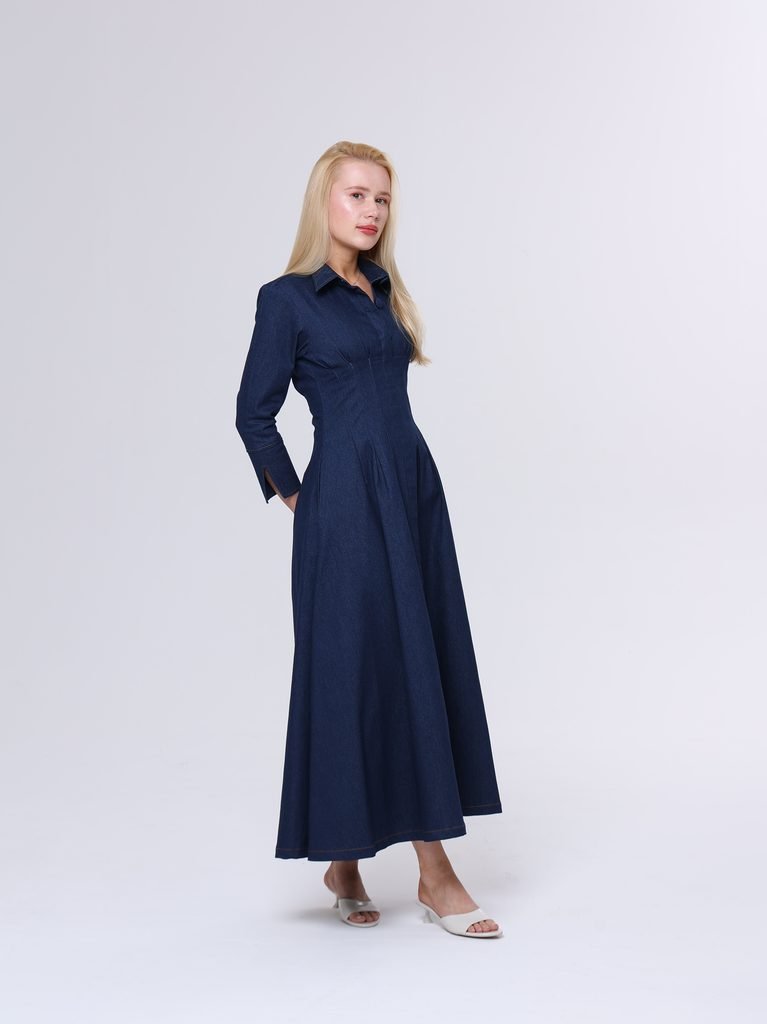
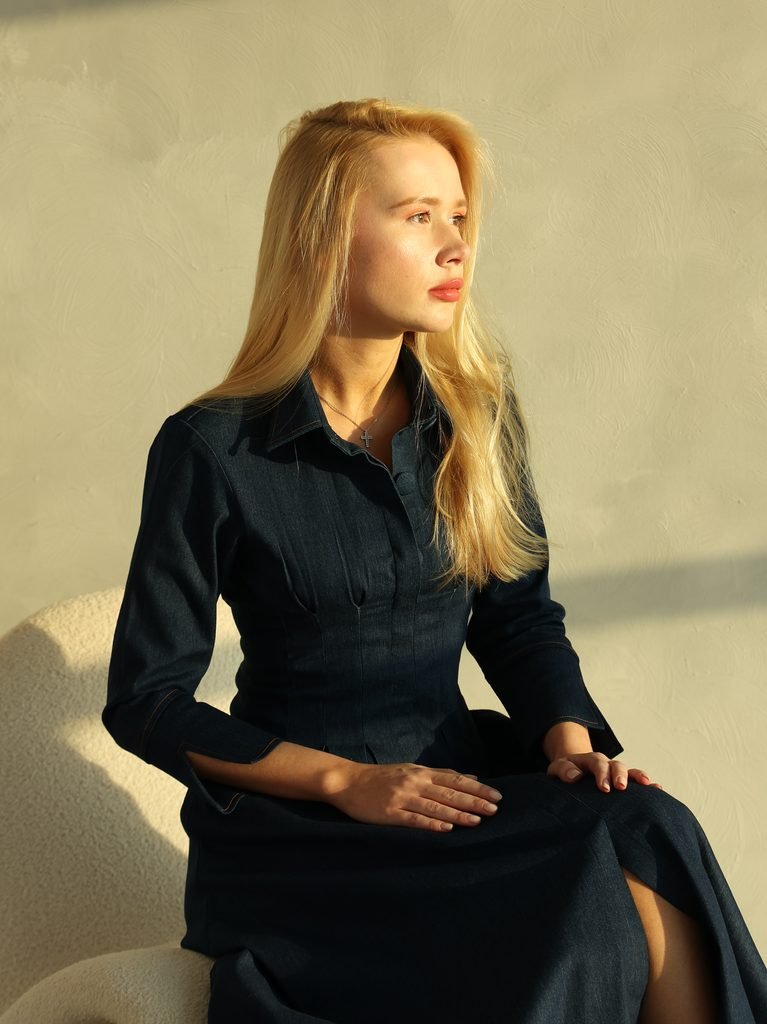
So, we are going to focus on organic cotton while making sure that our business can grow in a healthy manner. We are even going to have a denim dress in the collection. I learned that denim can be made from cotton or synthetic fibres, which I found interesting. So we are still applying the same principle while trying to keep the clothes at an attainable price.
What Banking Never Taught Her
FAB: You came from a professional world into something deliberately less conventional. In this relatively short period, what has building Loveskin taught you about yourself that banking never could?
Anastasia Tyuleneva: It has taught me that where there is a will, there is a way. It has taught me not to take no for an answer and simply try again and pivot when something doesn’t work out.
We have hit and continue to hit so many walls. People have told me that it is important to use polyester and synthetic fabrics because otherwise you cannot achieve the construction of a particular garment.
I could have simply accepted that and moved on. Instead, I thought, No, I am going to do the research. There must be a solution. And there was.
It took months of research, sourcing and testing, but eventually we got there.
So I think this entrepreneurial journey has taught me to be relentlessly persistent and never take no as the final answer. You can always find a way if you really want to. The question is whether you do.
More Than Beautiful Clothes
FAB: What do you hope someone who buys a piece from Loveskin feels or thinks about afterwards? What emotional response do you want to create?
Anastasia Tyuleneva: I would like them to feel like they are doing something great for themselves and their health, because that is ultimately the case. We read food and skincare ingredients, so we care about what we put in our bodies and often neglect what we put on. I want to change that notion and make clothes part of your health and wellness routine.
I also want to spark awareness in people. I want to encourage more conscious decisions and more conscious purchasing behaviour. Even cotton is not simply cotton. There is an important reason why we choose organic cotton rather than conventional cotton.
If you do not know about these differences or care about them, why would you think one is better than the other? So I want people not only to like the clothes, but also to become more educated about what they are buying and wearing.
Most importantly, I have not really encountered brands that do what we are doing. You can find brands that focus on natural fabrics, health and conscious fashion. You can also find elegant labels. But I have rarely, if ever, seen someone embody both.
I want to show that you do not have to compromise on style or elegance to choose natural materials. You can create something elegant and beautiful while also being more conscious of the environment, the people making the garments and yourself.
Those things can go hand in hand.
Ten Years of Loveskin
FAB: Imagine we meet again 10 years from now. Loveskin is 10 years old. What would have to be true for you to look at the brand and say, “We did not just build another fashion label. We changed something about the way women dress, consume and see themselves”?
Anastasia Tyuleneva: That is a really great question and, at the same time, a terrible question to ask a fashion founder because I am literally surviving day by day, but it is an excellent question.
Ultimately, I want to go beyond being a fashion brand. I also want Loveskin to educate people. One of my biggest personal goals is connected to something else I care strongly about: plastic.
I would like to contribute not only to reducing the amount of plastic that is manufactured, produced, worn, used and thrown away, but also to actively reducing the plastic that is already circulating in the world.
Going forward, I would also like to actively contribute to solving the landfill problem. We are currently working on an exciting initiative that no other fashion brand has done before, and for me, it would be important to take Loveskin beyond fashion and use the brand to contribute to a much bigger and positive change.