
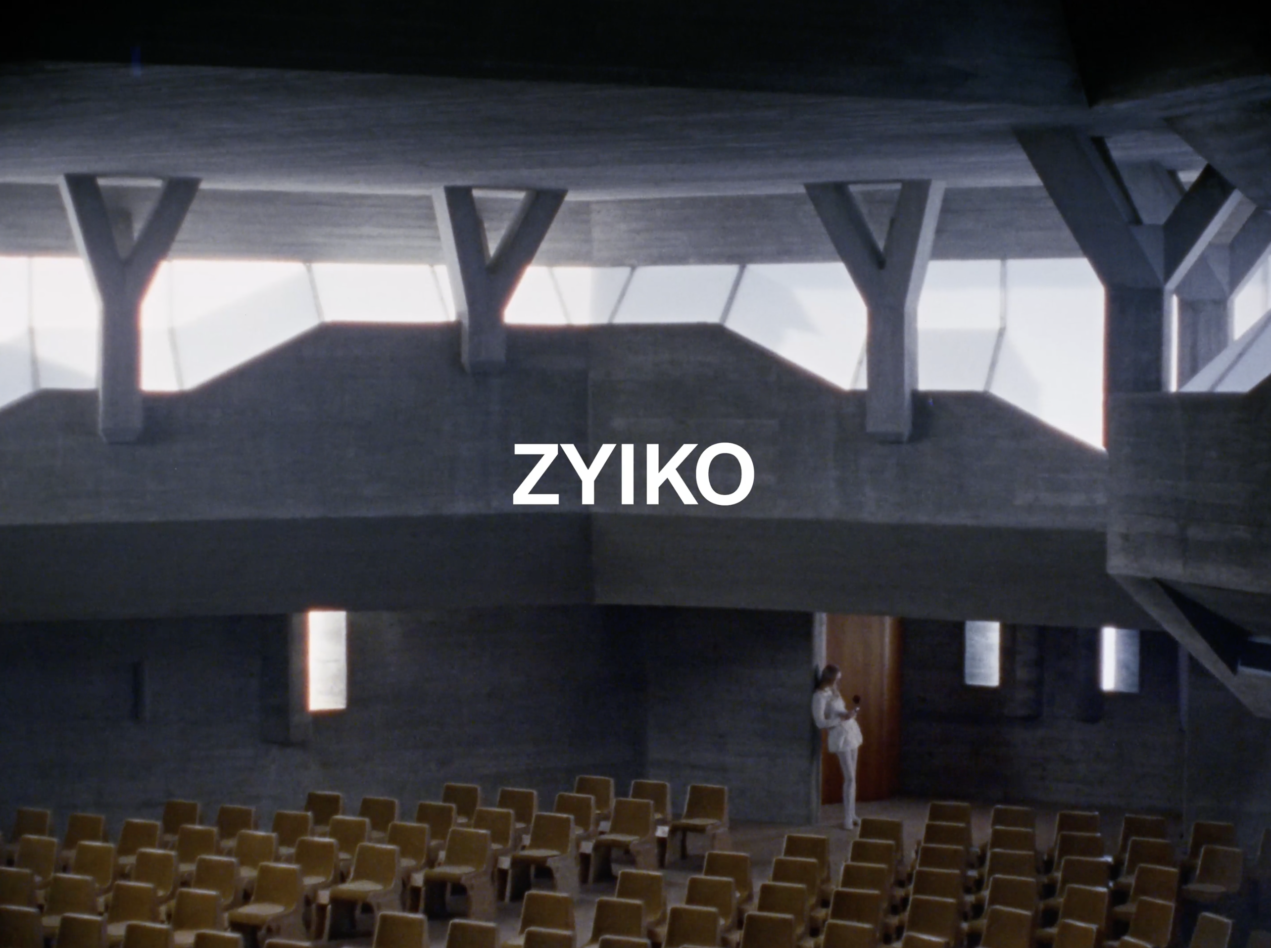
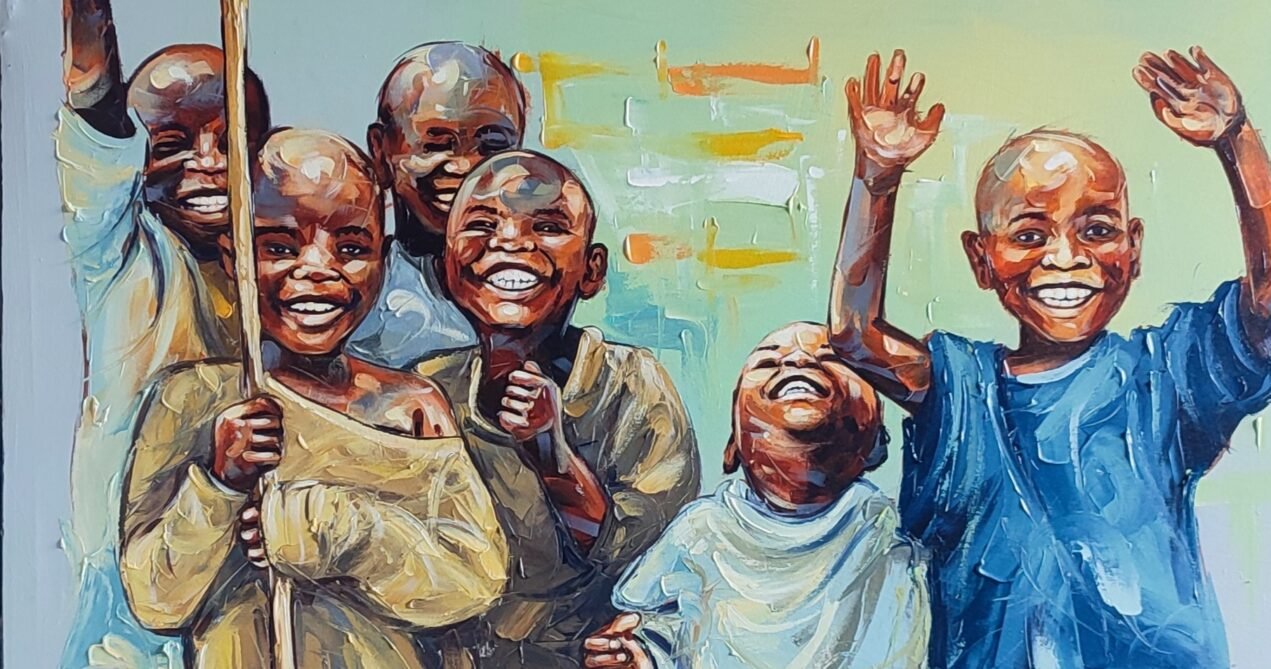
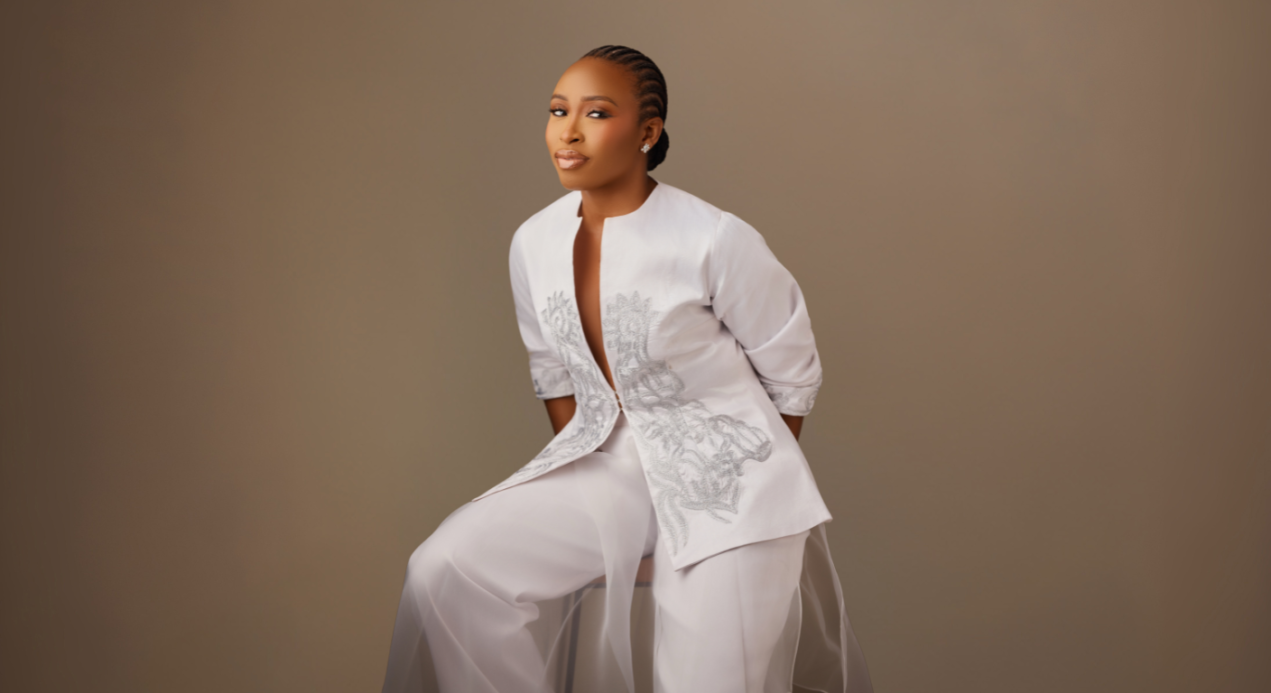

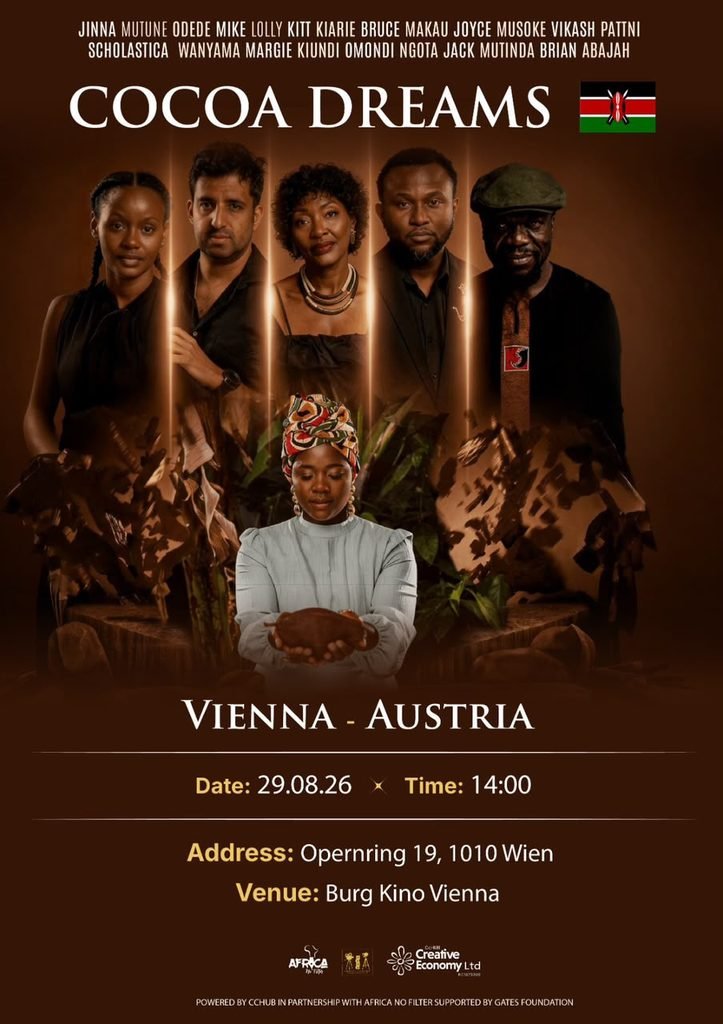
The cinema was full. People were sitting on the steps. The organiser looked around and said, “We should have booked a bigger cinema hall!” For Kenyan filmmaker Jinna Mutune, that moment in Vienna became more than a successful screening of Cocoa Dreams. It became proof of something she had long believed: African stories can travel, connect and bring people together. Her work does not ask the world to look at Africa with pity. It asks Africans to look at themselves with pride, curiosity and fresh eyes.
Through Cocoa Dreams, Jinna Mutune explores women, land, inheritance, indigenous knowledge and the many ways Africa can shape its own future. She also sees film as a tool to connect audiences across Africa and the diaspora. Her message is clear: we have stories worth telling, audiences ready to listen and a future worth building. In this conversation, Jinna Mutune shares why African stories should come home first, why women must have a voice in decisions about land and inheritance, and why the next chapter of African cinema may begin when we stop asking what is possible and start building it.
FAB: After the lights went down and the audience left, what stayed with you? Was it the significance of being the first Kenyan filmmaker to screen a film in Austria, something someone said to you, or perhaps something you felt privately that nobody else in the room could see?
Jinna Mutune: To walk into a cinema and find it completely full with people sitting on the steps just to watch our story was a moment I will never forget. It was surreal. So surreal that even my organiser said, “We should have booked a bigger cinema hall!”
And in that moment, I was reminded of why we tell these stories. African stories deserve the big screen. African stories deserve full houses. African stories deserve to travel. For so long, we have been told that our stories are too niche, too African, and too difficult to sell. But what happens when we dare to tell them with excellence and put them in front of the world? People show up. People connect. People care. This was more than a sold-out screening. It was a glimpse of what is possible when we stop waiting for permission to tell our own stories. The world is ready. And we are only just getting started.
FAB: There is something deeply personal about making a film about home and then taking that home somewhere far away. After showing Cocoa Dreams in Europe, has your understanding of Kenya, or of your own relationship with home, changed in any way?
Jinna Mutune: Every audience interacts with COCOA DREAMS differently. Each screening brings new conversations, new perspectives and deeper layers to the story. What you thought you understood when you were writing continues to evolve as people encounter it through their own cultures, experiences and lived realities. And that, for me, is the beauty of taking an African story around the world.
Every audience adds another layer. Every conversation reveals a nuance you may not have fully seen before. It gives you an even deeper appreciation of the richness, complexity and beauty of African culture and reminds you that Africa is not one story. It is layered, nuanced, diverse and deeply human; perhaps that is the power of storytelling: you write a story from one sense of home, and then the world encounters it and helps you discover even more about that home.
FAB: Your protagonist leaves one world of knowledge, nuclear physics, and returns to another, the land. There is almost a philosophical question there about what we consider valuable knowledge. What were you really trying to say about intelligence, tradition, modernity and the knowledge that already exists in African communities?
Jinna Mutune: That as Africans we come from an intelligent past. A past of ingenuity, creativity, knowledge, architecture, science, systems and ways of living that remind us that we have never been incapable of creating our own solutions. Our history is not simply something to look back at with nostalgia. It is evidence of what we are capable of. We Africans can engineer our own present.
We can imagine our own future.
We can build. We can create. We can innovate.
And we can tell our own stories while doing it.
FAB: Why did you need this story to be about a woman? Not simply because she is the protagonist, but because of what a woman returning home, inheriting land and attempting to change its future allows you to say that perhaps a male protagonist could not?
Jinna Mutune: I wanted to remind us that a woman is not lesser, secondary, or an afterthought. She is an equal image-bearer, created with the same dignity, intelligence, creativity, and capacity to shape the world. Through her story, I wanted to challenge the narratives that have diminished women and reclaim the truth that has always been there: A woman carries the image of God just as fully as a man does.
This story is therefore not only about one woman. It is about restoring a truth, honouring the women who came before us, and creating space for the women who will come after us to know who they are and what they carry. The main character’s arc was inspired by the daughters of Zelophehad, from the Bible, who inherit land.
Land is central to women’s empowerment in Africa. When women are locked out of inheriting ancestral land, we are not simply denying them a piece of property—we are creating an economic barrier. Land is wealth. It is security, livelihood, collateral, a place to build, farm, invest, and create generational wealth. When a woman is excluded from owning or inheriting it, her ability to make independent economic decisions is immediately constrained.
That is why the fight for women’s rights must also be a fight for women’s right to land, inheritance, ownership, and economic agency. At the heart of my story is a simple truth: a woman is an equal image-bearer, and therefore her dignity should be reflected not only in how we speak about her but also in the rights, resources, and opportunities we give her. This is not about taking from men. It is about removing the barriers that have kept women from fully participating in the economic and social life of their communities.
FAB: Land carries memory. It carries family history, sacrifice, conflict, inheritance and sometimes unresolved pain. What does the land in Cocoa Dreams represent to you personally, and what do you think Africans are losing when our relationship with land becomes purely economic?
Jinna Mutune: When our relationship with land becomes purely economical, we risk losing something far more valuable than the land itself. Across Africa, land carries memory, identity, community, indigenous knowledge, and generations of wisdom. It holds the stories of our ancestors, the ways communities have lived sustainably, the traditional crops they cultivated, and indigenous solutions developed through centuries of observing and understanding the environment.
When land is treated only as a commodity—something to buy, sell, or develop—we can sever the connection between people and the knowledge embedded in that land. We risk losing traditional crops that may hold answers to food security and climate resilience. We risk losing indigenous agricultural practices, communal systems of knowledge, and solutions that could help us build more sustainable communities today.
So the question is not simply, “Who owns the land?” It is also: “What knowledge, memory, culture and possibilities are we losing when we disconnect people from their land?”
This is why women’s access to ancestral land matters so deeply. We are not only talking about economic empowerment. We are talking about belonging, inheritance, identity, knowledge, community and the right to participate in shaping the future of our people.
FAB: You have taken an intensely Kenyan story into rooms where people may have little or no lived relationship with Kenya. Did you ever feel the responsibility of having to represent a country, or did you deliberately resist that responsibility because one filmmaker can never speak for an entire people?
Jinna Mutune: I don’t think of it as a responsibility to represent my country. I think of it as an honour. An honour to carry our stories beyond our borders and to contribute to reshaping Africa’s narrative on the global stage. For too long, Africa has been introduced to the world through the narrow lenses of war, famine and poverty. But our story is so much richer. We come from an intelligent past. We have knowledge, culture, creativity, resilience, innovation, beauty and stories that deserve to be seen and heard.
FAB: There is a difference between being seen and being understood. After Vienna, do you feel that European audiences are beginning to understand African stories on their own terms, or are African filmmakers still doing a great deal of work explaining themselves to the world?
Jinna Mutune: I think Europe is opening up, and I’m grateful for that. But my deeper passion is for Africans and Africans in the diaspora—to understand and engage with our own stories. They are my immediate audience because they understand the language of home almost instinctively. They understand the silences, the humour, the traditions, the land, the relationships, the tensions and the things that sometimes don’t need to be explained, and I became particularly passionate about Africans seeing ourselves in these stories. Because our immediate audience is home.
An African audience understands the nuances—the land, the humour, the contradictions, the things that don’t need to be explained. When someone from home watches your film and says, “I know this. This is us,” which is a different kind of validation. I want we Africans to see ourselves reflected on screen—not only through stories of suffering, but through stories that remind us of who we are, where we come from, and what we carry.
Before we ask the world to understand Africa, I want us to understand ourselves. The global audience is important, but there is something deeply powerful about an African sitting in a cinema thousands of miles from home and recognising themselves in the story. That is the audience I am most passionate about reaching. Our stories should come home first.
FAB: You have been telling African stories for nearly two decades. What has the industry taught you about the emotional cost of persistence? Was there ever a point when you wondered whether the world actually wanted the stories you were determined to tell?
Nearly two decades in this industry have taught me that persistence is not simply about working hard. It is about continuing to believe in the value of what you are carrying when there is very little external validation. There have been many moments when I wondered, does the world actually want these stories? Especially when the stories coming out of Africa that received the most attention seemed to fit familiar narratives of war, famine, poverty or crisis.
Sometimes you begin to question whether there is space for the stories you know are important. But I realised that the greater question was not whether the world wanted our stories. It was whether we believed our stories were worth telling. Persistence has therefore taught me that sometimes you have to build the audience alongside the story.
You have to keep showing up until people begin to see what you saw from the beginning. I don’t see the journey as a responsibility to represent my country. I see it as an honour—an opportunity to take our stories onto the global stage and expand the imagination of what Africa can be.
Because I don’t want Africa to only be seen through the stories the world already knows about us. I want us to tell the stories that remind Africans—and the world—that we come from an intelligent past, that we carry extraordinary knowledge and creativity, and that we have the capacity to engineer our own present and future.
FAB: Your career sits at an interesting intersection between storytelling and institutions. You have worked with major organisations and brands, while also creating your own films. Has working within those systems strengthened your voice as a filmmaker, or have you sometimes had to protect your voice from the expectations that come with institutional support?
Jinna Mutune: These institutions have been incredibly understanding of my journey as a filmmaker. They gave me the opportunity to create infomercials and civic-education campaigns at a time when my fiction work could not yet sustain me financially. When fiction could not pay the bills, they paid me to tell stories that served the public good. Those opportunities were more than just jobs. They allowed me to keep developing my craft, remain in the industry, and continue building toward the stories I was deeply passionate about telling.
In many ways, those institutions helped sustain the filmmaker who would eventually be able to tell the bigger stories. I have enormous gratitude for that part of the journey because it taught me that sometimes the path to telling the story you were born to tell is not a straight line. You take the work that sustains you, you learn from it, you serve through it and you keep creating.
FAB: African cinema is increasingly being described as a global opportunity. But opportunity and ownership are not the same thing. What needs to change so that African filmmakers are not simply supplying stories to a global entertainment machine, but are actually building sustainable businesses, intellectual property and cultural power around those stories?
Jinna Mutune: We have to build our own systems. It is wonderful that African cinema is increasingly being recognised as a global opportunity, but opportunity without ownership can easily become extraction. We cannot simply become suppliers of African stories to a global entertainment machine while someone else owns the intellectual property, controls the distribution and captures most of the value.
We need to build African systems around our stories—from financing and production to distribution, exhibition, marketing and archives. We need stronger African-owned production companies, distribution networks, cinemas, streaming platforms, festivals, training institutions and investment structures. Most importantly, filmmakers need to understand that the story is not just a film. It is intellectual property. It can become a series, a book, an educational resource, an animation, a game, a licensing opportunity or an entire body of cultural capital.
We also need audiences to participate in this ecosystem. I am passionate about Africans seeing our own stories because our immediate market is home. When Africans support African cinema, we are not simply buying a ticket—we are helping create an economic system in which our stories can survive and our filmmakers can retain ownership. The global market should be a partner, not the owner of our imagination. We don’t need to shut the world out. We need to enter the global market from a position of strength.
FAB: What have audiences abroad taught you about Africa that Africans themselves sometimes forget?
Jinna Mutune: Africans in the diaspora have taught me that they are brilliant. The African Diaspora is a catalyst to change, not just a source of remittance. It carries skills, networks, influence and a bridge between two worlds. We had important discussions about how the African diaspora can use its knowledge, experience, networks and entrepreneurship to support development and build stronger connections between Africa and the Nordics.
FAB: And conversely, what have you realised about the assumptions international audiences still carry when they encounter an African story?
Jinna Mutune: Sometimes the most surprising thing for an international audience is simply seeing Africans being ordinary, complex human beings—loving, ambitious, funny, flawed, spiritual, entrepreneurial, conflicted, intelligent and full of dreams. Stories where Africa is not the backdrop to a crisis, but simply the place where human beings are living their lives.
I’ve also discovered that audiences don’t necessarily need everything explained to them. Give them a compelling human story and they will find their way into it. The emotional truth travels. What I want to challenge is the assumption that African stories have to be translated into something familiar before they can be understood globally.
FAB: There is a quiet idea running through Cocoa Dreams about what we inherit versus what we choose to build. Looking at your own life, what did you inherit from the people and places that came before you, and what are you consciously trying to leave behind for the people coming after you?
Jinna Mutune: What I inherited was not necessarily wealth or material things. I inherited something that, for me, has been even more valuable: great support, mentorship, and people who were willing to believe in me and my ideas. There were people who opened doors, encouraged me, gave me wisdom, and sometimes saw something in me before I could fully see it in myself.
That kind of inheritance changes the trajectory of your life. I think that is the quiet question at the heart of Cocoa Dreams: What do we do with what we have been given? I don’t want to simply consume the opportunities that were created for me. I want to multiply them. I want to leave behind stories, knowledge, opportunities and systems that make it easier for the next person to dream—and to build.
I want to mentor, support and create platforms where other African creatives, particularly women and young people, don’t have to fight every battle from the beginning. If I have received support, then I want to become support for someone else. If someone opened a door for me, I want to leave the doors open behind me. I have done many of those mentorships in informal communities. K-YOUTH MEDIA, CANNON ETC
FAB: If you removed the filmmaker, the premiere, the international tour and all the professional achievements, who is Jinna Mutune? What experiences, fears, convictions or memories have shaped the woman who keeps choosing to tell stories?
Jinna Mutune: If you remove the filmmaker, the premieres, the international tour and all the achievements, I think what remains is a woman who has always been deeply curious about people—and deeply moved by stories that are not being heard. I have been incredibly fortunate in what I have inherited. I inherited great support, mentorship and the freedom to find my voice. My parents gave me room to express myself and, importantly, gave me wise counsel drawn from their own entrepreneurial journey.
My mother, who spent her career in banking, gave me a strong example of what it means for a woman to build, lead and create a life of her own. The church also played an important role in shaping me. It gave me a platform to sharpen my creativity through plays, but it also gave me a faith that continues to ground me. That foundation has stayed with me through every season. Then South Africa opened another world for me. I lived at the YMCA and studied at AFDA, and for the first time I was surrounded by Africans from different countries. It exposed me to Pan-Africanism in a very personal way. I began to understand that my story was not isolated—that there was a much bigger African story that I was part of.
Mentorship was another significant inheritance. My time under Binyavanga Wainaina and the literary community helped me understand the power of narrative and, more importantly, the value of my own voice in reshaping African narratives. And mentors such as Dr Musimbi Bernard W. Donald Gichane, Chris K. and Julian Kyula shaped the way I think about business. They helped me understand that creativity and business don’t have to exist in separate worlds—that if we want our stories to survive, we also have to understand how to build sustainable enterprises around them.
I was also the creative child who sometimes felt misplaced in an education system because the thing I was naturally good at was not always recognised as intelligence. That experience stayed with me. It taught me that there are many forms of intelligence and that sometimes, the very thing the world fails to value in you may actually be your greatest gift.
I think that is part of why I keep telling stories. I have inherited belief, faith, mentorship, community and the courage to use my voice. What I am consciously trying to leave behind is more of the same—but multiplied. I want to create opportunities for others. I want to mentor. I want to build systems where African creatives can own their stories and build businesses around them.
I want women to see themselves not as secondary characters, but as equal image-bearers with the capacity to create, lead and shape the future. And perhaps, ultimately, I want to leave behind a world where the next creative child doesn’t have to wonder whether their gift is valuable. If someone believed in me enough to help me find my voice, then my responsibility is to help someone else find theirs.
FAB: Perhaps the most important question after a journey like this is not “What is next?” but “What has this journey made you responsible for?” Having watched Cocoa Dreams cross borders and enter rooms you once could only imagine, what responsibility do you now feel towards the next African filmmaker who is still waiting for their first door to open?
Jinna Mutune: I think my responsibility now is to continue to tell different African stories and to galvanise the African diaspora and figure out how we create platforms that are owned by us and serve us. Cocoa Dreams has shown me that there is an audience hungry for stories that reflect who we are, and that audience is not just somewhere “out there”—it is within our own communities, across Africa and the diaspora. The question is, how do we organise that audience into cultural and economic power?
For the next African filmmaker waiting for their first door to open, I don’t just want to open one door. I want us to build the house. Film is ultimately a game of numbers. Bollywood understands this—it can speak to an audience of more than a billion people. Hollywood has built an enormous industry by thinking beyond individual markets and creating systems that reach hundreds of millions globally.
Africa cannot continue to operate as 54 separate markets when it comes to our stories. Our markets must integrate. If a Kenyan film is only thinking about Kenya, or a Nigerian film only about Nigeria, we are immediately limiting the economic potential of our own stories. We need to think of Africa and the African diaspora as one interconnected cultural and economic ecosystem. We have the population, the talent and the audiences. What we have not yet built at scale is the infrastructure to connect them—distribution, exhibition, investment, marketing and platforms that allow African content to travel seamlessly across borders.