
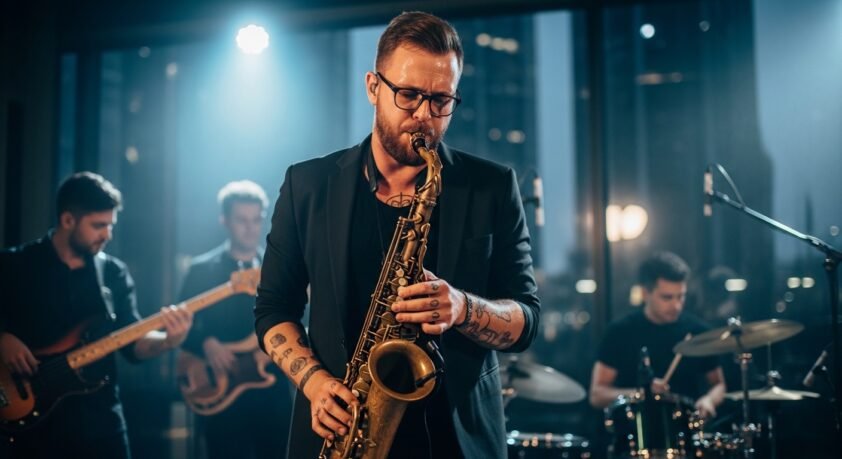
Nobody told Jazz it was supposed to stay in its lane. While critics periodically announced its death — too niche, too old, too difficult — the music kept moving, kept mutating, kept appearing in places it had no business being and making itself at home. It showed up in the production choices of a South London rapper. In the way a Lagos fashion designer described her process. The sustained, searching note a Johannesburg saxophonist held over a beat was unmistakably electronic. Jazz did not modernise in the way institutions modernise through committees and rebranding campaigns. It evolved the way living things evolve: quietly, in response to pressure, following the light. The question was never whether jazz would survive. It was whether we were paying close enough attention to notice where it went.
The generation currently remaking jazz did not arrive at it through reverence. They arrived through curiosity, through the side door, through a sample their older sibling had on a hard drive or a record their grandmother refused to explain. For the musicians clustering around scenes in London, Los Angeles, Lagos, and Tokyo, jazz is not a museum they are maintaining. It is a methodology: a way of thinking about sound and self that they carry into rooms that do not look anything like the Village Vanguard.
Shabaka Hutchings does not make music that asks permission. His work with Sons of Kemet and The Comet Is Coming drew from jazz the thing that has always been its most radical gift: the willingness to place incompatible things in conversation and see what survives. Afrobeat rhythms, grime’s urban impatience, spiritual jazz’s searching quality, the bass weight of dub — none of these were forced together. They were allowed to find each other. The result was something that could not be filed cleanly anywhere, which is precisely the point.
That unfileable quality is a form of resistance. It refuses the sorting mechanism that cultural industries depend on. You cannot market what you cannot categorise, and jazz has always known – instinctively, structurally – that categories are a kind of cage.
In Los Angeles, the scene around Leimert Park and the musicians who orbited Kamasi Washington’s extended universe produced something that felt genuinely new while being deeply ancestral. The Epic arrived in 2015 with the dimensions of a statement, a triple album, orchestral arrangements and the audacity of its own length and somehow found an audience that included people who had never knowingly listened to jazz before. Part of this was the moment: a cultural climate in which questions of Black identity and Black life in America had become impossible to avoid, in which the music that had always carried those questions felt suddenly urgent again.
But Washington was not simply capitalising on a mood. He was articulating something real about how legacy functions not as a weight but as a resource. To know where the music came from is not to be trapped there. It is to understand the full range of what the form can hold. The spiritual jazz of Alice Coltrane, the cosmic ambition of Sun Ra, and the orchestral sweep of Gil Scott-Heron – these were live wires.
Hip-hop and jazz have been in a long, productive argument for decades now, borrowing from each other, sampling each other, and occasionally claiming not to be related while clearly sharing a bloodline. The producers who built boom-bap from jazz breaks were doing something more complex than looping. They were recontextualising, taking a fragment of recorded emotion and asking it to mean something new in a different time and body. J Dilla understood this. His relationship to the jazz canon was that of a fluent speaker working in a second context: the grammar intact, the accent entirely his own.
When Kendrick Lamar anchored To Pimp a Butterfly in live jazz, when he brought Thundercat and Flying Lotus into that architecture, the choice was not stylistic nostalgia. It was an argument that certain kinds of truth require certain kinds of sound, that music born from unresolved histories is the correct vessel for unresolved contemporary realities. The album did not make jazz popular. It made it necessary again in a way that streaming algorithms and late-night playlists could not.
Recommended For You
What Makes Jazz a Living Language? History, Culture, and Meaning
More recently, the conversation has grown even more intricate. Producers like SAULT – deliberately opaque and structurally resistant to easy consumption – work in a zone where jazz, soul, and spiritual music merge into something that feels less like genre and more like atmosphere. You do not put SAULT on as background. It demands the same quality of attention that Coltrane demanded: presence, stillness, a willingness to follow. The influence has never been only sonic. Jazz carries an aesthetic, a posture, a way of being in the world that has always leaked into fashion and visual culture with the same ease it crosses musical borders. The cool that Miles Davis invented — precise, self-contained, and unbothered in a way that required enormous effort — runs through contemporary menswear like an underground current. It is there in the deliberate understatement of certain designers who understand that restraint communicates more than decoration. It is there in the visual language of photographers working in Black cultural spaces, the way they frame a body in a room: specific, unhurried, certain of its own importance.
Contemporary African fashion design, particularly from Lagos and Accra, carries jazz’s improvisational logic in ways that are rarely articulated but consistently visible. The willingness to combine unexpected textiles, to treat structure as a starting point rather than a constraint, and to let the work be simultaneously rooted and experimental – these are jazz principles applied to cloth and form. When designers like Kenneth Ize or Tokyo James discuss their processes, they describe something that sounds less like fashion production and more like composition: starting with a feeling and following it, trusting the material to tell you where to go.
What the younger generation inherited from jazz, whether they use that word for it or not, is the understanding that the most interesting creative work happens at the edge of what you know. That the task is not to perfect the familiar but to locate the boundary of your own fluency and step deliberately past it. Every improvised solo is a lesson in managed uncertainty: you have your training, your instincts, your knowledge of the tradition, and then you have the moment itself, which is always slightly different from what you prepared for.
This is not a metaphor that needs forcing. It is simply what the music does and what it has always modelled for anyone paying attention. The creative self is not a fixed object you protect. It is something you discover in motion, in the act of making, in the conversation with other people and other forms and the accumulated weight of everything that came before you.
Jazz taught that first. It keeps teaching it. There is a scene that repeats itself across cities right now: in a basement in Peckham, on a rooftop in Lagos, and in a studio in Kyoto at two in the morning, where musicians from different traditions sit down together without a clear plan and begin to play. What happens in those rooms is not always beautiful, and it is rarely convenient, but it is consistently alive in a way that more finished things often are not. Someone brings a rhythm from one world; someone else brings a harmony from another; and in the space between them, something appears that neither of them could have made alone.
Jazz prepared the ground for exactly this. It is always understood that the music is not in any single musician or any single tradition but in the exchange itself, in the willingness to listen as seriously as you play, to let yourself be changed by what you hear, and to trust that what emerges from genuine encounters will be more interesting than anything you arrived with. That is still true. It will keep being true. The room just keeps getting larger.