
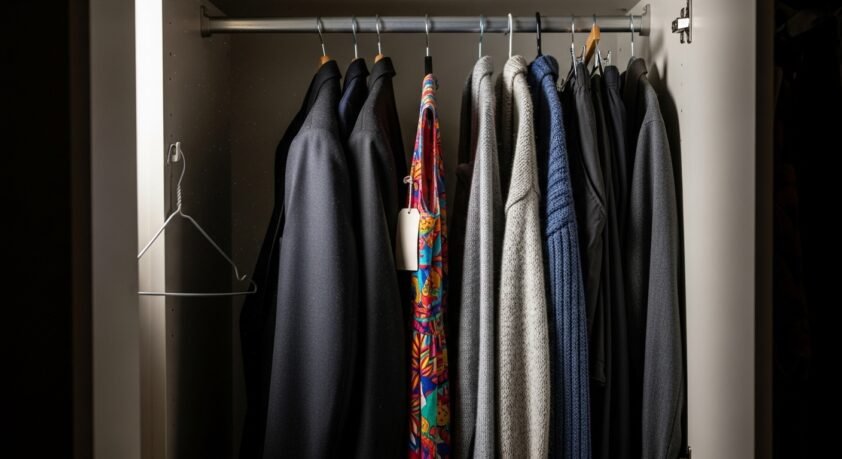
At the back of almost every wardrobe, there is a section that does not quite function as a wardrobe. It is not organised in the way the rest is organised. It does not participate in the daily negotiation between what is clean and what is appropriate and what will do. Its contents are not forgotten — you know precisely what is there — but they are not, in any practical sense, in use. They hang. They fold. They occupy space with the particular stillness of things that have been placed somewhere with care and then, for reasons that resist easy articulation, left.
These are the clothes we keep that we never wear. Every person who has ever cared about clothing has them. The dress bought for an occasion that felt, at the time, like it would recur and did not. The suit acquired at a moment of ambition. The coat that was expensive enough to deserve better than donation, and good enough to seem wasteful to discard, but wrong in some quality that has never quite been identified. The item that was worn once, or twice, or never — and has remained, season after season, a presence in the wardrobe that is neither active nor released.
What is interesting about these clothes is not what they say about our relationship to consumption, though they do say something about that. What is interesting is what they say about us — about who we have been, who we imagined we might become, and the distance between those two figures that clothing, more honestly than almost anything else we own, makes visible.
The Archaeology of a Wardrobe
To go through a wardrobe carefully — to handle each garment and ask, honestly, when it was last worn and why it is still here — is to conduct an archaeology of the self.
Most possessions do not do this. A book kept unread is simply an intention deferred. A piece of furniture retained beyond its useful life is habit or sentiment. But clothing is different because clothing is worn on the body, which is to say that it is intimate in a way that most objects are not. To own a piece of clothing is to have, at some point, imagined yourself inside it — to have held a version of yourself against it and found the combination plausible, desirable, or necessary.
The clothes we never wear are the residue of that imagining. They are not failures of taste, exactly, though sometimes they are that. They are more precisely records of the selves we have inhabited or attempted or abandoned. They mark transitions — between roles, between relationships, between understandings of who we are and what we are trying to do — with the accuracy of a diary that was never intended to be one.
The black tie dinner jacket kept twenty years past the last formal event attended. The maternity dress retained after the last pregnancy. The running kit bought at the beginning of a fitness commitment that lasted three weeks. The exquisite blouse purchased during a period of professional aspiration that has since softened into something more realistic. Each of these is a document. The wardrobe that contains them is an archive of a life — not the life as it was lived, but the life as it was imagined.
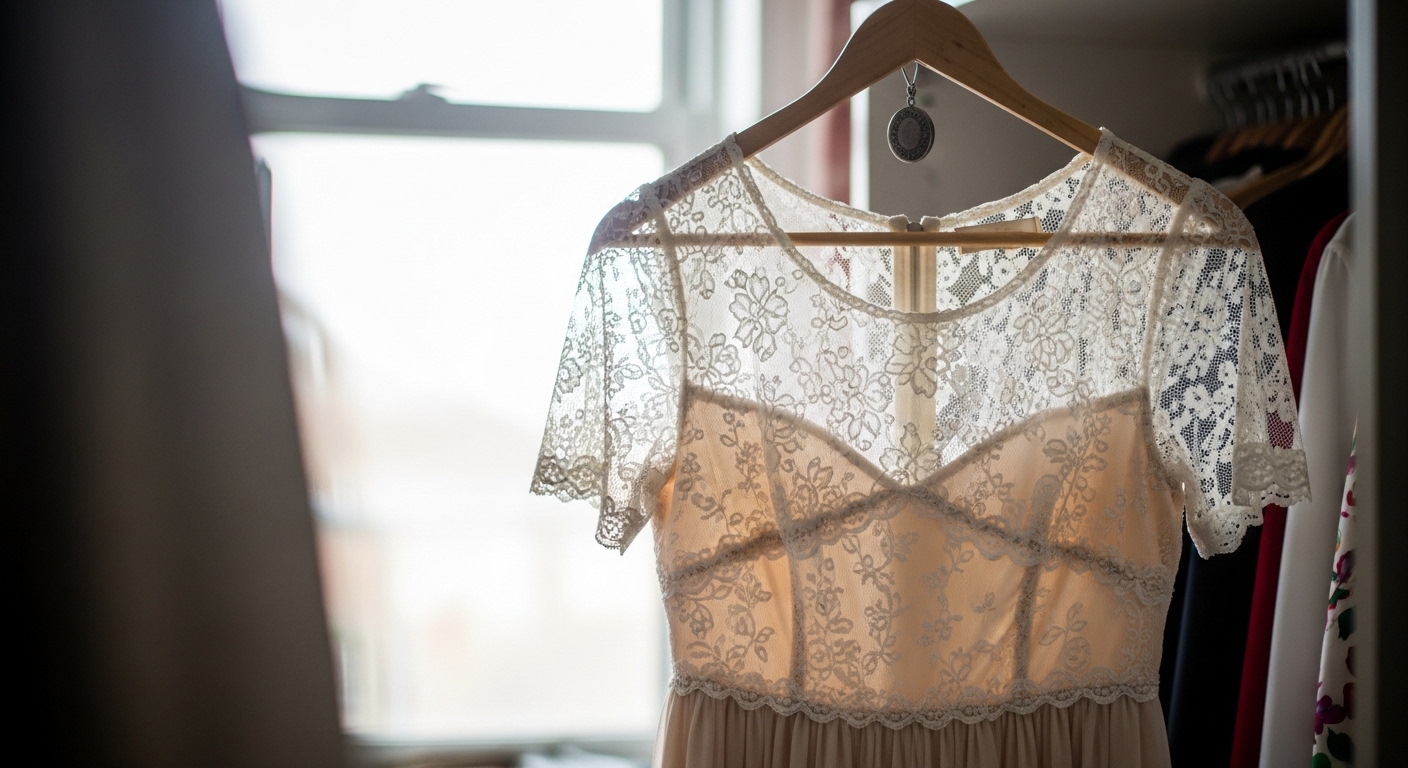
The Weight of the Aspirational Garment
Of all the clothes we keep without wearing, the most psychologically complex is the aspirational one — the garment acquired not for the person we are but for the person we intend to become.
This is a familiar category. The dress in the size you will fit into once you have lost the weight. The suit bought for the career stage that has not yet arrived. The beautiful linen shirt that belongs to the version of yourself who takes slow holidays in warm places and reads in the afternoon and has, somehow, fewer obligations. The clothes of a life adjacent to the one being lived.
The aspirational garment is not simply an expression of vanity or wishful thinking, though it can be both. It is, more fundamentally, an act of faith. To buy it is to commit, in a concrete and financial sense, to the possibility of a different future — to insist, against evidence, that the version of yourself it represents is not imaginary but merely not yet arrived. The garment hangs in the wardrobe as a form of promise. Discarding it would be a form of admission.
This is why the aspirational garment is almost always the hardest to release. Every wardrobe edit stalls at the same point: the dress in the wrong size, the jacket for the job not yet achieved, the holiday clothes for the holiday not yet taken. To keep them is irrational by any strictly practical measure. But practice is not what they are serving. They are serving hope, which is a need that does not respond to practicality in the way that other needs do.
What they also do — and this is the part that is less often acknowledged — is generate a low-grade, persistent weight. The dress in the wrong size does not simply occupy space. It asks a question every time it is seen. The suit for the future career is a reminder of a present that has not yet become the future. The aspirational garment, however quietly, holds its owner accountable to an intention that may or may not be real. This can be useful. More often, over time, it is merely tiring.
Recommended For You
The Garment That Belonged to Someone Else
There is a second category of unworn clothes that operates differently from the aspirational: the garment that belongs to a self that no longer exists.
This is the clothing of former lives. The office wardrobe retained after a career change. The going-out clothes kept from a decade when going out was a primary activity and a primary identity. The items purchased during a relationship, or for a relationship, that have since ended. The dress bought in a city you no longer live in, from a version of yourself for whom that city was still new.
These clothes are not aspirational. They do not point toward a future self. They point toward a past one. And the reason they are kept, when they are kept, is not hope but something closer to loyalty — an unwillingness to entirely discard the person who wore them, even though that person, in any practical sense, is gone.
There is something genuinely moving about this category of garment, and something that deserves to be treated with more seriousness than the fashion industry’s periodic injunctions to declutter and curate tend to afford it. The clothes of former selves are not clutter. They are evidence. They testify to the fact that the person now standing in front of the wardrobe has been other people — has held other ambitions, inhabited other contexts, and cared about other things — and that those versions are not simply cancelled by the current one but are part of a continuous life whose coherence depends, in part, on not being entirely forgotten.
The woman who keeps the jacket from her first serious job is not being irrational. She is keeping something that confirms a particular chapter of her own history — that says, mutely and reliably, this happened, you were this person, this mattered. To give it away would not be decluttering. It would be something closer to revision.
What We Are Really Keeping
The clothes we keep without wearing are, at bottom, a form of narrative management. Clothing is one of the primary means by which we construct and communicate identity — not just to others but to ourselves. The wardrobe we maintain, in its entirety, is a story we tell about who we are. The active part of the wardrobe is the story as it is currently being told. The inactive part — the unworn, the retained, the suspended — is the story in full, including the chapters that have closed and the ones that have not yet opened.
To keep a garment without wearing it is to insist on its place in the story. It is to say: this is still part of what I am, even if I cannot currently demonstrate how. It is to refuse the reduction of identity to its present expression — to maintain, in cloth and thread, the claim that the self is larger and more continuous than any single season of dressing can represent.
This is why the instruction to keep only what brings joy — or what is used, or what earns its place — misunderstands the function of the unworn garment. Joy is not the relevant criterion. Meaning is. And meaning in clothing, as in most things, is not always comfortable or active or practically useful. It is sometimes heavy, dusty, and hanging very still at the back of a wardrobe that otherwise gets on with its life.
The Question of Release
None of this is an argument against ever letting go. There are clothes in every wardrobe that have ceased to function even as narrative — that have become inert, their meaning expired, their connection to any past or future self genuinely dissolved. These are worth identifying and releasing, not because tidiness is a virtue, but because a wardrobe crowded with the meaningless makes it harder to see the meaningful. The clothes that still matter deserve space.
But the process of deciding what matters and what does not cannot be conducted by a rule. It requires the slower, more honest reckoning of actually standing in front of the garment and asking what it is doing there — what it represents, whether that thing is still real, whether keeping it serves the life being lived or merely avoids a small, overdue confrontation with the life that has passed.
Some of what you find will be ready to leave. Some will not be. The black tie jacket might be, after honest examination, simply taking up space. Or it might be the last remaining physical evidence of a period of your life that you are not, actually, finished with. The dress in the wrong size might be genuine aspiration, or it might be punishment. The going-out clothes from a decade ago might be nostalgia for a self you have outgrown, or they might be a reminder that the self who loved those things is not as gone as the current calendar suggests.
These are distinctions that only the wearer can make. They cannot be made quickly, or by someone else, or by a principle imported from outside. They require the kind of attention that the fashion industry, with its emphasis on the new and the next, rarely encourages — the willingness to stop in front of what has been kept and ask, seriously and without impatience, why. The clothes we keep that we never wear are waiting for exactly that question. They have been waiting, in most cases, for quite some time.