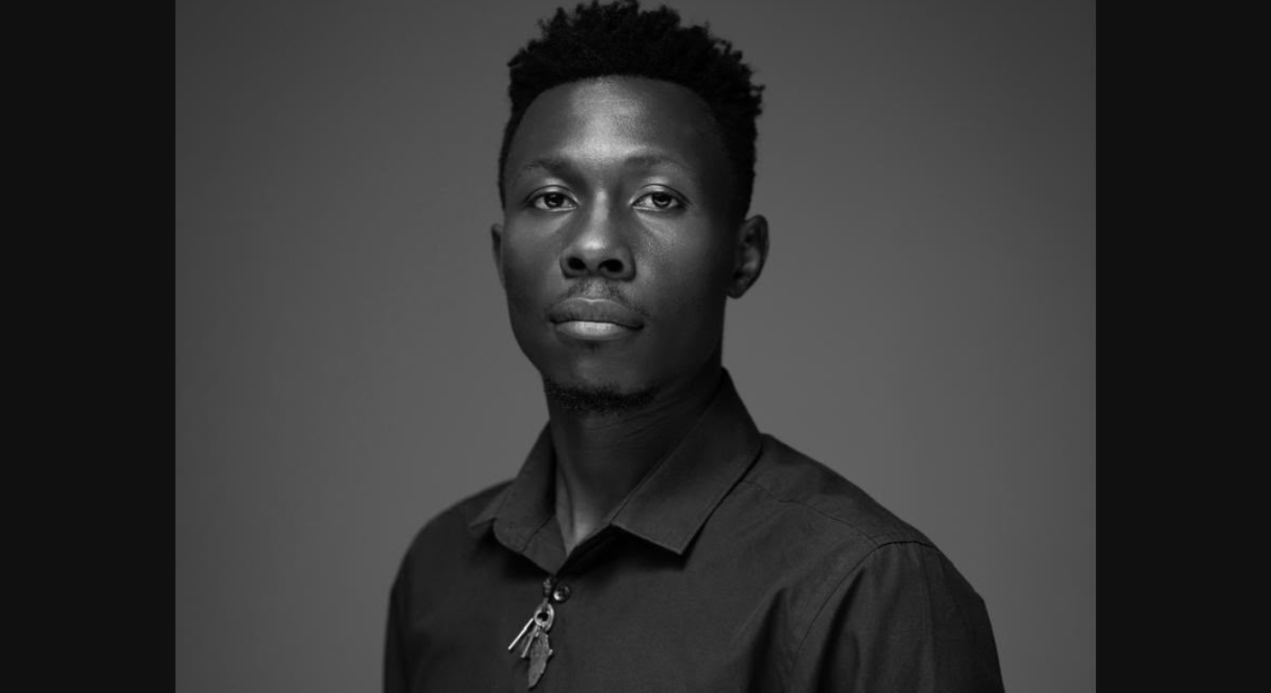
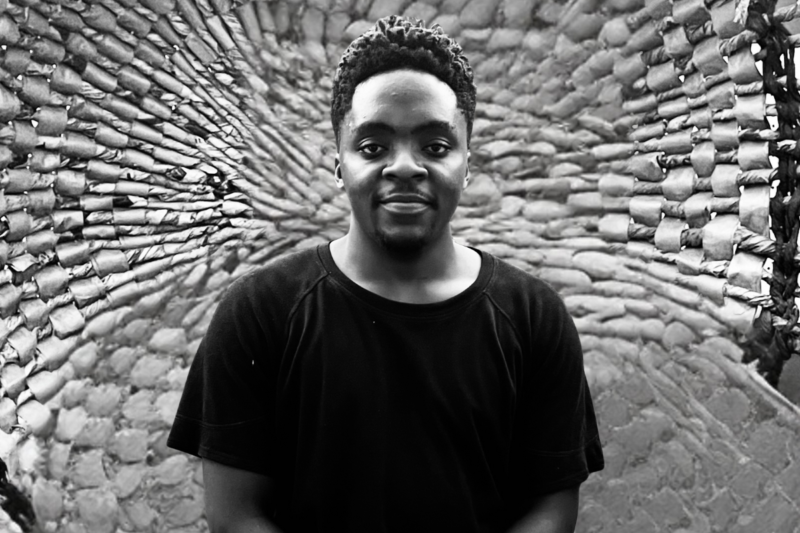
Some artists paint what they see. Dennis Kasagga paints what he listens to. He has carved out a universe made of stillness, lunar whispers, and the quiet pulse of the cosmos. His work is not simply visual; it is a translation of energies, a conversation with the sky he grew up staring at in the Ugandan night. Long before he had words for it, the moon was already impacting his imagination, slipping into his drawings, haunting the corners of his sketchbooks like a secret calling.
Today, Dennis stands as one of the most intriguing celestial storytellers of his generation, merging sound, light, colour, and texture to give the moon a voice that feels ancient and futuristic at the same time. His canvases challenge our addiction to urgency and invite us into a slower world, one where emotion becomes atmosphere and silence becomes a language. In this rare conversation with FAB L’Style, Dennis opens up about the childhood curiosity that launched him into the universe, the global influences that continue to reform his craft, and the luminous rebellion at the heart of his art.
Inside the Celestial Art of Dennis Kasagga
FAB: Let’s just start from the beginning of it all. What drew you to the moon and the broader mysteries of the cosmos?
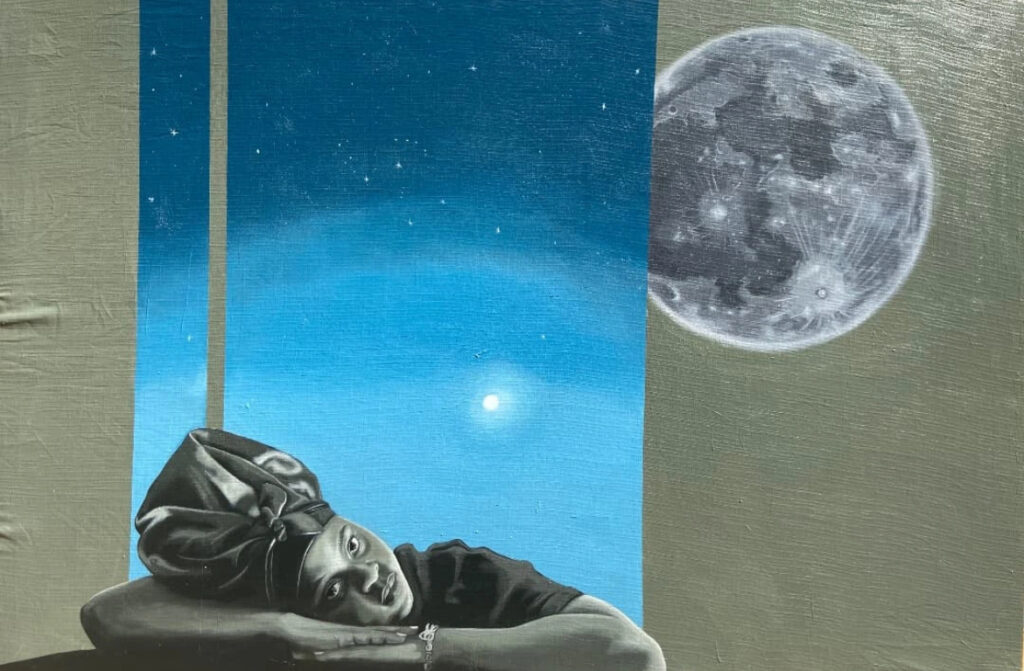
Dennis Kasagga: The very initial reason why I decided to explore the solar system was based on my childhood settings. Where I come from, we usually spent most evenings, up until around 9 p.m., seated outside. So I had the chance to stare at the sky. Out of curiosity, I would ask myself, “Okay, I’m seeing this big white circular body in the sky; what is this? What is it doing there? What else is out there?” That curiosity gave me the courage and inspiration to explore other celestial bodies and to find out how all these different things influence my life here.
FAB: Speaking about that beginning for you, do you remember the very first artwork you created that made you feel, Oh, this is my language?
Dennis Kasagga: Yeah, I actually do. It was in 2018. But back then I was more into drawing than painting. Painting came later as I found myself expressing more freely and fully. So I did a drawing for one of my mentors. At that time, I was good at drawing. But out of experimenting—saying, “Okay, let me try adding this and that”—I discovered something that had been in me for a long time but I wasn’t paying attention to. I realised that in most of the drawings I was making, the moon was there, and the stars were there.
Subconsciously, I was already including them, but I wasn’t giving them much attention. It was only after taking time to meditate on a couple of things I was going through that I thought, “Wait, there’s this recurring element in my art that I’m not giving attention to, but it’s always been there.
FAB: You’ve exhibited in different parts of the world; how have these diverse environments determined the way you interpret the universe on your canvas? Or let me put it this way: what’s different about working in these different environments?
Dennis Kasagga: What I would say is that different environments respond to art in different ways. At the moment, I have a couple of mentors who come to see my art, and you realise they give you different suggestions like, “Okay, try doing this.” Then I have friends from Kenya and also one from the U.S., and when I share my work with them, they all respond differently. Because of these different responses, you begin to discover different pathways and new ideas for how to communicate what you’re trying to say in different ways.
At the moment, I’m working on a sound project where the moon is given a voice, so to speak. Usually, it’s me trying to communicate to people what I’m seeing and envisioning. But through conversations with friends, one of them asked me, “You’re trying to show us, but don’t you think what you’re doing isn’t just storytelling? Isn’t it also a form of trial and error?” That made me realise that by being open and willing to take in new ideas, you discover new methods of doing things.
FAB: People interpret art in different ways. For instance, someone in Uganda and someone in Nigeria or Rwanda will interpret your art differently. Let’s hold onto that. So for you, how have people in Uganda received your art?
Dennis Kasagga: People here actually give me very good responses. Most of the art in Uganda is about portraiture—human faces, murals—but I’m trying to address something that very few people want to touch. People find it quite strange.
FAB: How do you translate something as intangible as lunar energy into colour, form, and texture for us to see and appreciate? I’m talking about your creative process now.
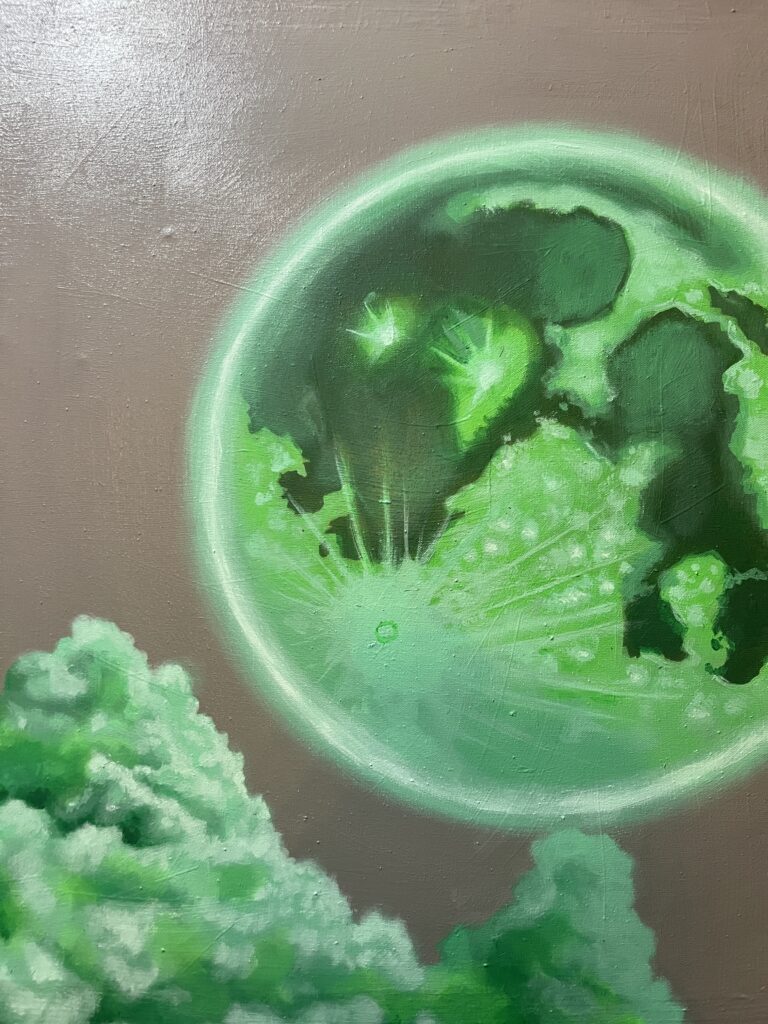
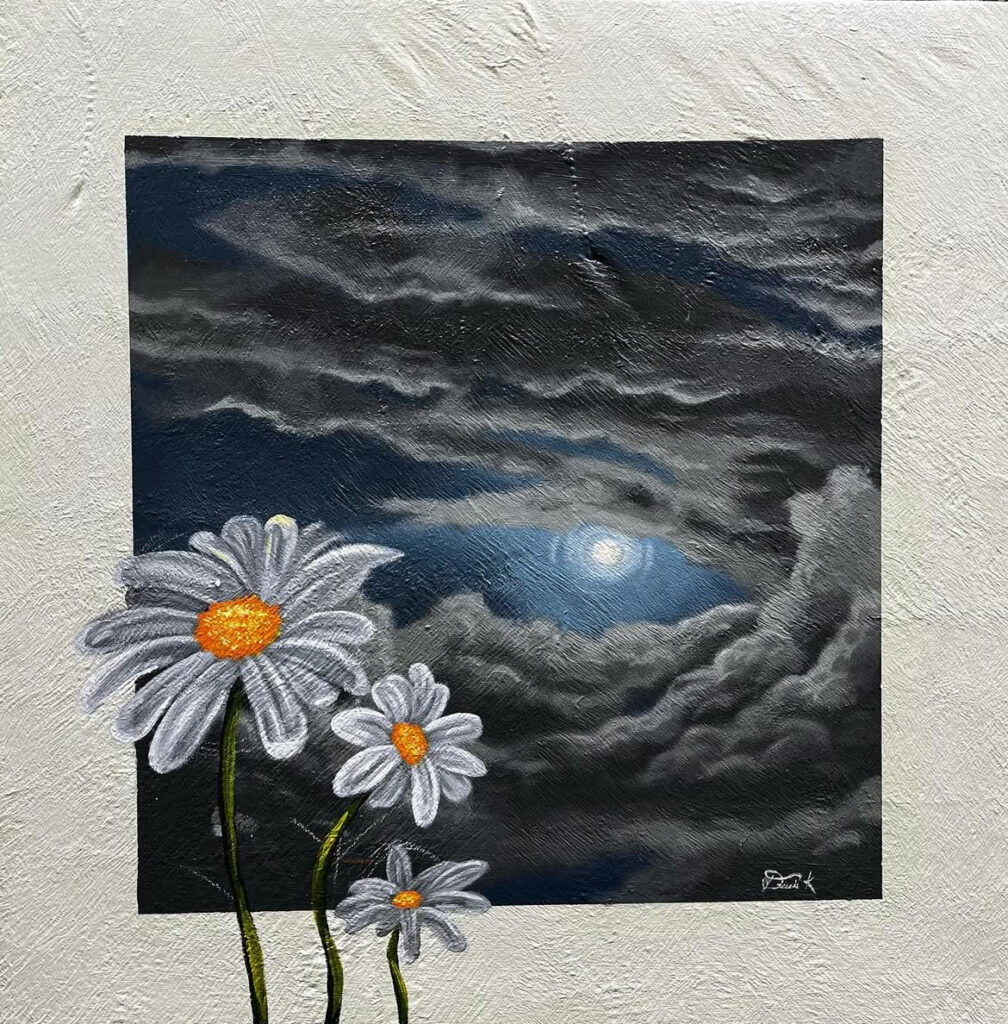
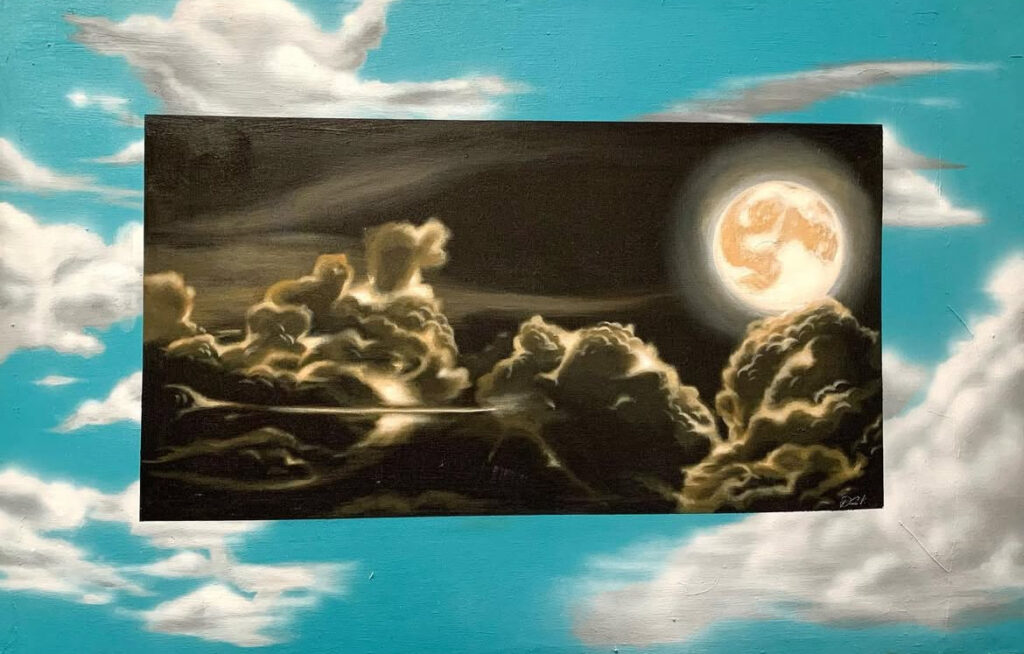
Dennis Kasagga: The approach I’m currently using to explore these energies is through sound. I’ve realised that a lot of people listen to music, which is sound, or watch movies, which combine sound and light. So at the moment, I’m merging light and sound to communicate more deeply. Initially, though, I was using different colours, blues in particular, because each shade of blue gives off a unique energy. I also use reds, greens, and yellows, which all evoke different energies. Then I began to ask, “What other forms of expression can I use?” That’s how I came to explore tactile elements through touch, binding and layering materials together.
All this is building up toward a solid project, either at the end of this year or the beginning of next year. One has to draw from different inspirations and different voices that talk about the moon. You can’t say you know everything about the moon; that’s nearly impossible.
Colour Symbolism and Emotional Language
FAB: And when someone stands before one of your pieces, what do you hope they feel? Not just see, but feel?
Dennis Kasagga: When someone stands before my work, I hope they feel the unseen energies within it, the quiet emotions, the movement, and the stillness. I want them to sense something beyond the surface, something that words can’t explain. My hope is that the work meets them where they are and lets them feel whatever truth it stirs in them.
FAB: Your art really does invite stillness, reflection, and introspection. I mean, we are in such a fast-paced world. Everybody wants things quickly; it’s smart technology here and there. So do you see your work as an act of rebellion against this constant noise?
Dennis Kasagga: Yeah, because personally, with the way I create or with the environment I work in, I always make sure it’s quiet. That’s one of the key points I rely on when I’m creating. So in a way, my work is a form of rebellion. So yes, I would say it is a rebellion.
FAB: What’s your response to voices out there—the ones saying, “Are you sure there’s even a future in what you’re doing?”
Dennis Kasagga: I hear those voices sometimes, but I don’t let them shape how I move. I believe in what I’m doing because it feels true to me. Art isn’t something I chose just for the future — it’s something that chose me. As long as I keep creating with honesty and purpose, I know the path will open in its own time.
FAB: We’re in 2025, and a major conversation is around artificial intelligence. Some say there’ll be no space for artists anymore because AI can create anything. Others argue that artists should actually start collaborating with AI. Which side of the divide do you lean toward? Are you against artificial intelligence, or how are you using it in your own craft?
Dennis Kasagga: Personally, this is me speaking, not on behalf of any artist; I see artificial intelligence as a source of knowledge. It could be used as a library for things one may not fully understand at the moment. So I personally have no problem with AI.
FAB: When you’re not creating, where do you go in Kampala or beyond to recharge yourself?
Dennis Kasagga: Personally, I’m someone who enjoys quiet environments. So I usually go to the beach or find a spot near water. I’ll just sit there for five or six hours, enjoying the oneness and silence. Then I recharge a bit and head back home or to my studio.
FAB: If the moon had a soundtrack, what three songs would you put on its playlist?
Dennis Kasagga: “Moon” by Kanye West. Then “Scared” by Joshua Baraka, a local artist. And then there’s a Drake song, You and the Six. Because personally, I feel I was raised by the moon. So those three.
FAB: How would you describe your favourite colours in three words?
Dennis Kasagga: Blues and shades of grey.
FAB: And what did those colours represent to you?
Dennis Kasagga: Blues and greys, for me, carry a sense of stillness and emotion. They represent the quiet spaces — moments of reflection, peace, and sometimes uncertainty. I use them to express what’s felt but not always seen, the kind of emotions that sit beneath the surface.
Where He Dreams to Exhibit His Work
FAB: If you could exhibit your work anywhere in the universe, real or imagined, where would it be?
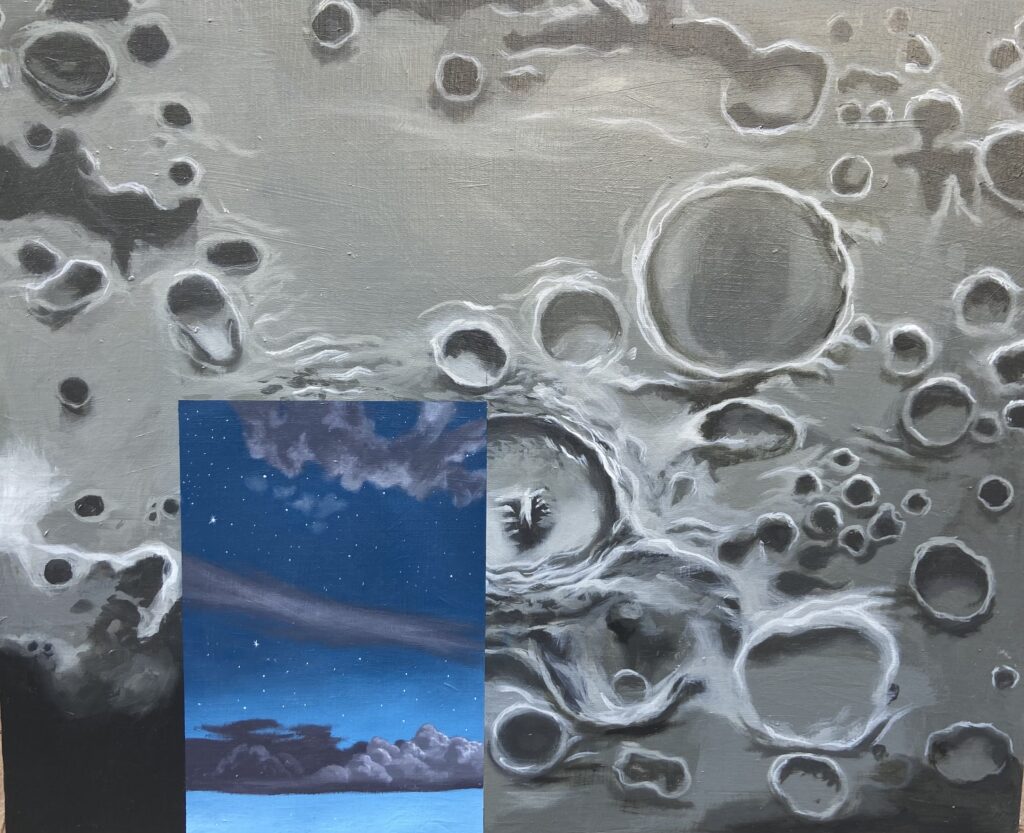
Dennis Kasagga At the moment itself, I would say maybe if I’m getting to be delulu a bit. I would take my work to the moon. Then I would also wish my art to be in a gallery of the Louvre Museum someday. Yeah, those two.
FAB: Who are your dream collaborators? I mean, visual artists, musicians, scientists, or fashion designers that you would love to work with on a celestial project, let me put it that way.
Dennis Kasagga: I would like to work with Boaz. He’s an American artist and designer.
FAB: How do you want people to remember your work a hundred years from now?
Dennis Kasagga: If someone stands before my work a hundred years from now, I hope they feel a pulse — the same quiet energy that moved through me when I created it. I want my work to remind them that art is a living thing; it keeps breathing long after we’re gone.
FAB: Finally, if you could leave our readers with one thought about our connection to the universe, what would it be?
Dennis Kasagga: We’re never separate from the universe—we’re part of its rhythm. The same energy that moves the stars moves through us. The more we slow down and listen, the more we can feel that connection.