
Ask the question in a room full of African creatives and watch what happens to the temperature. Some will tell you, with real heat, that grants have kept African creativity alive in its most fragile forms: a foundation paid for the scanning equipment that built the photography archive; a fund covered the shoot that produced the documentary; and a line item in a European cultural ministry’s annual budget funded the residency that changed their practice.
Others will tell you, with a different kind of heat, that the grant economy has quietly become one of the most distorting forces in African creative production: artists now build their practice around what funders want to hear rather than what their communities need to see; the ability to write a compelling proposal, rather than make compelling work, now shapes entire careers; and an industry has formed around teaching people how to perform need convincingly to an audience that has never lived the answer.
Both groups are right. This is the uncomfortable starting point of any honest investigation into African creativity, and most conversations about it fail because they pick a side before they have looked at the evidence.
The provocation in the headline is not rhetorical. It is the actual question facing a generation of African writers, filmmakers, designers, archivists, and visual artists, at a moment when the grant economy that has underwritten a significant share of the continent’s formal creative infrastructure is contracting, and when artists built the continent’s most commercially explosive creative successes, the ones that have genuinely changed how the world consumes African culture, almost entirely without it.
The Money That Came With Conditions
To understand what is at stake, we need to look honestly at how the grant economy in African creative and cultural production actually works, rather than how brochures describe it.
International donors, overwhelmingly based in the Global North, continue to dominate the philanthropic and development funding space that much of Africa’s formal arts and culture sector depends on. Research compiled by the African Education Research Funding Consortium found that while African institutions are frequently listed as the recipients of grants, the majority of the funding itself originates outside the continent and the decision-making power over what gets funded typically stays there too. A widely cited statistic from philanthropic research puts a specific number on the imbalance: just 5.2 percent of US foundation funding directed at Africa goes to African-led organisations directly, with the remainder flowing through international intermediaries headquartered in the donor country, organisations that researchers describe as having reach and influence but not necessarily an intimate knowledge of the communities the money is meant to serve.
What Gets Made, and What Doesn’t
This is not a minor technical detail about disbursement mechanics. It impacts, in ways that are rarely discussed openly, what kind of African creativity gets funded into existence and what kind gets quietly filtered out before it is ever made. A donor with a mandate focused on gender equity will fund the documentary about women’s economic empowerment and decline the one about something the photographer actually wants to explore. A foundation whose programme officers sit in Brussels or Washington will, consciously or not, favour proposals that translate easily into the language and metrics their own institutional reporting requires: measurable outcomes, clear beneficiary numbers, and a theory of change that fits a template designed for an entirely different kind of intervention.
Sarah Michael, the Harvard researcher whose work on local NGO power in Africa remains a foundational text on this dynamic, has argued that an arts or development sector purely dependent on donor support produces an absence of local power by definition: the capacity to set your own priorities, define your own creative agenda, and resist external direction even when you disagree with it, is precisely what disappears when your survival depends on convincing someone else, repeatedly, that your work matches their interests.
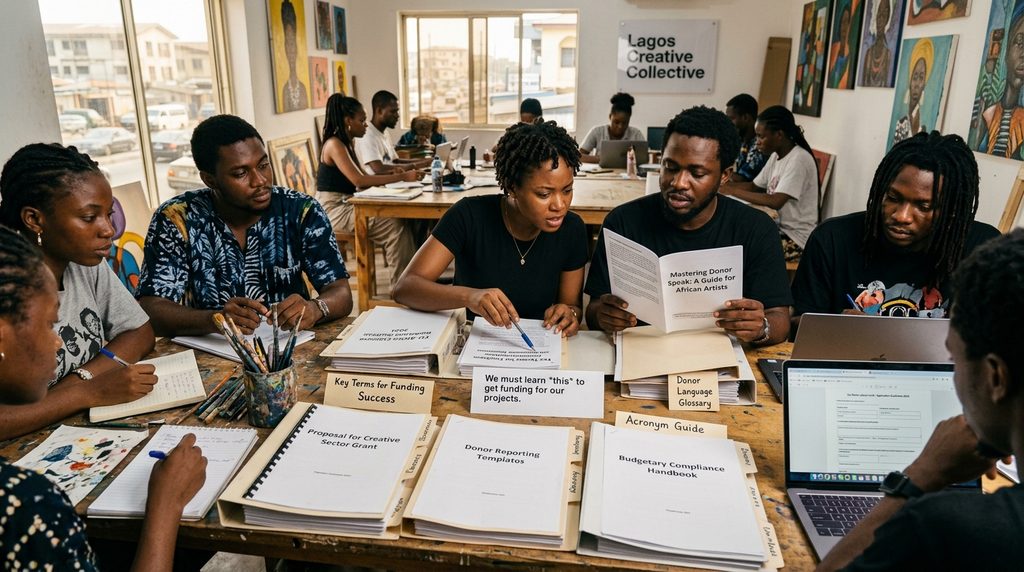
Learning to Speak Donor Language
The artists living inside this system describe it with a vocabulary that has become almost standard across interviews, panels, and private conversations: ‘grant fatigue’, ‘proposal performance’, and ‘donor language’. A photographer documenting his own neighbourhood’s architectural history learns, often within his first unsuccessful application cycle, that the foundation reviewing his work wants to hear about heritage preservation and community resilience, terms that may describe something real about the project but are not, originally, how he would have framed it to himself. He learns to speak in this register because the alternative is not making the work at all. Over years, and across a career built application by application, the donor’s vocabulary does not remain external to the work. It becomes part of how the artist understands his own practice.
What Happened When Nobody Was Funding African Creativity
Set this system against the two creative industries that have done more to change global perceptions of African creativity in the past decade than any grant-funded initiative in history, and the contrast becomes difficult to ignore..
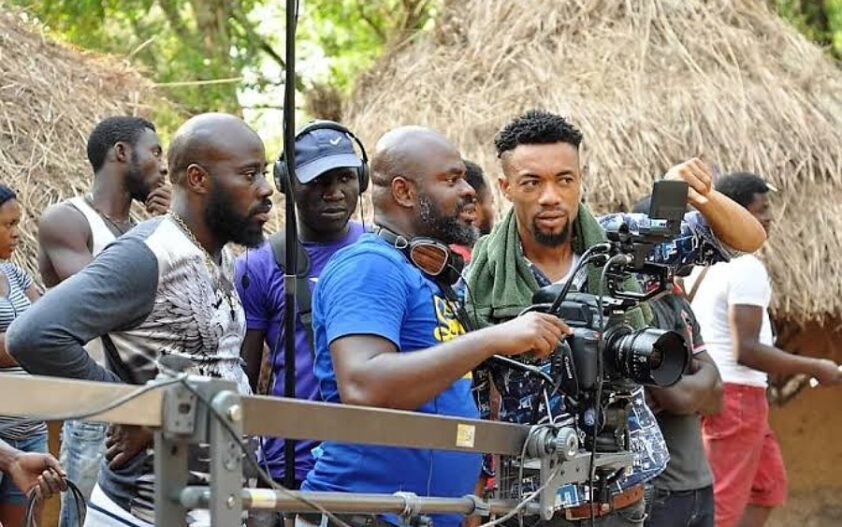
Nollywood produces more than two thousand five hundred films annually, making it the second-largest film industry in the world by output, behind only India’s Bollywood. It generates upward of six hundred million dollars a year and employs hundreds of thousands of people across production, distribution, and the informal economies that surround them.
It built this scale with almost no formal government or philanthropic support, financed instead through a combination of direct-to-video sales, cinema revenue, and increasingly, licensing and co-production deals with platforms like Netflix and Amazon Prime, who recognised an audience and a content pipeline that already existed and simply needed international distribution.
Afrobeats has become, by some measures, Nigeria’s leading export after oil, reaching listeners in more than one hundred and eighty countries, and crossing 2.2 billion streams on a single platform in 2024 alone.
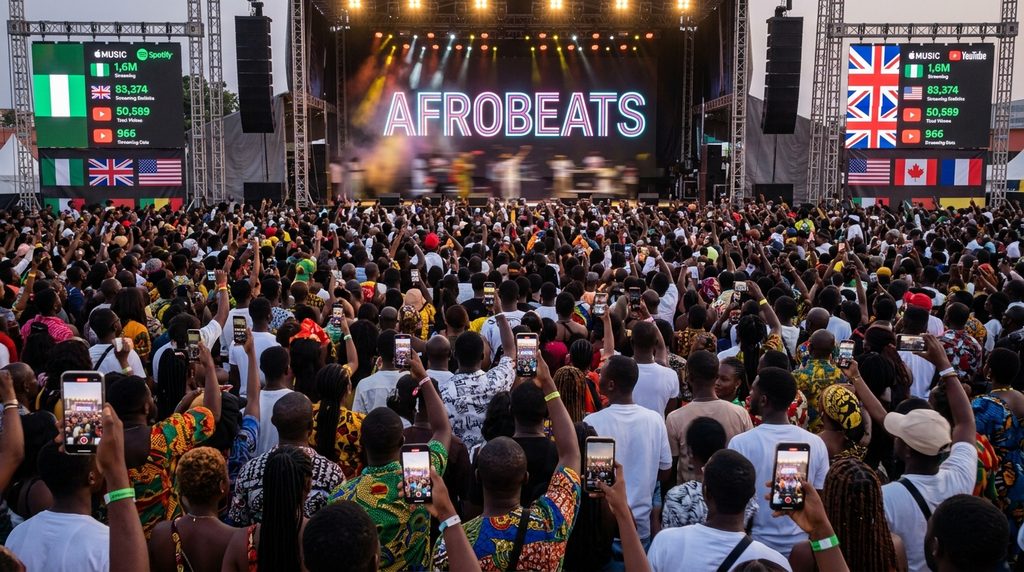
It did this through an entirely market-built infrastructure: independent labels, diaspora networks, streaming economics, and an audience that found the music and carried it forward without a single foundation grant cycle determining which artist’s sound was worth amplifying.
The Funding Gap Nobody Can Justify
The journalist covering this paradox for one Nigerian outlet put the contradiction in terms that deserve to be quoted directly for their precision: with almost no formal support, the sector has taken Afrobeats global, made Nollywood a cultural export, and built a thriving ecosystem of digital creators, and the entire federal allocation to creative industries in recent years has often come in below five billion naira annually, less than what a single mid-range Hollywood film spends on costumes.
The implied question sits at the centre of this investigation. If the two largest, most globally significant African creativity industries grew to this scale almost entirely without grants, what does that suggest about the relationship between formal funding and the kind of creativity that actually travels?
The honest answer is not that grants are unnecessary. It is that grants and markets reward different things, and the difference matters enormously for what gets made.
What the Market Cannot Fund
Markets are extraordinarily good at scaling work that already has a clear audience willing to pay for it. Nollywood succeeded because Nigerian and diaspora audiences wanted Nigerian stories and were willing to spend money to see them, first on pirated VHS tapes and home videos, and later on cinema tickets and streaming subscriptions.
Afrobeats succeeded because the music was genuinely excellent and an audience existed, both at home and across a vast diaspora, hungry for it. The market did not have to be persuaded that African stories and African sound were worth attention. It simply had to be given access to them.
The Work With No Natural Buyer
This model breaks down completely for African creativity that does not yet have a paying audience, work that is experimental, work that documents something nobody has decided is commercially interesting yet, and work that exists primarily to preserve, to question, or to push against the aesthetic and political assumptions a market has already settled into.
The archivist building a visual record of a disappearing photographic tradition is not serving a market. The painter working through a formally difficult, uncomfortable body of work that resists easy commercial categorisation is not serving a market, at least not yet, and possibly not ever.
The poet, the experimental filmmaker, and the textile researcher documenting indigo dyeing traditions before the people who hold that knowledge pass it on or do not: none of this work has a natural buyer in the way a Nollywood film or an Afrobeats single does.
Where the Foundations Come From
This is precisely the work that grants, at their best, exist to support. The case for grant funding in African creative production is not, in its strongest form, an argument that the market is insufficient at everything. It is an argument that markets systematically underfund the kind of work that builds the cultural and intellectual infrastructure from which future commercially successful work eventually draws.
Nollywood’s storytelling conventions, Afrobeats’ sonic palette, and the visual languages that contemporary African fashion and art now deploy with such confidence on global stages: none of these emerged from nothing.
They drew, in ways not always acknowledged, on decades of archival, experimental, and frequently uncommercial work that someone, somewhere, found a way to fund and sustain.
The question, then, is not whether grants matter. It is whether the grant economy as currently structured is actually funding that foundational work well, or whether it has become something else: a parallel economy with its own gatekeepers, its own fluencies, and its own distortions, that does not reliably serve the purpose it claims to.
The Gatekeeping Nobody Names in African Creativity
The uncomfortable finding across multiple independent studies of African civil society and cultural funding is that the grant system, far from democratising access to African creativity, frequently concentrates it among a small number of repeat recipients. Research compiled through interviews with fifty six civil society representatives across Ethiopia, Ghana, Kenya, Nigeria, and South Africa found a structural pattern repeating across very different national contexts: large grants flow disproportionately to institutions with pre-established reputations and the administrative capacity to manage complex reporting requirements, capacities that are themselves products of prior funding and institutional access. The artist or small organisation without a track record of successfully managed grants, without staff capable of producing the financial reporting a major foundation requires, without an existing relationship with a programme officer who can vouch for them informally before a formal review, is structurally disadvantaged in ways that have nothing to do with the quality of their creative work.
This produces a recognisable caste system within African creative funding, rarely named as such but visible to anyone who has spent time inside it. A small number of organisations and individuals become what insiders call the ‘usual suspects’: repeat grantees who have learnt the language, built the relationships, and developed the institutional muscle to win successive funding cycles. Everyone else, including artists doing work of comparable or superior quality, competes for a shrinking pool of opportunity that was never evenly distributed in the first place. The system rewards grant literacy as much as, and sometimes more than, it rewards creative merit. An entire informal economy of consultants and workshops has emerged specifically to teach African creatives and organisations how to write proposals that funders want to read, a skill set that is genuinely valuable and entirely separate from the skill of making the work the proposal describes.
Who Gets to Set the Agenda
There is a deeper critique embedded in this pattern that the sector has been slow to confront directly. When research agendas, creative priorities, and the criteria for what counts as worthwhile cultural work are set predominantly by funders headquartered outside the continent, the work that gets produced reflects, however unconsciously, what those funders already believe is important. African researchers and creatives are frequently relegated to roles described, in one analysis, as data collection or local consulting, while the leadership, framing, and authorship of the larger narrative the funded work serves remains elsewhere.
This is not a conspiracy. It is a structural consequence of where the money originates and who controls its allocation. But the effect, compounded across decades and thousands of individual funding decisions, has been to shape a meaningful share of Africa’s formally documented creative and cultural output around the interests, however well intentioned, of people who do not live inside the cultures being documented.
Recommended For You
What Happens When the Money Leaves
The fragility of this entire arrangement became clear in 2025. The United States moved to dismantle USAID that year. This immediately disrupted funding flows. For decades, those flows had supported a significant portion of Africa’s development and cultural funding ecosystem. Some organisations had built their entire operating models around continued international support. Within months, several of them found themselves unable to function.
The response from within African civil society and cultural sectors has split, broadly, into two camps. The disagreement between them is telling. It is the clearest evidence available that one question remains unsettled. Can African creativity survive without grants? Even the people most affected by it do not agree on the answer.
Two Camps, One Crisis
One camp argues for localisation. This means a deliberate shift away from foreign donors. It means building sustainable funding controlled within Africa itself. This funding can come from domestic philanthropy, government investment, and private sector engagement with the creative economy. Proponents argue that financial independence is the only path to true creative and intellectual independence for African creativity. They believe something important about accountability. Artists who answer to local stakeholders will produce better work. This work will genuinely reflect local priorities. Distant programme officers cannot offer that same connection. Their oversight tends to import priorities rather than reflect local ones.
Proponents acknowledge a real difficulty here. Many African governments lack the regulatory and tax frameworks that encourage robust local philanthropy. At the same time, the private sector’s appetite for funding culture remains underdeveloped across much of the continent. Sport attracts far more private investment than culture does.
The other camp is more pragmatic than ideological. They see the disruption of international funding as a crisis to manage, not an opportunity to celebrate. Without a transition plan, the continent’s current domestic funding capacity will struggle. It will fail to sustain organisations doing genuinely important work. This includes work that has no plausible commercial market.
For this camp, the real question is different. Almost nobody believes dependency is healthy. The actual question is whether withdrawing it too soon counts as progress. Or does it simply amount to abandonment, if no alternative exists yet?
The Honest Answer
The most rigorous answer to this investigation’s question is neither triumphant nor alarmed. It is not simply ‘Yes, look at Afrobeats.’ It is not simply ‘No, the funding cliff will end everything’ either. The real answer is less satisfying but more accurate. African creativity has already proven something important. It can build commercially self-sustaining global industries without grants. This happens when the work has a natural audience willing to pay for it.
African creativity has not yet demonstrated something else, though. It has not shown that foundational, archival, experimental, and uncommercial work can survive without grants. This is work that lacks a natural paying audience. Arguably, it has not even been given a fair chance to prove this. The current grant economy remains the only structure sustaining this work at scale. That structure includes donor agendas and gatekeeping distortions.
This means the real provocation is not whether grants should exist. The real question is different. Is the current grant economy actually the best mechanism for sustaining the work it claims to protect? Access concentrates among institutions fluent in donor language. The system imports external priorities into local creative decisions. It also remains vulnerable to the political whims of foreign governments. Those governments can withdraw funding as quickly as the United States withdrew USAID’s funding in 2025.
Building What Comes Next
A genuinely honest reckoning with this question would require something specific. African creative communities must build domestic funding infrastructure. The grant economy has rarely incentivised them to do this. Diaspora investment is one part of the answer. Royalty and rights infrastructure is another. This keeps more value from Afrobeats and Nollywood circulating on the continent rather than offshore. Cultural philanthropy matters too. A growing class of African business leaders has, so far, directed most of their giving elsewhere. None of this is easy. All of it is more within reach than the sector’s persistent dependency narrative tends to suggest.
The artists who built Nollywood and Afrobeats did not wait for permission, or for a grant cycle, or for a foundation in another country to decide their work was fundable. They built an audience, and the audience paid, and the industries grew from there. Some artists do harder, less commercially obvious work. These include archivists, experimentalists, and documentarians of things that have not yet found their market. They deserve better infrastructure should not have to make the same bet against the same odds. They should not have to spend a third of their creative energy learning a language that was never their own. Survival should not depend on that.
Whether that infrastructure gets built remains an open question. African governments could build it. Their capital could build it. African cultural institutions could build it too, if they are willing to fund work without requiring it to first justify itself in someone else’s terms.
It will determine the answer to this investigation’s question far more than any single grant cycle, donor pivot, or funding crisis ever could. The talent has already answered for itself. African creativity has already proven what it can build. The infrastructure has not yet caught up.