




You said yes this morning before you finished hearing the question. You said yes last Tuesday when every cell in your body said no. You have been saying “yes” for so long that you have forgotten what your own “no” even feels like. Does that sound familiar?
I said yes to my boss to help him with a project after hours when I knew I had to go home and be with my kids. I said yes to meet my friends when I felt exhausted and needed time alone. I said yes to the school committee knowing it would completely derail my work schedule. I didn’t say yes because I wanted to. I said yes because somewhere along the way, saying no started to feel like a threat. I thought saying yes would make me a better person. But what I never stopped to ask is, what is saying yes actually costing me?
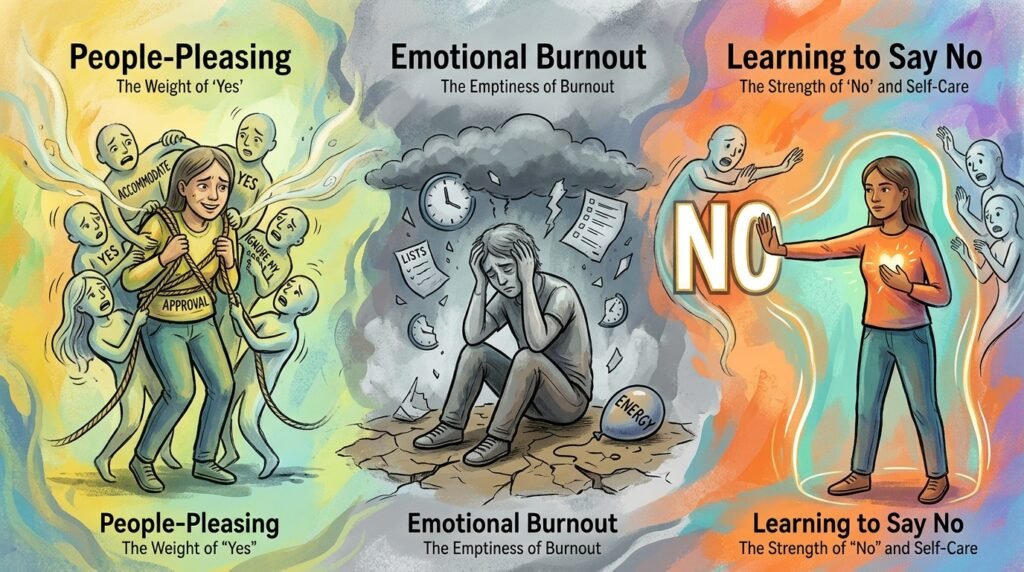
The Hidden Costs of People-Pleasing
The energy tax. Research on emotional labour shows that managing others’ comfort while suppressing your own needs is one of the most depleting things a human nervous system can perform, because the conflict between what you feel and what you show is exhausting to sustain.
The identity tax. People-pleasing comes down to three things: feeling responsible for everyone else’s problems, putting yourself on the back burner, and constantly scanning for what others expect from you. Over years of organising our lives around these three patterns, we lose track of what we actually want, value, and feel. Our identity becomes defined entirely by how useful we are.
The joy tax. Resentment, the slow-burning cost of saying yes to everyone except yourself. But where did this come from? This is precisely what most people-pleasing advice fails to address.
Why Saying Yes Feels Safer Than Saying No
Known in psychology as the fawn response, it means your nervous system learned that the safest way to survive was to keep everyone else calm, especially if you grew up somewhere unpredictable. In adulthood it looks like chronic people-pleasing. Not a choice. A survival strategy your body built before you had words for it.
How does this show up? I saw it when I stayed silent at a school parents’ meeting because I didn’t want to be the “complaining immigrant mum”. When I found myself apologising for everything in the office, for simply existing. When I worked overtime managing everyone’s mood at home just to avoid conflict. Have you ever felt a tightness in your chest the moment you say yes to something? That is the fawn response speaking.
Studies reveal that the roots of people-pleasing run deep, often starting in preschool, when girls are taught to be obedient rather than bold. But you were not born with this. It is a habit you learnt along the way, and the beautiful thing about learnt habits is that you have the power to unlearn them. So what does unlearning actually look like?
The Moment I Realised I Had Forgotten Myself
For me, saying no was not part of who I believed I was. Saying yes meant being accepted, valued, and needed. The day it hit me hardest was a Tuesday after work when I had said yes to attending an event with a dear friend. My weekend had been chaotic as both my children, aged eight and five, had been sick. I hadn’t slept properly in days. My body and mind were running on empty, but I had made a commitment and I was going to keep it. I was so determined to hold onto this friendship, because as an immigrant in Austria, good friendships are not easy to find. I needed to feel accepted. To belong.
When I arrived home late that evening, I asked myself, “Ceri, did you show up for yourself today or for others? And did this benefit you in any way?” Both answers were no. That moment and so many others like it are exactly where the Phoenix Rising Programme was born. It was built from the rubble of a woman who had been saying yes to everyone else’s life for so long that she had forgotten what her own looked like.
The First ‘No’ Is the Most Important One You Will Ever Say
The first step of the Phoenix Rising Programme is Reconnect, learning to listen inward before acting outward. Here are three ways to begin:
1. Notice the body before the mouth moves.
Your body reacts before you speak. The fawn response fires automatically, pushing out a yes before your mind has even processed the request. Practise the pause. One single breath before you answer. You don’t have to say no yet. Just listen first. Ask yourself: is this a genuine yes, or am I just avoiding a ‘no’?
2. Audit the resentment.
Resentment is useful data. Ask yourself who you feel quietly angry at and you will find the exact people you say yes to most automatically. That anger is not a flaw. It is a late invoice for the boundaries you forgot to set.
3. Practise the soft no.
Not the aggressive, boundary-enforcing ‘no’ of self-help mythology. Just a quiet, complete sentence: “I can’t take that on right now.” No explanation. No apology. Just a simple truth that puts your needs in the room alongside everyone else’s.
What Happens When You Stop Paying
Saying my first real ‘no’ felt unexpectedly calm. My body wasn’t bracing for disaster. I wasn’t questioning myself or drowning in guilt. I felt something I hadn’t expected: ease. And then I felt something even more surprising. Power. Because I had forgotten I actually had a choice.
The next time I was invited somewhere and felt uncertain, I said, “Thank you so much for thinking of me; let me check and get back to you.” When the day came and I couldn’t make it, I simply said, “Thank you for the invite, but I can’t make it this time. I hope you have an amazing time.” That was it. No catastrophe. No lost friendship. Just a woman, finally telling the truth.
I have come to understand that the most generous thing any of us can ever do is stop abandoning ourselves for the comfort of others.
This is my challenge to you.
This week, pause before you speak. Let a single breath divide your impulse from your answer. In that quiet second, strip away the noise and ask yourself the raw, honest question: am I saying yes out of genuine desire or out of a debt I never agreed to carry? The no that terrifies you is the yes to yourself you have been waiting for. You are not broken. You are becoming. And only the woman who dares will rise.
If this resonated, the Phoenix Awakening Programme was built for the woman who is ready to stop paying. Find out more at www.cerisamvilian.com

Ceri Samvilian is an identity reconstruction coach, keynote speaker, and founder of the Phoenix Rising Programme, a transformational coaching experience for women ready to rebuild their confidence and reclaim their identity after life’s biggest transitions.