


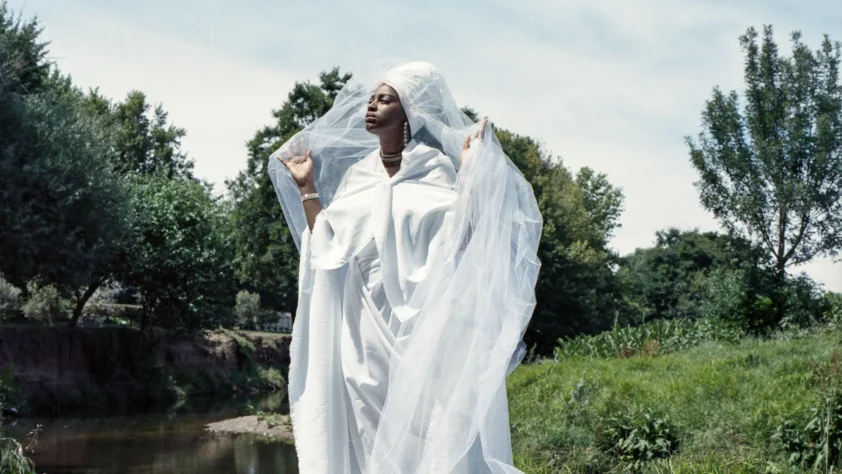
In a converted space in Johannesburg’s inner city, Thebe Magugu has been building something that resists easy description. His collections reference apartheid-era spies, Tswana cultural heritage, South African gender violence statistics, and the specific textures of Kimberley, the township suburb whose name translates as “make yourself pretty”. He is the first African-born designer to win the LVMH Prize. He has dressed Rihanna, Lupita Nyong’o, Iman, and Ivy Getty. His work is held at the Metropolitan Museum of Art. This is African Fashion.
Ask him what kind of designer he is, and he will tell you: a South African one. Specifically, a designer from Johannesburg, from a women-only home, from a suburb called Ipopeng. His creative references are dense and particular. They are not, he has said explicitly, reducible to a continent.
In Vienna, where he was born and trained before establishing his eponymous Lagos label, Kenneth Ize builds luxury suiting from aso-oke, a handwoven Yoruba textile with a specific history, a specific geography, and specific artisan communities whose skills and livelihoods are part of what he is working to sustain. He is, in the sharpest sense, a Yoruba designer working in a Viennese mode. He is a Lagos designer in conversation with European tailoring. He is, depending on who is asking, many things. The one thing he is probably not, and has rarely described himself as being, is an African designer in the generic sense the fashion press has long preferred.
Both men are grouped, by editors, critics, exhibition curators, and global media, under the same two-word umbrella. It is an umbrella that covers every designer working on a continent of fifty-four countries, over three thousand distinct ethnic groups, and creative traditions whose geographic and cultural differences are, in many cases, more significant than the differences between any two European national fashion traditions ever described as separate things. No editor has yet written a round-up of “European fashion.” The category would be considered too imprecise to be useful. It has never occurred to anyone that all European designers should be filed together as a creative bloc.
The term “African fashion” has been considered useful for decades. The question this article sets out to ask is whether that usefulness is reaching its end, and what the consequences might be when it does.
Where the Term Came From
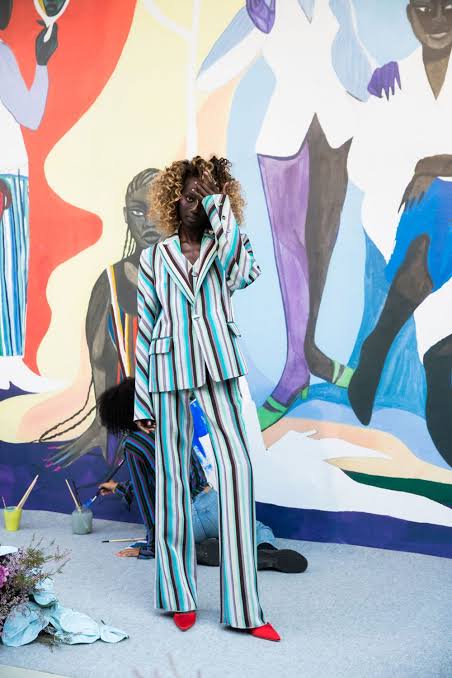
Categories in fashion, as in most cultural fields, do not emerge from neutral observation. They are created, usually by people with power in the system, to organise something that would otherwise resist organisation. The category of “African fashion” did not emerge from inside the continent’s creative communities as a description of how they understood their own practice. It emerged from outside, as a way of making a vast, varied, and largely unfamiliar body of work legible to editors, buyers, and cultural institutions operating primarily in New York, London, Paris, and Milan.
The parallel with “world music” is not an accident. When the music industry created the “world music” category in the late nineteen-eighties, it did so explicitly to shelve everything that did not fit the existing genre categories, which were, without exception, organised around Western popular forms. World music was not a description of what the music was. It was a description of what it was not. It was not rock, not pop, not jazz, not classical. It was everything else, filed together under a term that made its own bias legible to anyone paying attention: music that came from the world outside the world the category-maker inhabited.
African fashion operates the same logic. It is not Parisian fashion. It is not Italian fashion. It is not the fashion of a city or a country or a tradition specific enough to have a name a Western editor would be comfortable using in a headline. It is the fashion that comes from everywhere else on the continent, grouped by geography rather than by aesthetic affinity, creative tradition, or any other criterion that actually organises design practice into meaningful categories.
This matters because categories are not passive containers. They shape what they describe. An editor who reviews “African fashion” is not reviewing fifty-four national fashion traditions individually. She is reviewing a blur, filtered through whatever preconceptions the category carries, and the preconceptions the term “African fashion” carries in the European and American press have included, over decades and with remarkable consistency, a set of assumptions about what African design looks like, what materials it uses, what cultural references it draws on, and what its relationship to Western fashion should be. Kente cloth. Ankara prints. Beading. Bright colour. Rich texture. These are real and beautiful elements of specific African design traditions. They are not a complete description of what designers across the continent make, and they have functioned, under the umbrella of “African fashion,” as both a template and a constraint.
The Label and the Limitation
The constraint operates in two directions simultaneously, and understanding both is essential to understanding why the term has grown increasingly uncomfortable for many of the designers it purports to describe.
In one direction, it limits what designers can make and still be recognised as making “African fashion.” The designer whose work is not visually coded with easily legible African reference, whose collection is in a muted palette without obvious textile heritage, whose silhouette is architectural rather than draped, whose references are as likely to be Japanese cinema as West African weaving, risks being described as not quite African enough. The creative penalty for this is invisible until it is not: the exhibition that chooses more recognisably coded work, the editorial that selects the image with the brighter print, the buyer who is looking for what they already expect African fashion to offer. The designer who resists the visual grammar of the category does not simply escape categorisation. They fall out of the story.
In the other direction, the label limits what the broader fashion world permits itself to notice in African work. If the defining quality of “African fashion” is its relationship to African cultural heritage and textile tradition, then a designer using those references is doing exactly what the category predicts. The work confirms the category. It is legible, familiar, reassuringly what it was expected to be. The innovation inside it, the particular intelligence brought to the reinterpretation, the specific formal decisions, the argument the collection is making in relation to both the tradition it draws on and the broader fashion canon it enters, all of this can be obscured by the category’s gravitational pull toward the expected.
Thebe Magugu’s early curriculum at what was then LISOF in Johannesburg was, by his own account, heavily Western, focused on the fashion capitals and the designers who came from them. As the curriculum evolved, a conversation about decolonisation developed. He started looking at South African designers. He became, as he has put it, a very observational designer who responds to what is in the air. His collections have addressed apartheid-era espionage, gender-based violence, South Africa’s complex tribal heritage, and the experience of Black womanhood across several generations of his own family. His work is deeply, specifically South African. It is also, clearly, global, in the sense that it participates in and contributes to conversations that fashion is having everywhere about identity, history, politics, and what clothing is allowed to do. His identity as an African designer, applied from outside as a category rather than claimed from inside as a description, does not illuminate any of this. It partially obscures it by suggesting that the primary frame through which his work should be understood is geographic.
Recommended For You
What Specificity Reveals
The LVMH Prize, which has had consistent and significant representation from designers of African origin across its recent editions, illustrates the tension with unusual clarity. Since Thebe Magugu’s win in 2019, the roster has included Sindiso Khumalo from Cape Town, Lukhanyo Mdingi from South Africa, Adeju Thompson’s Lagos Space Programme, Idris Balogun and Tokyo James from Nigeria, Tolu Coker and Torishéju Dumi from the British-Nigerian diaspora, Yasmin Mansour from Egypt, and David Kusi Boye-Doe from Ghana.
Consider these designers as an “African fashion” cohort, and the category’s inadequacy is immediately visible. Tolu Coker’s work draws on Yoruba spirituality, Aladura church garments, and Louisiana ritual wear. Torishéju Dumi’s precision tailoring found its way to the Metropolitan Museum of Art’s Sleeping Beauties exhibition. The Lagos Space Programme operates at the intersection of gender-fluid design, contemporary Lagos urbanism, and a specific kind of intellectual provocation rooted in queer African experience. Yasmin Mansour is working within Egyptian and Middle Eastern design traditions that have almost nothing in common, aesthetically or historically, with the West African textile heritage that many readers picture when they see the words “African fashion.”
None of this is to say these designers are not African. They are. The point is that African is the least interesting and the least precise thing you can say about any of them, and that the category “African fashion” performs a particular kind of erasure every time it is deployed as though it were a meaningful description of what unites this body of work. What unites it is geographical origin. What differentiates it, when you look closely, is everything else: the specific traditions, the specific cities, the specific cultural conversations, the specific formal preoccupations that make each of these practices distinct from one another and distinct from the assumptions the category carried when it was coined.
The fashion press has begun, haltingly, to notice this. A Twyg publication analysis of 2026 fashion trends stated it with a directness that would have been unusual a decade earlier: there is no belief in one African production system, but rather a multiplicity of nodes across the continent, each doing what they excel at, each presenting collections that reflect a plurality of African cultures. The plural noun is doing significant work in that sentence. It is acknowledging, if not yet fully reckoning with, the fact that the singular has always been the problem.
The Political Case for Keeping It
The argument for preserving the term is not negligible, and it is made by people with direct experience of the alternative.
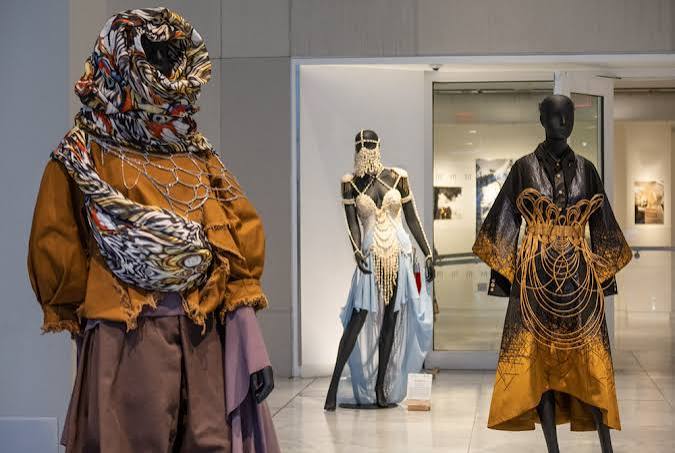
“African fashion” as a category has political and commercial utility that “Johannesburg fashion” or “Lagos fashion” does not straightforwardly replicate. It creates a grouping visible enough to demand institutional attention, to fill an exhibition, to justify a magazine supplement, and to make a claim on the fashion calendar that individual national industries, lacking the critical mass to command that attention alone, might not easily sustain. The FIT exhibition Africa’s Fashion Diaspora required a frame large enough to hold sixty designers from across the continent and the diaspora in productive conversation. That frame was, in part, the shared identity the label provides.
There is also a question of solidarity. The designers who have succeeded under the “African fashion” umbrella have, to varying degrees, benefited from being part of a visible cohort, a group whose collective presence made a claim the industry found harder to dismiss than any single voice alone. Kenneth Ize dressing Naomi Campbell and Thebe Magugu winning the LVMH Prize in the same year was a more significant event, in terms of what it communicated to the fashion world about African creative capacity, than either achievement would have been in isolation. The category held them together long enough to be seen.
The Fashionista analysis of African fashion’s global expansion in early 2026 noted, carefully, that the concern driving organisations like the Fashion Law Africa Summit is not the proliferation of the label but the protection of what the label contains: the intellectual property, the textile heritage, the cultural identity, and the right of designers to benefit from their own creative output rather than having it absorbed and sold back to them through a value chain they did not control. That concern is real, and the protection it requires is structural. Dismantling the category without dismantling the conditions that made it necessary does not advance the cause.
The Term After the Term
The death of “African fashion” as a useful category is not, most likely, going to be an event. It will be an erosion. The designers working at the highest levels of the global industry are increasingly insisting, in their work and in how they discuss it, on the specificity that the label smooths over. Thebe Magugu returns, collection after collection, to Johannesburg, to Tswana culture, to the women who raised him, and to stories that are rooted in a geography precise enough to have a street address. Tolu Coker builds collections around Yoruba spirituality with enough specificity that the reference is not decoration but argument. Lagos Space Programme uses Lagos, not Africa, as its operating context, and the city’s particular urban texture, its social pressures and its specific negotiations with gender and sexuality and modernity, is not interchangeable with the context of any other city on any other continent.
What is emerging, slowly, is a fashion world capable of discussing individual African design traditions with some of the particularity it has long applied to European ones. Lagos fashion. Johannesburg fashion. Nairobi fashion. Dakar fashion. These cities have distinct creative scenes, distinct textile industries, distinct relationships to global fashion capital, and distinct bodies of critical writing and curatorial attention beginning to document them on their own terms. The geography is becoming granular. The categories are becoming more accurate.
This will produce, in time, a situation where “African fashion” is no longer sufficient as a description for anything but the most general, introductory purposes, in the same way that “European fashion” would be insufficient as a description of the differences between a Milanese tailor and a Parisian couturier and a London streetwear brand. The continent’s creative complexity has always exceeded the category. The category is simply catching up to what was already there.
What Gets Lost, What Survives
Some things will be lost when the term loses its utility, and they are worth naming honestly.
The solidarity that came from shared visibility. The critical mass that made institutional attention possible. The sense of a collective project, fragile but real, in which designers from Accra and Cape Town and Nairobi and Lagos were understood to be participants in a shared endeavour, even if that endeavour was partly a fiction imposed from outside rather than chosen from within.
What survives is more interesting, because it is more true. The specific creative traditions that the term was too broad to illuminate. The distinct cities that were flattened into a continent. The individual practices that deserved, and are beginning to receive, the precision that serious engagement with any creative tradition requires. The designers who were always more than the label assigned to them.
And perhaps the most important thing that survives the death of the category: the question the category was always, at its most useful, trying to answer. How do you make room, inside a global fashion industry built around specific European capitals and their histories, for creative intelligence that comes from everywhere else? That question does not disappear when the answer changes. It just becomes more interesting, because it is finally being asked at the level of detail it always deserved.
The term will not die a single death. It will become gradually less adequate, season by season, collection by collection, as the designers it has been applied to continue to insist on being seen for what they actually are. Which is, in every case, worth paying attention to, something considerably more specific than African.