
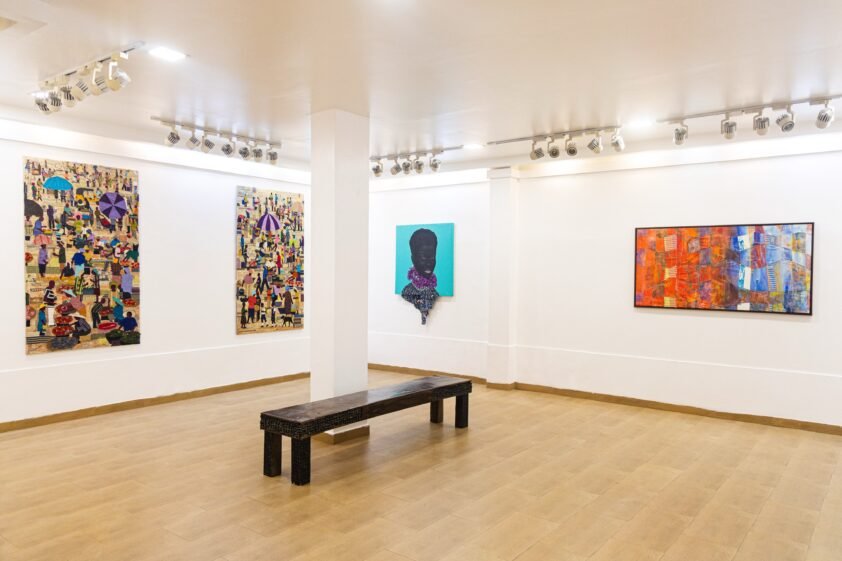
What does it mean to inherit something you cannot hold? A name. A gesture. A story told by a grandmother. A fabric saved long after its original purpose has disappeared. A spiritual belief that survives even when the people who first carried it are gone. These questions sit at the centre of Cosmic Inheritance, a group exhibition at Affinity Gallery that brought together five contemporary African artists whose practices examine how identity, memory, spirituality, and cultural knowledge travel through generations.
Featuring Tejumola Adenuga, Nola Ayoola, Mahari Chabwera, Reggie Khumalo, and Pelumi Ponmile, the exhibition opened in Lagos on 21 June 2026. Through painting, beadwork, portraiture, weaving, and textile collage, the artists offered different interpretations of inheritance while arriving at a similar idea: what we receive from those before us does not simply remain in the past. It continues to shape who we become.
Rather than treating inheritance as something confined to family trees or historical records, Cosmic Inheritance presents it as something living. It can be found in materials, rituals, movements, beliefs, memories, and the everyday ways people understand themselves. The exhibition is also a reflection of contemporary African art itself, a field increasingly concerned with questions of belonging and identity while refusing to separate the personal from the historical.
Beyond What We Can See
Walking through the exhibition is an encounter with different forms of memory. For Nola Ayoola, memory takes shape through layered surfaces and figures. The Lagos and New York-based interdisciplinary artist works across painting, portraiture, sculpture, and immersive environments, drawing from Yoruba symbolism and personal experience to explore womanhood, displacement, transformation, and belonging. Her practice is tactile. Weaving, collage, hand printing, and painting become ways of translating experiences that are often difficult to describe directly. The result is work that asks viewers to consider memory not simply as something remembered, but as something embodied.
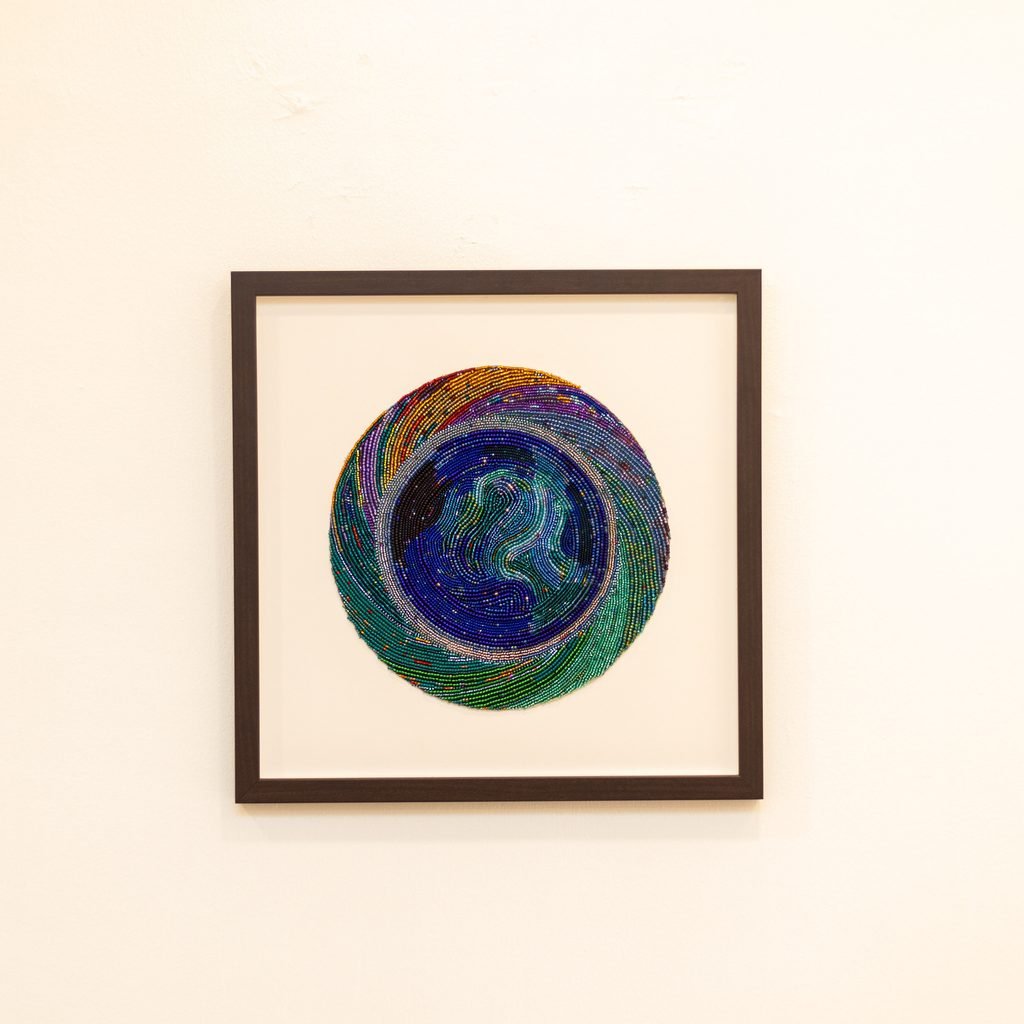
Mahari Chabwera approaches inheritance through another language. The Zimbabwean-American visual artist uses glass seed beads, tempered glass, fabric, and shells to create tapestry paintings that explore meditation, energy, and self-mythologisation. Light becomes an important part of the experience, allowing her materials to shift between delicacy and intensity.
Her work suggests that inheritance can also be spiritual. It can exist in the unseen forces, beliefs, and inner knowledge that move from one generation to another without necessarily being documented.
For Tejumola Adenuga, absence can be just as powerful as presence. The Nigerian artist and designer, who works between Lagos and London, creates minimalist figurative works from found imagery. By reducing images to their essential forms, he creates space for viewers to consider what is missing as much as what remains. His practice is rooted in memory and storytelling, but it also reflects the fragmented nature of contemporary life. Images travel quickly. People move. Places change. Memories are edited and reconstructed. What remains becomes significant.
Materials Remember Too
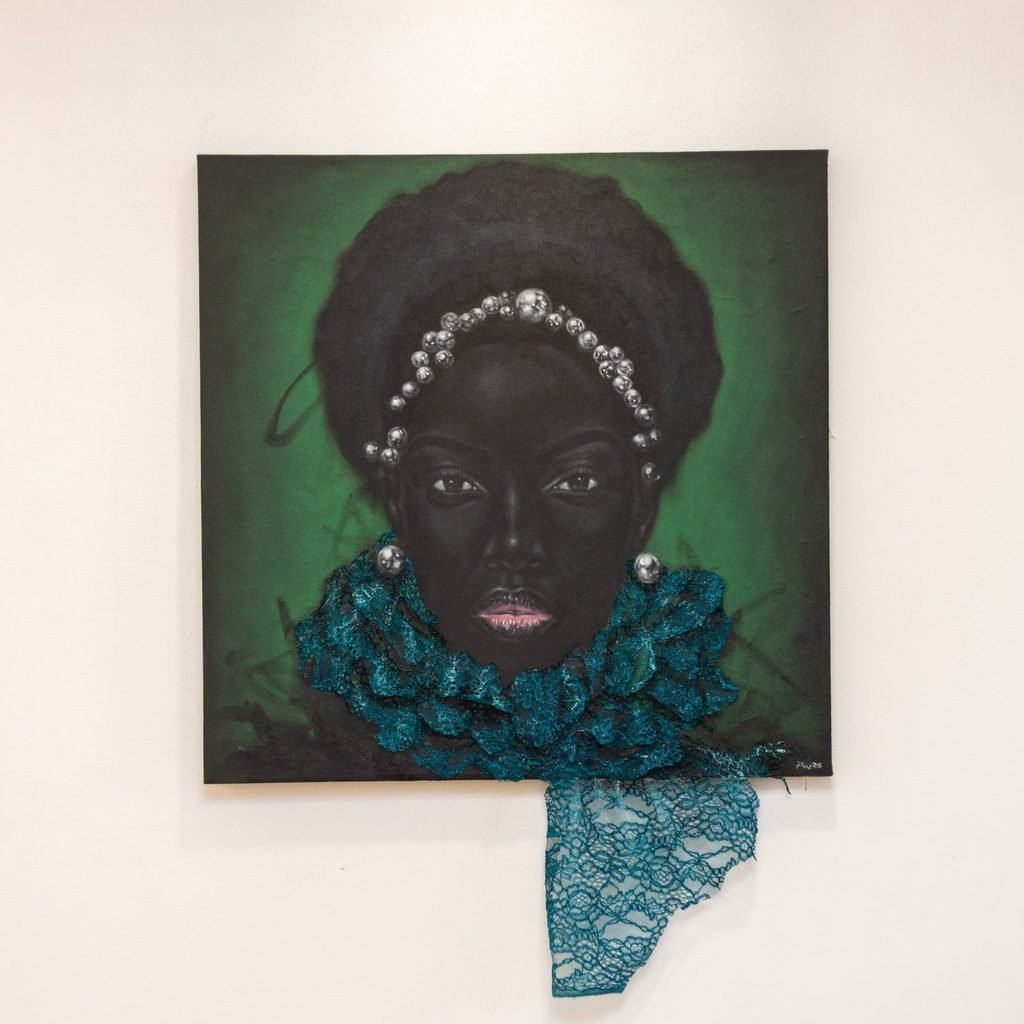
Perhaps nowhere is the idea of inheritance more physically visible than in the work of Pelumi Ponmile. The Nigerian artist works with reclaimed textiles, particularly aso òkè and aso òfì, materials deeply connected to Yoruba culture and social life. Fabrics that might otherwise be discarded are transformed into layered compositions and portraits.
Here, material becomes memory. A piece of fabric can carry a history of where it came from, who wore it, when it was used, and what it represented. By bringing these materials into contemporary art, Ponmile gives them another life while preserving their connection to the past. His practice also introduces questions of sustainability and renewal. Something considered finished is not necessarily without value. It can be reworked, reinterpreted, and made meaningful again. That idea runs quietly through Cosmic Inheritance. The past is not presented as something frozen. It is material that can be carried forward.
Reggie Khumalo and the Journey Across Africa
Reggie Khumalo approaches these questions through portraiture and the human figure. The self-taught South African artist has spent years travelling across the African continent, including a four-year motorbike journey from Cape Town to Cairo. Those experiences have informed a practice concerned with identity, belonging, empowerment, and the spirit of Ubuntu.
His paintings are bold and expressive. They celebrate people with an emphasis on dignity and humanity, while reflecting the diversity of experiences that exist across the continent. Khumalo’s work adds another dimension to the exhibition’s central question. If inheritance impacts identity, identity is not necessarily restricted by geography. It can expand through movement, encounter, and shared experience. His travels across Africa become part of that conversation.
5 Artists, One Larger Question
What makes Cosmic Inheritance compelling is not that the five artists approach the subject in the same way. They do not. Their materials,histories and methods differ. What connects them is the understanding that identity is accumulated. It is built from things we remember and things we inherit without knowing we have inherited them. It can be carried in language, clothing, religion, family stories, images, landscapes, objects, and even in the ways we make things with our hands. The exhibition therefore feels particularly relevant to a generation of Africans living between places.
Across the continent and its diaspora, migration has created increasingly complex relationships with home. Lagos connects to London. Johannesburg connects to New York. Harare connects to cities and communities far beyond Zimbabwe. People leave, return, adapt, and begin again. Yet distance does not necessarily erase connection. Sometimes, it makes the question of where we come from more urgent.
Why Cosmic Inheritance Matters to Contemporary African Art
Affinity Gallery’s presentation of Cosmic Inheritance also reflects the gallery’s broader commitment to contemporary African art and to artists who are contributing to the ongoing story of the continent. The gallery positions African artists not simply as custodians of history, but as active participants in driving how Africa is understood today.
African contemporary art is no longer being discussed only through the language of heritage. Increasingly, artists are using inherited materials, symbols, and histories to ask new questions about modern life. Cosmic Inheritance belongs to that conversation. The artists are not asking audiences to return to the past. They are asking what happens when the past arrives with us in the present.
What We Choose to Carry Forward
There is something quietly universal about the exhibition’s central idea. Everyone inherits something. Some inherit objects. Others inherit stories. Some inherit a language they later lose and then spend years trying to recover. Others inherit traditions they once considered ordinary, only to understand their significance after leaving home. The inheritance may be visible or invisible. It may be celebrated, questioned, rejected, or transformed. But it rarely disappears completely.
That is where Cosmic Inheritance finds its strongest point. The exhibition does not treat cultural inheritance as a burden or a museum piece. It presents it as an active force, something that can be reimagined by each generation without losing its connection to those who came before. In the hands of Adenuga, Ayoola, Chabwera, Khumalo, and Ponmile, memory becomes material. Heritage becomes contemporary. Personal experience becomes part of a much larger African story. And perhaps that is the real meaning of inheritance. Not simply what was left behind for us, but what we choose to carry forward.
Credit: All Images, Courtesy of Affinity Gallery