
African diaspora artists are commanding the attention of global art museums at a scale that would have been unimaginable a generation ago. The most interesting art being made today does not come from one place. Artists make it in the space between places by people for whom geography is not a fixed condition but a perpetual negotiation. Understanding what that negotiation produces requires looking at what it costs.
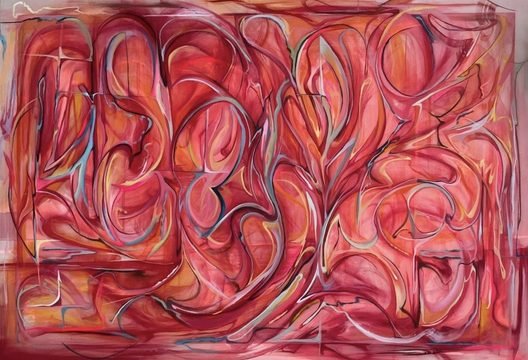
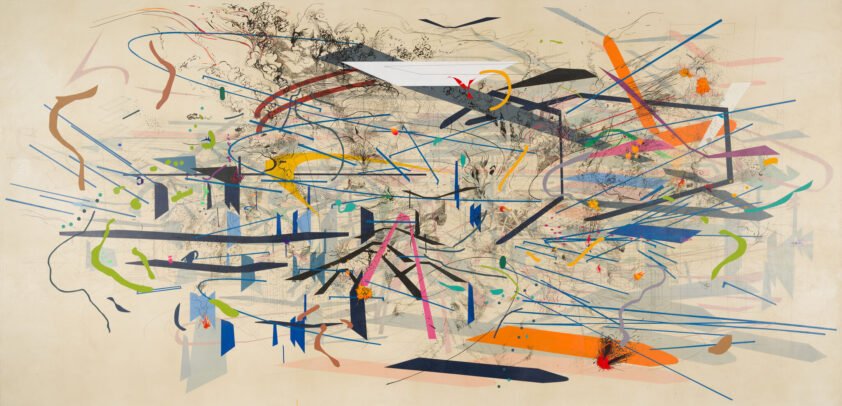
A studio in Manhattan’s Chelsea district receives light at a particular angle in the afternoon. It falls across canvases large enough to occupy a room by themselves. Julie Mehretu works here. Her paintings sometimes measure ten feet by twenty. Marks accumulate across their surfaces over months before a finished work emerges. The paintings are abstract. No obvious Ethiopian identity marks them. No obvious American identity does either. Instead, they capture what happens when someone born in Addis Ababa, who fled to Michigan during the Red Terror of the Derg, studied in Dakar and Rhode Island, lived in Berlin and New York, and spent decades thinking seriously about migration, urban violence, and the archaeology of human movement, tries to find a visual form adequate to all of that at once.
Interviewers regularly ask whether she is an African artist or an American artist. Her answer is worth sitting with. She is, firstly, just an artist. Yet she takes full responsibility for being American, and describes herself as both Ethiopian and American. She is not evading the question. She refuses its premise. The question assumes a geography one can choose among, a single frame to operate within. Mehretu has spent her career demonstrating that the most interesting frame is the one the question cannot hold.
Many artists share this position. Among those shaping what contemporary art looks like in the second quarter of the twenty-first century, it is not unusual. What is unusual is the scale at which the world has begun to notice.
The Third Space and What It Produces
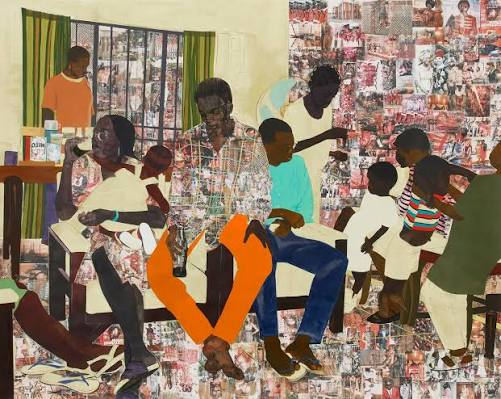
Nigerian fabric hangs in Njideka Akunyili Crosby’s Los Angeles home alongside work by friends including Wangechi Mutu and Kehinde Wiley. The paintings she makes there are, in every technical sense, American. They draw on the language of Western academic painting she studied at Swarthmore, Yale, and the Pennsylvania Academy of Fine Arts. They reference the tradition of intimate domestic interiors running from Edouard Vuillard through American figuration of the mid-twentieth century. Large, meticulous, and formally composed, they take the history of painting seriously on its own terms.
Look closer, though. Those surfaces, which appear from a distance to be patterned wallpaper or fabric, resolve on approach into photographs. Nigerian pop stars appear. So do military dictators from Akunyili Crosby’s childhood. Pages from magazines she read growing up in Enugu and Lagos transfer through acetone onto the canvas surface. Her Nigerian past and her American present occupy the same physical plane. Her own skin, in paintings where she appears, does not show as painted brown. Instead, transferred images compose it so that what she is made of and what she comes from are, literally, the same material.
Neither Nigeria nor America
She has described the space her work inhabits with precision. The deeply personal universe she depicts is neither Nigeria nor America. It is some other space that she and any immigrant occupies. This third space is not a compromise between two fixed positions. It is a distinct territory with its own conditions, challenges, and creative possibilities. Neither of the two originating geographies could have produced it alone.
This territory is also, increasingly, where some of the most commercially and institutionally significant art of this period originates. Akunyili Crosby’s auction record reset in 2024 when Bush Babies sold for close to three and a half million dollars. Mehretu’s Walkers With the Dawn and Morning sold for over ten million dollars at Sotheby’s New York in 2023, setting a new record for any artist born on the African continent. These are not marginal or emerging figures. The Whitney, the Guggenheim, the Tate, the Metropolitan Museum of Art, and the National Gallery of Art all hold their work. The art world has decided, with the authority of its most significant markers of value, that this is serious work.
What the Market Knows and What It Misses
The figures reveal more than commercial success. They point to a structural shift in how the global art market organises itself and where it now believes value originates.
African artists generated $70.5 million in global auction sales in 2025, a forty-three percent increase from 2024. One significant caveat comes with those numbers. Total art auction sales in Africa have declined over the last decade. African art trades more frequently outside the continent than within it. Global audiences celebrate the work while the primary market infrastructure that would sustain artists at home remains underdeveloped relative to what they produce.
This is the condition of the contemporary African diaspora artist in its sharpest form. Artists can set auction records in New York and London. Selling a work in Lagos or Nairobi at a price that supports the practice is another matter entirely. Auction houses, institutional collections, critical frameworks, collector networks, and residency programmes remain disproportionately concentrated in the cities of the Global North. Artists whose work is rooted in African experience still need to navigate those cities to build professionally legible careers.
The El Anatsui Paradox
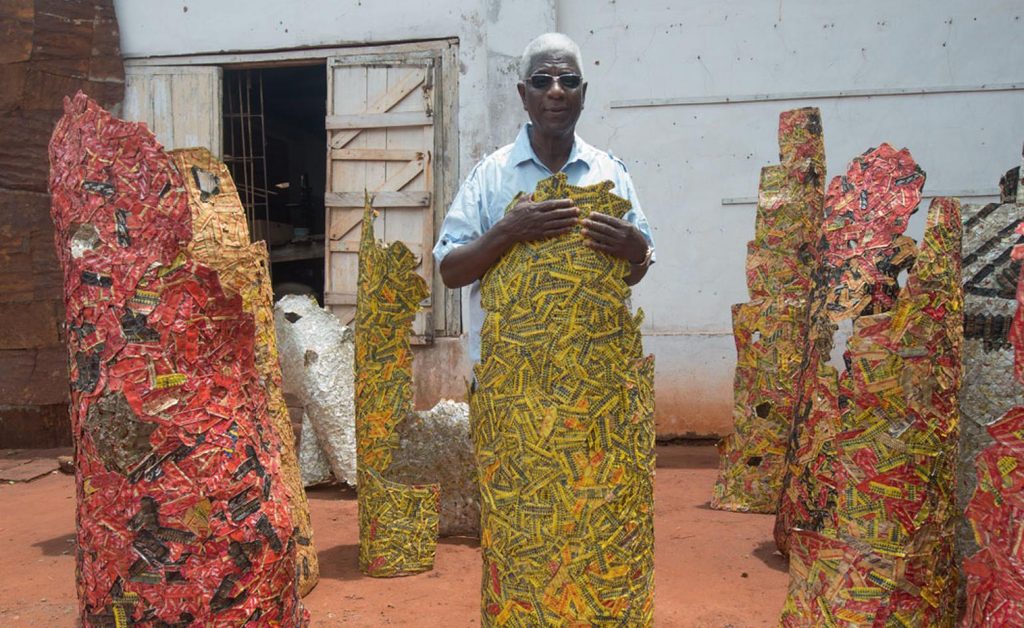
El Anatsui, the Ghanaian sculptor who has spent most of his working life in Nigeria, demonstrates both the possibility and the limitation of this condition. His monumental wall works, made from thousands of bottle caps and metal scraps woven into tapestries of extraordinary scale, rank among the most critically acclaimed and institutionally collected works of the past forty years. His Turbine Hall commission at Tate Modern placed him alongside the handful of artists whose single institutional appearances can shift how an entire field is understood. By the metrics of the global art world, his reputation is undeniable.
Yet his foundational commitment has always been to making work in Nigeria, from materials found in Nigeria, in engagement with specifically Nigerian and Ghanaian communities and histories. The distance between where he makes his work and where the world receives it has been a condition of his career rather than an exception to it.
Artists who choose to work at home, physically present in Lagos, Accra, or Nairobi rather than in a Chelsea studio or Berlin residenc, still pay a career cost. That cost has diminished but has not disappeared. The infrastructure of validation is still largely elsewhere. What has changed, significantly, is that the elsewhere has begun to come looking.
The Question of Home
What does it mean to go home when you have built your life and your practice somewhere else?
Julie Mehretu does not return to the African continent as a tourist. Nor does she return as an expatriate performing a nostalgia she is not certain she feels. She returns as someone for whom the continent has always drawn her back. Zimbabwe and Senegal have both been home to her at different points. She has travelled extensively and describes an immense creative possibility in what can happen on the continent. Rather than simply observing that possibility, she has spent significant recent energy trying to build it. She co-founded the African Film and Media Arts Collective with filmmaker Mehret Mandefro. The organisation has run workshops in Lagos, Tangier, Nairobi, Dakar, and Cape Town, working with young African filmmakers and media artists in each city.
A Road From Cairo to Cape Town
Her BMW Art Car commission, completed in 2024, extended this commitment further. Selected to design the twentieth car in a series that has included Andy Warhol and Roy Lichtenstein, Mehretu used the project to build partnerships with cultural institutions across the continent. The road from Cairo to Cape Town became a connective tissue between creative communities that had been working in relative isolation from one another.
Returning to Addis Ababa carries its own complications. Homecomings always do for people who left young and have changed as much as the place they left. Ethiopians greet her with pride and warmth that she finds humbling and moving. She has noticed a palpable shift in Ethiopia’s art schools, a shift in imagination and investment she witnessed when she returned for The Addis Show at the Modern Art Museum Gebre Kristos Desta Centre. Her family’s history weighs on how she holds the country. Her parents invested their lives in Ethiopia and left everything behind five months after building their house, when the revolution that consumed the country’s modernist ambitions also consumed their specific future there.
This texture characterises what living between continents actually feels like for the generation of African-born artists who built careers in America and Europe while maintaining roots their biographies demanded they keep. It is not a simple or resolved condition. Competing claims on belonging, competing frameworks for understanding the work, and competing markets for what it is worth all press simultaneously.
What Akunyili Crosby Photographs
Njideka Akunyili Crosby returns to Nigeria annually. She goes specifically to photograph, to replenish the archive of images she transfers onto her canvases and to maintain the relationship with the material of her childhood that gives her work its emotional authenticity. What she photographs, she has said, is what she hopes other people who grew up in Nigeria in the eighties and nineties will recognise. Her work reaches for shared memories across whatever distance has opened between the people who left and the place they came from. She makes the work in Los Angeles from materials collected in Nigeria and assembles it through techniques she learned in Pennsylvania and Connecticut. Removing any of those geographies from the practice would cost something essential.
What Berlin Taught and What Lagos Demands
The conversation about African artists living between America, Europe, and Africa cannot focus only on the most commercially successful practitioners. The condition they describe extends to a much larger number of artists whose work has not yet reached the market visibility that makes individual careers legible as data points.
For every Julie Mehretu with a studio in Chelsea, hundreds of artists navigate the same fundamental geography with far less institutional support. Berlin has absorbed the largest and most artistically productive community of African diaspora artists in Europe for the better part of two decades. Low studio costs relative to London or Paris drew them. So did a residency and grant ecosystem relatively accessible to international applicants and a curatorial culture that has, by European standards, shown genuine interest in practices from outside the Western canon. African artists who built practices in Berlin during the two-thousands and twenty-tens contributed substantially to the city’s reputation as a creative capital. Many did so under conditions of mobility precarity, visa anxiety, and income uncertainty that the art world’s celebration of their work does not acknowledge.
Recommended For You
The Visa Gap
European art institutions have been slow to reckon with the relationship between their enthusiasm for African creative production and their structural role in making it harder for African artists to be physically present in the cities where that enthusiasm is expressed. The gallery showing Nigerian work at Frieze London, the museum acquiring a Ghanaian painting for its permanent collection, the fair flying African collectors to a VIP preview in Basel, few of these institutions have actively lobbied for the visa access that would allow the artists they celebrate to attend openings, meet collectors, and participate in the professional ecology that builds careers. The infrastructure of celebration and the infrastructure of access remain structurally misaligned.
Lagos demands something different from artists who choose to base their practice there. The city’s creative economy has developed with extraordinary speed over the past decade. A gallery ecosystem, a collector base, an art fair platform in ART X Lagos, and a curatorial intelligence that generates critical frameworks for African contemporary art from inside the continent , rather than importing them, have all emerged. Galleries including Tafeta, Rele, and ADA Contemporary build programmes of genuine ambition. They represent artists in dialogue with global contemporary practice while maintaining rootedness in Lagos’s specific cultural and urban conditions.
The Double Demand
Lagos-based artists navigate a double demand. They must earn serious local recognition while remaining legible internationally. They must build a practice that sustains itself within the city’s still-developing commercial art infrastructure while accessing international exhibition and residency opportunities that remain important for career development. Artists who solve this problem do not experience it as solved. They experience it as a condition of permanent active management, a kind of professional bilingualism the art world rarely names but consistently expects.
The Work That Comes From the Between
Living between places produces something that cannot come from anywhere else. Mehretu describes a constant crisscrossing across the ocean, a mapping and charting that interests her because of its historical dimension and the particular quality of mind that sustained displacement produces. Her paintings embody this literally. Layers of architectural drawings from different cities and different historical periods compress into single surfaces, making visible a topology of human movement that no single geography could contain.
Akunyili Crosby describes the universe her work inhabits as a space immigrants occupy, a third territory genuinely distinct from either of its constituent cultures. This is not, she is careful to clarify, a space of comfortable hybridity or easy synthesis. Active negotiation characterises it. Code-switching, cultural translation, and the specific emotional labour of maintaining authentic connection to two places simultaneously, without fully belonging to either, define daily experience there. Her work emerges directly from inhabiting that space honestly rather than resolving it prematurely into a legible identity.
What Collectors Are Actually Buying
The global art world has, after decades of treating this condition as a biographical footnote, begun to recognise it as the generative condition it actually is. Collectors paying ten million dollars for a Mehretu are not paying for a painting by an Ethiopian who happened to make it in New York. They are paying for the specific visual intelligence that the full complexity of that biography has produced. No simpler biography could have produced the same thing.
Whether this recognition translates into structural changes, access infrastructure, domestic investment, equitable distribution of residency and grant funding, that would allow more artists to build practices of this depth without bearing the full cost of the negotiation alone remains the question the market’s enthusiasm has not yet answered.
Buyers collect the work. The conditions that produce it are still, for most of the people who navigate them, lived alone.