


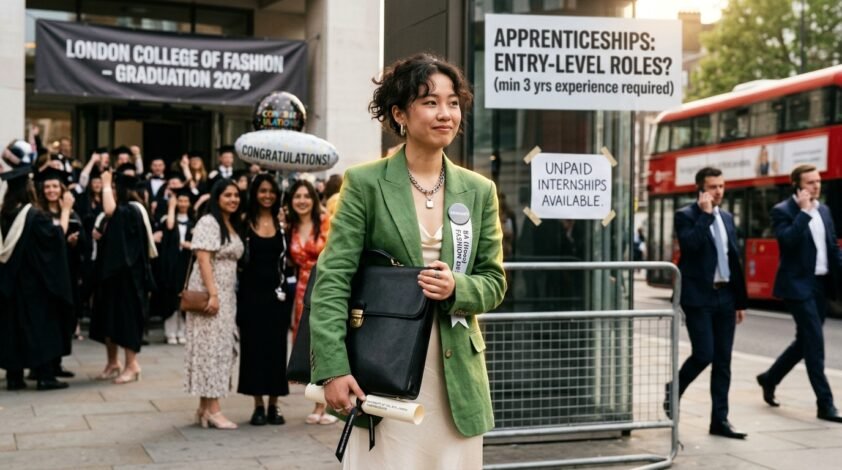
The fashion and creative industries sell a dream that education alone cannot deliver. What graduates actually find, on both sides of the Atlantic and across the continent, is a more complicated education than anything they paid tuition for. She graduated with distinction. Her final collection had been photographed for three independent publications and praised by her course leader in terms she replayed, quietly, on the days she needed to. She had spent four years studying fashion design at a respected institution. She had taken out loans she did not fully understand the terms of, eaten badly, slept worse, and produced, in the end, work she was genuinely proud of. She had done everything the institution asked. Then she graduated, and the industry asked for something else entirely.
The first internship lasted four months. It was unpaid. The second lasted three months and paid just below minimum wage, which in London meant that the difference between what she earned and what she spent to be there left her roughly four hundred pounds short each month, a gap she covered by working weekend shifts at a café she had promised herself she would leave once she was in the industry. The third position finally paid a salary that qualified as survivable, not comfortable, at a company that asked her to perform tasks she had been overqualified for since her second year of study.
She is not exceptional in these experiences. She is, in the data and in the testimonies of recent graduates across London, Milan, Lagos, and Nairobi, entirely representative. What happened to her after art school is what happens to most of them. And the industry whose talent pipeline depends on these experiences has, with remarkable consistency, declined to examine what it costs.

The Gap Has a Name
There is a specific experience that defines the year or two after creative education ends, and it is common enough to have been studied, documented, and named. Researchers call it the qualification paradox: the degree that grants access to the industry does not, by itself, grant entry to the positions the degree was designed for. Between the qualification and the position sits a corridor of unpaid or underpaid experience that the industry requires and the graduate must personally finance.
A Sutton Trust survey in the UK found that sixty-one percent of internships undertaken by recent graduates in creative fields were unpaid or underpaid. In London specifically, where the majority of fashion industry positions are concentrated, independent research has estimated that an unpaid intern in fashion spends more than one thousand pounds a month on the costs of the internship itself, not including accommodation in one of the world’s most expensive cities. The University of Cincinnati’s Sustainable Fashion Initiative documented that the average fashion design student paid close to forty thousand dollars in internship-related expenses over the course of their studies, taking on debt to fund experiences that were supposed to be the beginning of their careers.
This is not a niche problem affecting a small number of unfortunate graduates. It is the normal structure of entry into an industry that generates, globally, several trillion dollars in revenue each year. The fashion industry’s business model at the talent end is, functionally, to have young people subsidise their own training for the benefit of companies that could afford to pay them. A Design Interns Club document created in 2020 to collect testimonies has gathered hundreds of accounts describing internship experiences as unpaid, unstructured, and in several cases conducted through WhatsApp at hours extending to two in the morning, with no defined office, no working hours, and no real mentoring.
The mechanism by which this structure sustains itself is class. If access to the industry requires the ability to work without payment, the industry selects for those whose families can absorb the cost, whose accommodation in expensive cities is subsidised, or whose loan capacity has not been exhausted by tuition. The graduate from Lagos or Nairobi who arrives in London on a student visa and a scholarship, with no family financial cushion and a legal restriction on how many hours per week they can work, is not competing on the same terms as the graduate whose parents live in Zone 2 and whose childhood bedroom remains available. The industry produces, as a structural consequence of its entry requirements, a workforce that is considerably less diverse than the talent pool that art schools admit. The schools are, in many cases, more representative than the businesses their graduates enter. Something is being lost in the transition, and the industry has never been asked to account for it.
What the Degree Actually Teaches
Part of what makes the gap so jarring is the distance between what art school cultivates and what the industry immediately requires. The most respected fashion education programmes in the world, at Central Saint Martins, the Royal College of Art, Parsons, IED Milan, and comparable institutions, are built around the development of a creative intelligence rather than a commercial one. They teach students to think, to research, to develop a point of view about what clothes are for and what they are allowed to do. They give access to the history and theory of fashion, to the critical vocabulary with which work can be discussed and evaluated, to the kind of deep formal education in construction, material, and silhouette that separates the designer who understands fashion from the one who merely produces it.
What they teach with considerably less consistency is how to run a business, manage a production schedule, negotiate with a manufacturer, cost a garment, price a collection, deal with a stockist, or survive the cash flow conditions of an independent label in its first three years. The Royal College of Art builds career advisory support into its MA programmes and maintains an alumni business aftercare scheme. Central Saint Martins offers entrepreneurship and management pathways. But the gap between what is available and what graduates actually need when they find themselves responsible for turning their education into a livelihood is, for many, the first thing they learn after they leave.
A designer who graduates from a fashion programme understands, at a deep level, why a particular collar is cut the way it is. They understand the references, the history, and the argument the collection is making. They may not understand how to write a purchase order, what net sixty terms mean, or why a buyer in Paris might love the work and still not take the collection because the minimum order quantity the designer has proposed is too small to justify the logistics. These are not failures of education, exactly. They are the inevitable consequence of institutions whose mission is to develop creative capacity and whose teaching staff are overwhelmingly recruited from the creative world rather than the commercial one. The boundary between the two worlds is crossed on graduation day, and many graduates cross it without a map.
The African Art School Problem
The conversation about what happens after art school in European and American creative education is, in some ways, a conversation about privilege failing to recognise itself. The graduates who struggle through unpaid internships in London and Milan are struggling through an unpleasant experience that, for a significant number of them, eventually leads somewhere. The infrastructure exists, however inequitably it is distributed. The galleries are there. The fashion weeks are there. The buyers, the publications, the institutions that confirm creative careers are there, even if access to them is filtered through class in ways the industry rarely discusses honestly.
In many parts of Africa, the infrastructure problem runs deeper. Many of the art schools and fashion design institutions across the continent trace their roots not to indigenous aesthetic traditions but to colonial and post-independence frameworks that positioned European practice as the standard toward which African creative education should aspire. The Académie des Beaux-Arts in Kinshasa was founded as a colonial project. Many post-independence institutions were established as part of nation-building programmes that looked to Western models for their curricula. The question of which visual languages, which material traditions, and which historical references form the foundation of a contemporary African creative education has not been consistently resolved, and the consequence is that graduates from institutions in Lagos, Nairobi, Accra, and Johannesburg often receive an education whose reference points sit in cities they cannot easily visit, on pathways whose gatekeepers hold passports that function differently from their own.
Research across parts of the continent has found that many African fashion and design institutions still rely heavily on Western frameworks, often positioning New York, London, and Paris as the primary reference points for innovation, even as creative capitals such as Lagos, Dakar, Nairobi, and Johannesburg continue to impact global culture in real time. The student who graduates from an Accra fashion programme, having been taught to measure excellence against European Fashion Week standards, is not necessarily being given tools that serve their specific environment. The market, the supply chains, the production relationships, the cultural context, and the economic conditions of building a creative business in Accra are different, in ways that matter, from the conditions in London. The education that prepares a graduate for one may not prepare them for the other.
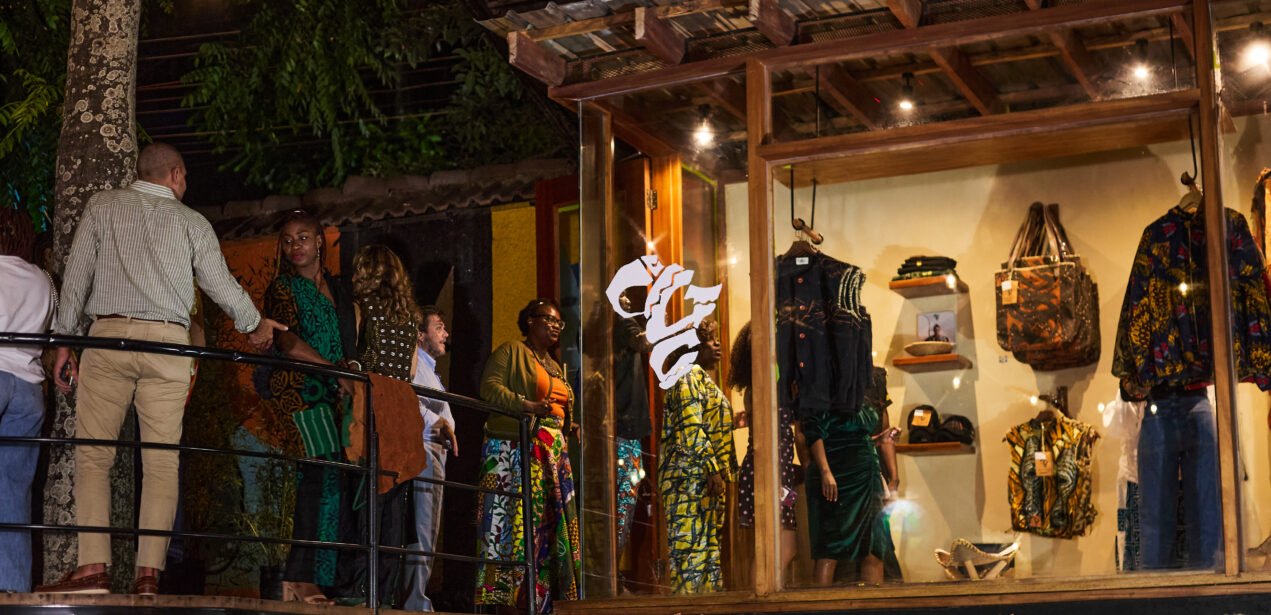
What happens after art school in Nairobi is that a graduate encounters a market with real appetite, a creative economy that is genuinely expanding, and an infrastructure that is still, in many critical respects, being built. There is often little government funding, few resources such as studios or workshops, and little of the support infrastructure that exists elsewhere: public galleries, established arts organisations, the funding bodies and residency programmes that give early-career artists and designers somewhere to go while they develop their practice. The counterweight is the energy of a scene that is building its own institutions precisely because the existing ones are insufficient, the kind of creative urgency that tends to produce distinctive work and occasionally produces transformation.

Lagos demonstrates what becomes possible when the creative economy reaches sufficient critical mass. The events of Detty December 2024 alone contributed over seventy-one million dollars to Lagos State revenue, a figure that makes visible the economic weight of a creative culture that the continent’s institutions have historically underinvested in. The creative hubs, Co-Creation Hub in Lagos, Creatives Garage in Nairobi, and the incubators in Johannesburg, represent an informal infrastructure that is partly compensating for what formal education systems have not provided: business training, mentorship, connections to markets, and the practical knowledge of how to convert a creative qualification into a sustainable livelihood.
The Ones Who Stay and the Ones Who Leave
In fashion education, as in most creative fields, graduation produces two broad movements. Some graduates stay in the cities where they trained and build careers in proximity to the industry’s established infrastructure. Others leave, return home, or move sideways into adjacent fields that will sustain them financially while they work out what their education is actually for.
Both movements are more complicated than they look. The graduate who stays in London or Paris after completing their fashion degree is not staying in a system designed to support them. They are staying in a market with a surplus of qualified creative labour, in which employers have learnt they can take their time and offer entry conditions that would not survive scrutiny in most other professional sectors. Federal Reserve Bank data from early 2024 found that visual and performing arts majors faced an unemployment rate of eight percent and an underemployment rate of over sixty-two percent, meaning nearly two-thirds were working in roles that did not require their qualification. The degree has been paid for. The career it was supposed to unlock is not necessarily where the graduate ends up.
The graduate who returns to Lagos or Nairobi or Accra with a European fashion education faces a different calculation. They carry a qualification that was designed for a market they have left, a set of references that may or may not translate, and a set of skills that are genuinely valuable in their home market but that the local industry may not yet have the institutional framework to absorb. The returning graduate who decides to build something, who opens the studio, hires the seamstresses, builds the client list, and starts doing the work, is making a bet on the market rather than on the infrastructure. Many of the most interesting things happening in African fashion right now are the result of exactly this bet, placed by exactly these people.
What they almost universally report is that the education they received abroad, whatever its limitations as preparation for the specific conditions of their home market, gave them something harder to quantify than technical skills or industry knowledge. It gave them permission. The permission to take the work seriously, to consider themselves designers in the full sense of the word, to see their practice as continuous with a global tradition rather than as something happening at its margins. That is not a small thing, and it is not something that can easily be replicated outside a formal educational environment. The education’s real value, for many of its graduates, is not the curriculum itself. It is the depth of engagement it required, and the sense of legitimacy it conferred.
Recommended For You
The Question the Institutions Haven’t Answered
Art schools talk about their graduates’ careers in the language of possibility. The brochures and open day presentations and alumni profiles tell the story of the path from graduation to a particular kind of professional life, a story in which talent and effort produce the expected outcomes. The institutions are not lying, exactly. The outcomes they describe are real. They are just considerably less common than the framing suggests, and considerably more dependent on factors that have nothing to do with talent or effort.
The honest conversation the institutions have not, in most cases, had with their students is about what talent alone cannot buy. It cannot buy the network that opens the first door. It cannot buy the family support that makes an unpaid internship financially survivable. It cannot buy the passport that allows entry to the rooms where the most important work is seen and evaluated. It cannot buy the market infrastructure that would allow a returning graduate to translate their skills into a sustainable business without building the infrastructure themselves. These are structural problems, and they require structural responses.
Research published in peer-reviewed academic literature has found that unpaid internships in the creative sector do not, on their own, improve graduate employment outcomes, and that the assumption underpinning them, that free labour is a reasonable exchange for career access, is not supported by the evidence. Paid internships lead to full-time employment sixty-five percent of the time. Unpaid ones, thirty-nine percent. The exploitation is not even efficient on its own terms.
Some institutions are beginning to respond. The RCA’s business aftercare and career integration is a genuine investment in what happens after graduation, not merely before it. Central Saint Martins’ entrepreneurial and management programmes are a recognition that creative skill without business literacy is a partial education. The growth of creative hubs and incubators in Lagos and Nairobi is a recognition that the formal institutions are not sufficient and that the gap between education and career requires its own infrastructure.
But the deeper problem remains. Art school teaches people to make extraordinary things. It does not consistently teach them how to exist in a world that does not have a ready place for extraordinary things, that requires them to be patient in conditions that reward wealth, connected in networks that reward prior connection, mobile in a system that rewards certain passports, and resilient against a set of entry barriers that were not designed with their presence in mind.
What happens after art school is that you find out how much of your education was about the work and how much was about learning to carry the work through a world that will not make it easy. The ones who persist do not do so because the industry cleared a path for them. They do so because they cleared it themselves. That is not a feature of a well-functioning system. It is the system’s central failure, dressed up as a story about individual resilience.