

Some artists speak. Others whisper through the textures they choose, the histories they carry, and the worlds they blend together. Gabriel Kibirango Ogal belongs to the rare third group, the ones who do not simply create but translate the unseen. His work moves between art and fashion with the quiet force of someone who once lacked a voice and decided to build one from scratch. Raised between two ethnic identities and impacted by the complex beauty of belonging and displacement, he creates pieces that feel both ancient and new, tender and disruptive. In his hands, bark cloth becomes more than a textile. It becomes memory, ancestry, conflict, and reconciliation. It becomes a question. And then, it becomes a story.
In this conversation with FAB L’Style, Gabriel opens a door into the spiritual and cultural terrain that guides his work, revealing how an artist who once struggled to speak now uses fabric, hides, rattan and stitches to articulate everything words once failed to hold.
Finding a Voice Through Art, Fashion, and Spirituality

FAB: What’s your story? Where did it all begin?
Gabriel Kibirango: It’s quite an intriguing one. I’d say I’m an artist navigating spiritual awareness, artistic expression and culture through fashion and art. I move between art and fashion spaces, using both as forms of self-expression, especially within the African context, and more specifically, in Uganda.
When I was little, I was always very reserved. But when you’re quiet, there’s often so much you want to say but can’t, mostly because of fear or the environment around you. Growing up, I wanted to find a channel where I could have a voice. At school, I discovered that art allows people to express what they feel without using words. So, I poured my energy into art as a subject, and later into poetry and literature. Through that, I found something that I could call my voice.
More recently, I started exploring art spaces and, during the lockdown, I did a bit of modeling. That experience completely changed my perspective. I realized that fashion could also be a voice. It has the power to communicate emotions, culture, and stories that words sometimes cannot.
Found For You
The Untold Story of East Africa’s Destroyed Textile Empire
Ugandan Designer Godfrey Katende on Fashion, Sustainability & African Heritage
FAB: That’s powerful. You mentioned that some of the things we struggle to express verbally can find their way out through art or fashion. From what I’ve read, your designs draw inspiration from personal experiences, cultural traditions, and everyday challenges. Can you share a moment or story that deeply influenced your artistic journey or the kind of work you do today?
Gabriel Kibirango: One of the biggest stories I carry, and one that still shapes me, is about my background and what it means to be the product of two ethnic groups. In Uganda, we have many tribes, and I come from two different ones through intermarriage. That experience often placed me in between worlds. I’ve felt what it’s like to be an outsider and how identity shifts depending on where you stand. I channel those feelings and experiences into my art. Through it, I explore belonging, difference, and the spaces in between.
FAB: I’ve spoken to many artists about bark cloth, and every conversation reveals something new about that remarkable material. Seeing how you reinterpreted such a traditional fabric was incredible. What drew you to working with bark cloth?
Gabriel Kibirango: My ancestral roots are Baganda, and that connection naturally drew me to the textile. Bark cloth is deeply symbolic in our culture, but it’s also one of the most sustainable materials we have. It’s eco-friendly, biodegradable, and perfectly aligns with the global movement toward sustainability. I thought, why not use something that resonates deeply with my heritage and also allows me to communicate my message in a meaningful way? That’s how bark cloth became an essential part of my work.
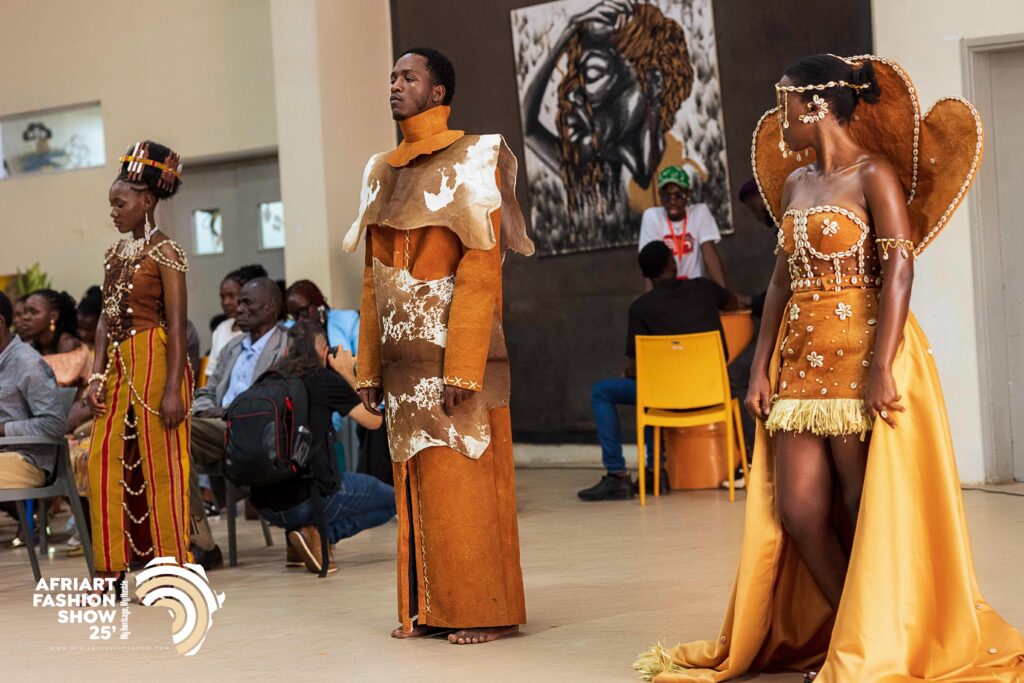
FAB: Can you walk us through the concept behind your piece Kwarenah[my ancestors in luo]? What story were you trying to tell through bark cloth and your material choices? I saw what other students made, and yours really stood out.
Gabriel Kibirango: Thank you. That means a lot coming from you. I’ve always wanted to speak without using words, to let art communicate for me. When I found my footing in fashion, I knew I didn’t want it to be about glamour. I wanted it to serve as a canvas for education, storytelling, and awareness.
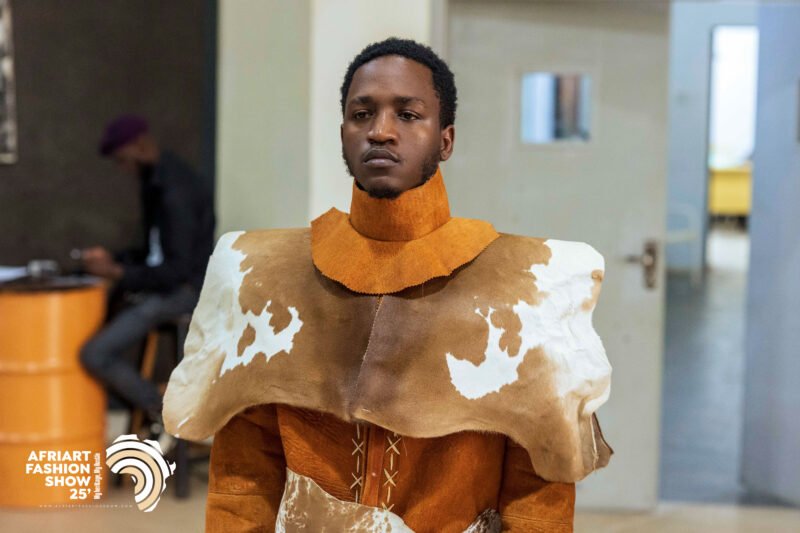
The concept behind Kwarenah comes from my personal story. The piece is titled Kwarena, which means my ancestors in Langi, a language spoken in northern Uganda. Through this work, I wanted to connect my two ancestral lineages, the Baganda from central Uganda and the Langi from the north, and explore what it means to exist between both cultures.
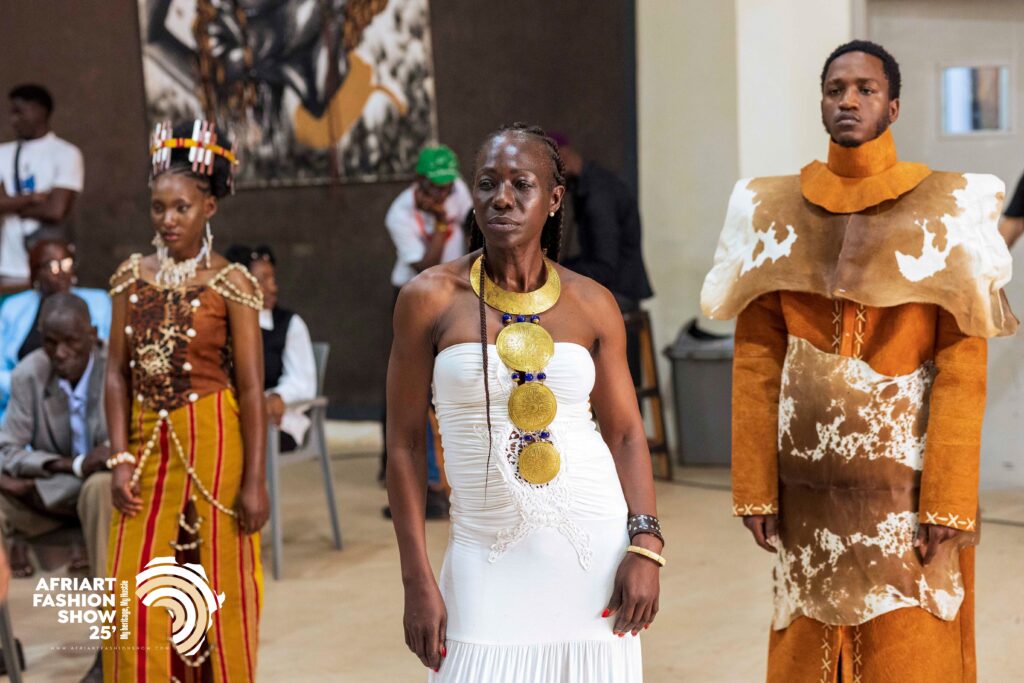
The bark cloth represents the Baganda heritage. It is one of Uganda’s oldest textiles, deeply symbolic of identity and ceremony. The hides and skins I used speak for the Langi people, who are pastoralists and farmers. They live closely with cattle, and their traditions reflect that bond.
However, the hides in my piece carry a deeper meaning. They were taken from young calves whose mothers had died during conflicts over grazing land, a reality I witnessed growing up. Those moments stayed with me. As a child, I could not control what was happening around me, but I could feel the loss and confusion that came with it. In the piece, that sense of displacement and grief became part of the story.
The bark cloth also allowed me to reflect on transformation within culture. For instance, the Baganda adopted the kanzu, their traditional attire, after encountering missionaries and explorers in the 18th and 19th centuries. Originally, the kanzu was made from bark cloth before it evolved into what it is today. By bringing the bark cloth and hides together, I wanted to highlight how cultures evolve, merge, and adapt, while also revealing the fragility and beauty within that process.
Ultimately, I did not want to dictate how people should interpret the work. I hoped it would stir curiosity. Maybe they would wonder, Why does this piece feel different? Why is it made this way? If the piece could make people stop, reflect, or question, then it had already spoken in its own way.
A Childhood of Silence That Became a Language of Creation
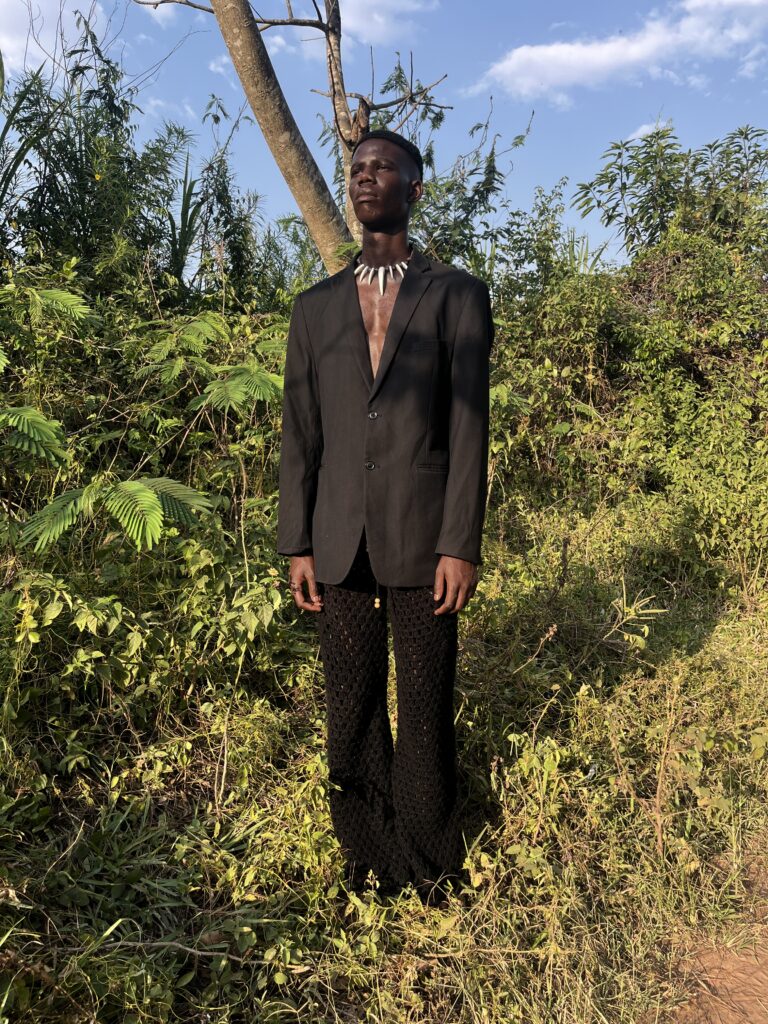
FAB: I have to say, I was really intrigued by your choice of fabric, the patterns, the rattan work, and the use of animal skin to accentuate the design. You also mentioned how difficult it was to work on this piece. I noticed some parts that tore during the process. What was the most challenging aspect of working with this material, and how did you overcome it?
Gabriel Kibirango: The biggest challenge for me was having so many ideas and needing to narrow them down to what felt essential for the piece. I didn’t want to overcrowd it because, at the end of the day, too many ideas can confuse the audience. For this work, I tried to focus on introducing the world I come from—my people, my family background, and the reality of my identity.
If you look closely, you’ll see an infant motif where I used different stitches, such as cross stitches and running stitches. That section represents an artist standing at a crossroads. It reflects me trying to find balance, unsure of which direction to take. Should I hold on to my Northern heritage, or should I align more with the Baganda culture? The piece questions where I belong and what path I should take.
FAB: So, it’s essentially a reflection on identity, right?
Gabriel Kibirango: Yes, exactly.
FAB: Bark cloth is natural, sustainable, and biodegradable. Do you see it becoming a future alternative to leather or synthetic fabrics in global fashion?
Gabriel Kibirango: Absolutely. Beyond its sustainability, bark cloth is deeply cultural. It’s a fabric that carries identity and history. For artists like me who are searching for who we are, it helps us connect with our roots and express that visually. I believe that as more creatives embrace it and raise awareness, bark cloth could become the next big fabric the world turns to as an eco-friendly solution to the problems caused by synthetic materials.
FAB: While I was holding your piece, Harriet and I talked about caring for bark cloth. For example, if I’m wearing my Aso Oke or Adire from Nigeria and spill soup on it, I can easily clean it. But bark cloth comes from a tree and seems delicate. How do you take care of it? Have you found any reliable techniques for maintaining this special material?
Gabriel Kibirango: That’s a question I get a lot. I think many people hesitate to use bark cloth because they don’t know how to care for it. But I often ask, if our ancestors used it long before us, how did they clean it? There must have been a method. For now, I recommend gentle spot cleaning or dry cleaning as the best options. Personally, I’m exploring new and innovative ways to make cleaning easier and safer for the fabric, so that more people can use it without fear of damaging it.
Why Bark Cloth Became His Creative Medium
FAB: One of the things that stood out in your piece is how you reimagined bark cloth. For a long time, we’ve seen it as something exotic, like many other African cultural heritages. In the past, people wore the mud-coloured bark cloth, and you’d wonder, where would I wear this? But your version is different. I would wear it anywhere. I would wear it to the Met Gala or on a red carpet. What other innovations or techniques do you think designers and artists like yourself should explore to make bark cloth more versatile, wearable, and functional?
Gabriel Kibirango: I think young artists like myself often follow too many rules. Recently, I spoke with one of my mentors, who reminded me how important it is to stay open-minded and curious. That really shaped how I approach my work. My mindset is simple: why can’t bark cloth be used for something new? Why can’t it serve a different purpose? For so long, people have viewed bark cloth as strictly traditional wear. But I believe this new generation of artists can turn it into everyday fashion. We can use it just like any other fabric. That’s how I approach it—by making it part of daily life and using it in different forms of art. I don’t want to set limits for myself, and I would encourage others to do the same. Don’t be afraid to bend the rules and experiment.
FAB: Speaking of experiments, do you see a role for technology in refining bark cloth? For example, people now mix synthetic fibres with linen or use nanotechnology. Could something similar happen with bark cloth?
Gabriel Kibirango: When it comes to bark cloth, craftsmanship is still at its core. Looking ahead, I think there is potential for technology to play a role, but we’re not there yet. Even now, very few artists have the traditional knowledge required to make bark cloth. I know a bit, but not much. I’ve thought about integrating technology into its production, but it’s still a wide and unexplored area. For now, my focus is on craftsmanship and finding ways to raise awareness about bark cloth while supporting local artisans who keep the tradition alive.
FAB: Are you of the view that craftsmanship should be left entirely to artisans, without involving technology in bark cloth production?
Gabriel Kibirango: That’s a great question. Personally, I believe that the more time and energy an artist puts into a piece, the more life it carries. I’m not against technology; machines are great for efficiency and saving time. I’d love to see how it could help. But for me, true craftsmanship should stay authentic. It’s where an artist fully expresses their creativity and emotion. Every handmade piece carries its own life, and that’s something no machine can replicate.
Is Bark Cloth the Future of Sustainable Fashion
FAB: Let me take you back a bit to when you talked about eco-friendly designs in your ‘The Locals’ stylist project. What role do you believe sustainable fashion plays in driving Uganda’s creative economy?
Gabriel Kibirango: I believe sustainable fashion has the potential to transform Uganda’s economy. A slower, more intentional approach not only protects the environment but also reduces waste. Every project built around sustainability brings together different creatives and gives them the chance to share ideas and create something meaningful. If we continue to collaborate on larger sustainable projects, we can amplify our voices as a creative community. Producing work that reflects sustainability gives us both cultural visibility and economic independence.
FAB: When you create, what do you hope people feel when they interact with your designs?
Gabriel Kibirango: Whenever I design, I put a part of myself into each piece. I always look for a cultural connection that speaks from a personal and collective point of view. I want the message behind my work to be so strong that people cannot ignore it. Even if they do not fully understand it, I want them to be curious enough to ask questions. Why did he choose this detail? What story is he telling? I am not necessarily trying to make people feel one specific thing. I just want them to engage with the story I am communicating through my designs.
FAB: When people remember you, Gabriel, fifty or even a hundred years from now, what do you hope your legacy will be?
Gabriel Kibirango: I have not really thought deeply about that. But I hope my work inspires people to express themselves freely and do something meaningful. I want to motivate others to act with purpose and to create with respect for both people and the planet. My goal is not to be remembered for fame, but for inspiring others to do the right thing in their own spaces.
FAB: If you had the chance to showcase this piece internationally, where would you want it to be exhibited? And what message would you want the global audience to take away from it?
Gabriel Kibirango: That’s an interesting thought. As an artist, I aim to raise awareness and address community challenges. This piece represents more than just my story; it also carries the stories of the artisans who worked with me, the people who inspired the fabric, and the energy behind its creation. I would not limit it to one exhibition or fashion event because I believe everyone should see it. The message should reach people everywhere, regardless of age, race, or gender. This story deserves to be heard by all, because it speaks about humanity, creativity, and the shared responsibility we have toward our world.
Gabriel Kibirango: Yes, I’m working on a project that started during my internship at a creative space I recently engaged with IGC studios and TEXFAD Limited. The inspiration comes from traditional textiles that have largely been forgotten. The project is titled The Forsaken/Forgotten, it explores the idea of being an out-cast the blacksheep in the herd. I’m focusing on materials like bark cloth, hides, and skins. While at the factory, I noticed a lot of discarded materials and waste, so I decided to include those offcuts in my work. They fit perfectly with the idea of forgotten materials finding new life, acceptance, renewal, inclusion and sense of belonging.
This project draws from three key materials: offcuts, bark cloth, and hides. Together, they express the theme of rediscovery and sustainability. I also want to reflect the lifestyle of my village through these textiles. My hope is to complete the collection and hold the exhibition before the end of the year, if all goes well.
FAB: And finally, if bark cloth could speak, what do you think it would say about your piece?
Gabriel Kibirango: Oh wow, that’s a powerful question. If bark cloth could speak, I think it would say, “Keep preaching.” And what would that message be? It would speak about its own importance — its sustainability, its cultural value, and its place in creative expression. It would call on artists to embrace it, experiment with it, and share its story with the world. Those would be the words of bark cloth.