



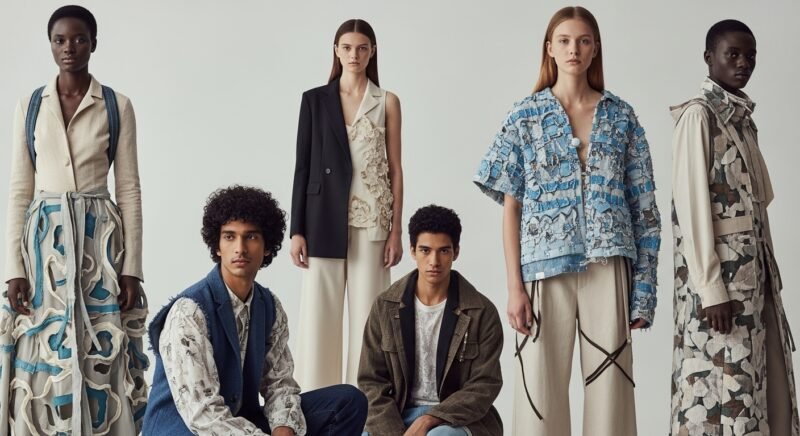
We are living in an era where sustainability is the most valuable currency in fashion, and that is a good thing. The industry is finally reckoning with its colossal waste problem, its toxic supply chains, and its ethical failings. But we need to have an honest conversation about where we are focusing our energy. For the past decade, the face of ethical fashion has often been upcycling: the patchwork quilt, the visible seam, the deliberately mismatched textile. This aesthetic of visible reclamation has become the shorthand for conscious consumption.
While upcycling is a crucial tool for waste management, it has become a creative comfort zone that is dangerously limiting the scope of true innovation. It has led to a monotony where ‘sustainable’ often equals ‘rough around the edges’ or ‘deliberately deconstructed.’ The implication is that ethics must always come at the expense of seamless, aspirational design. We need to be bolder. The next generation of sustainable fashion cannot afford to be defined by a distressed visual identity. True sustainability is the merger of beauty, ethics, and groundbreaking material science, where the clothes are so desirable, their ethical credentials are a bonus, not a compromise. We need to move beyond the aesthetic of upcycling and embrace a radical new blueprint for fashion.
The Monotony of the Visible Patch: When Ethics Becomes a Trend
The upcycled aesthetic, with its exposed seams and visible repairs, served an important purpose: it was a protest banner. It loudly declared, “This garment is anti-waste,” forcing a visual confrontation with the industry’s disposable nature.
However, this visual language has now become codified, limiting creativity and sometimes even masking laziness. We see luxury brands releasing “upcycled” collections that feature sloppy tailoring and predictable pieced-together constructions, essentially demanding premium prices for what is often the cheapest form of labor: stitching together scraps. This aesthetic has created a paradox:
- The Limitation of Design: If every sustainable collection must shout its origins through visible signs of reclamation, it restricts the designer from exploring minimalist, precise, or highly refined aesthetics.
- The Problem of Scale: Upcycling, by its very nature, is difficult to scale effectively. It relies on inconsistent material sources (scraps, deadstock), making the process non-replicable and labor-intensive. It is a necessary artisanal practice, but it cannot fix the trillion-dollar problem of global textile waste alone.
My friend, an emerging designer, recently abandoned his pursuit of a 100% upcycled line. He found that the constant hunt for matching scrap materials consumed his entire production time, and the finished product, while ethical, was aesthetically constrained. He realized that the greatest sustainability challenge wasn’t just using old clothes; it was creating new clothes that never had to become waste in the first place. That requires systemic change, not just creative triage.
The Real Meaning of Sustainable Innovation
To truly move beyond upcycling, we must expand our definition of sustainability from simply waste management to encompassing material science, circular systems, and cultural preservation.
1. Circularity from the Fibre Up
The future of sustainable fashion lies in designing for disassembly. A truly circular garment is one that, at the end of its (long) life, can be easily broken down into its original components and returned to the production cycle without loss of quality.
- Monofilament Magic: This means moving away from complex fiber blends (like polyester-cotton) that are nearly impossible to recycle mechanically. Designers must commit to monofilament fibers—garments made of a single material. For example, a shirt that is 100% Tencel or 100% recycled cotton can be recycled endlessly. The sustainability here is invisible but fundamentally systemic.
- Biodesign: This is where the innovation gets exciting. We should be looking at materials that actively heal the planet, not just reduce harm. Think about textiles grown in labs from fungi (mushroom leather), fermented bacteria, or even food waste (like Piñatex made from pineapple leaf fibers). These bio-designed materials naturally integrate into the Earth’s systems when discarded, offering a complete, non-toxic solution.
2. The Supply Chain as Ethical Ecosystem
Sustainability must be measured not just at the end product, but at every single checkpoint along the supply chain. This is the ethics-meets-science benchmark.
The Social Thread: The most important measure of sustainability is often the human one. True ethical fashion demands radical transparency regarding labor practices, fair wages, and safe working conditions. A garment made from recycled plastics is not truly “sustainable” if the person who sewed it cannot afford to feed their family. The definition must encompass social justice as a core pillar
Waterless Dyeing: The fashion industry is notoriously thirsty. Innovation in waterless dyeing (using pressurized CO2 instead of water) or natural, locally sourced dyes that don’t pollute local ecosystems is a quiet, powerful form of sustainability that dramatically reduces a garment’s footprint.