

These are not simply beautiful places to sleep. Each of these ten hotels is a considered argument about what a building can do, what a place can mean, and how design impacts the way we experience the world. From a converted grain silo above Cape Town’s harbour to polished steel orbs floating above the Red Sea, here are the rooms worth travelling for.
What separate remarkable hotels from merely expensive ones is rarely the thread count. It is the degree to which every design decision, from the architecture of the entrance to the weight of the door handles, has been made in service of a coherent idea. The hotels on this list all have that quality. They also, each in their own way, say something true about the place they occupy. That is harder to achieve than it sounds, and rarer than the industry likes to admit.
Each hotel is scored across five points: Architecture, Interior Design, Sense of Place, Sustainability, and Overall Experience.
How These Boutique Hotels With Exceptional Design Were Scored
| Hotel | Architecture | Interiors | Sense of Place | Sustainability | Experience | Total |
| Shebara Resort, Saudi Arabia | 5 | 5 | 5 | 5 | 5 | 25 |
| Aman Nai Lert Bangkok, Thailand | 5 | 5 | 5 | 4 | 5 | 24 |
| Mahali Mzuri, Kenya | 4 | 5 | 5 | 5 | 5 | 24 |
| Orient Express La Minerva, Rome | 5 | 5 | 5 | 3 | 5 | 23 |
| The Silo Hotel, Cape Town | 5 | 5 | 5 | 3 | 5 | 23 |
| Desert Rock Resort, Saudi Arabia | 5 | 4 | 5 | 5 | 4 | 23 |
| Rosewood Amsterdam, Netherlands | 5 | 5 | 5 | 3 | 5 | 23 |
| Villa Sahrai, Casablanca | 4 | 5 | 5 | 4 | 4 | 22 |
| Capella Taipei, Taiwan | 5 | 4 | 4 | 3 | 5 | 21 |
| NOA Hotel Shenzhen, China | 5 | 4 | 4 | 4 | 4 | 21 |
1. Orient Express La Minerva, Rome, Italy – One Of The Boutique Hotels With Exceptional Design in Rome
Architecture 5/5 | Interiors 5/5 | Sense of Place 5/5 | Sustainability 3/5 | Experience 5/5
Total: 23/25
There are hotels in Rome that have history, and there is Orient Express La Minerva, which practically is history. Set in a 17th-century palazzo on the Piazza della Minerva, moments from the Pantheon, the property has welcomed writers, aristocrats, and travellers for generations.
Restored by award-winning artist-architect Hugo Toro, the interiors channel the elegance of the original Orient Express carriages through rich wood panelling, bespoke travel trunks, hand-painted ceilings, and a palette inspired by Rome’s skies and classical architecture. Each of the 93 rooms and 36 suites has been individually crafted to reflect the property’s historic soul.
The four signature suites, the Stendhal, La Minerva, Obelisco, and Orient Express, feature textured plaster walls, Rosso Verona marble bathrooms, and original 17th-century floors, as well as views of the Pantheon and Bernini’s Elephant and Obelisk sculpture in the square below.
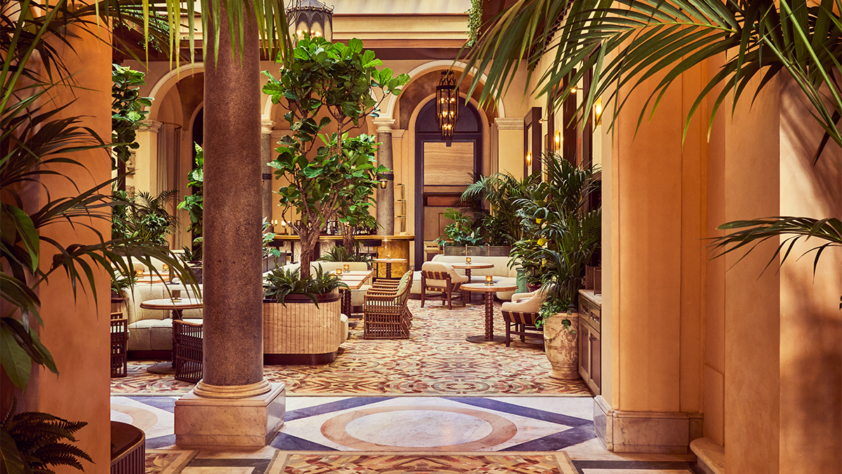
La Minerva Bar sits beneath a grand glass ceiling flanked by marble columns and the preserved statue of the goddess Minerva, the ambient light shifting from natural Roman warmth to intimate sophistication as the day moves.
Named AHEAD Global Hotel of the Year for 2025, it is the benchmark against which every other heritage conversion in Europe is now measured.
Best for: Design obsessives, slow travellers, and anyone who wants to feel the full weight of Rome from a room with a Pantheon view.
2. Shebara Resort, Red Sea, Saudi Arabia
Architecture 5/5 | Interiors 5/5 | Sense of Place 5/5 | Sustainability 5/5 | Experience 5/5
Total: 25/25
On a chain of untouched islands off Saudi Arabia’s Tabuk Province, Shebara Resort rises from the Red Sea like something out of a science fiction film. Created by Dubai-based Killa Design and developed by Red Sea Global, the enclave of 38 overwater villas and 35 beachfront retreats is a remarkable experiment in radical architecture.
Overwater villas clad in polished stainless steel with sinuous mirrored silhouettes resemble a string of pearls skimming above the waves. The architect’s intention was to reflect the sky, the lagoon, and the coral below. The effect is precisely that: the buildings dissolve into the environment they occupy rather than imposing on it.
Inside, Studio Paolo Ferrari’s cocoon-like interiors replicate the seamless surfaces and smooth curves of the outer shells, rendered in a restrained materials palette: travertine floors, carved-oak vanities, ebony built-ins, leather panelling with dark-bronze inlay, wool rugs, and plaster ceilings.
The resort is a fully autonomous sustainable project, powered entirely by an on-site solar farm and supported by its own desalination and waste-processing systems, setting a new paradigm for regenerative design with zero energy, zero water, and zero waste commitments.
Named one of TIME Magazine’s World’s Greatest Places of 2025. The most architecturally daring hotel on this list, and arguably the most important new hotel building of this decade.
Best for: Architecture lovers, conservation-conscious travellers, and anyone who wants to understand what luxury hospitality looks like when it decides to take sustainability seriously.
3. The Silo Hotel, Cape Town, South Africa
Architecture 5/5 | Interiors 5/5 | Sense of Place 5/5 | Sustainability 3/5 | Experience 5/5
Total: 23/25
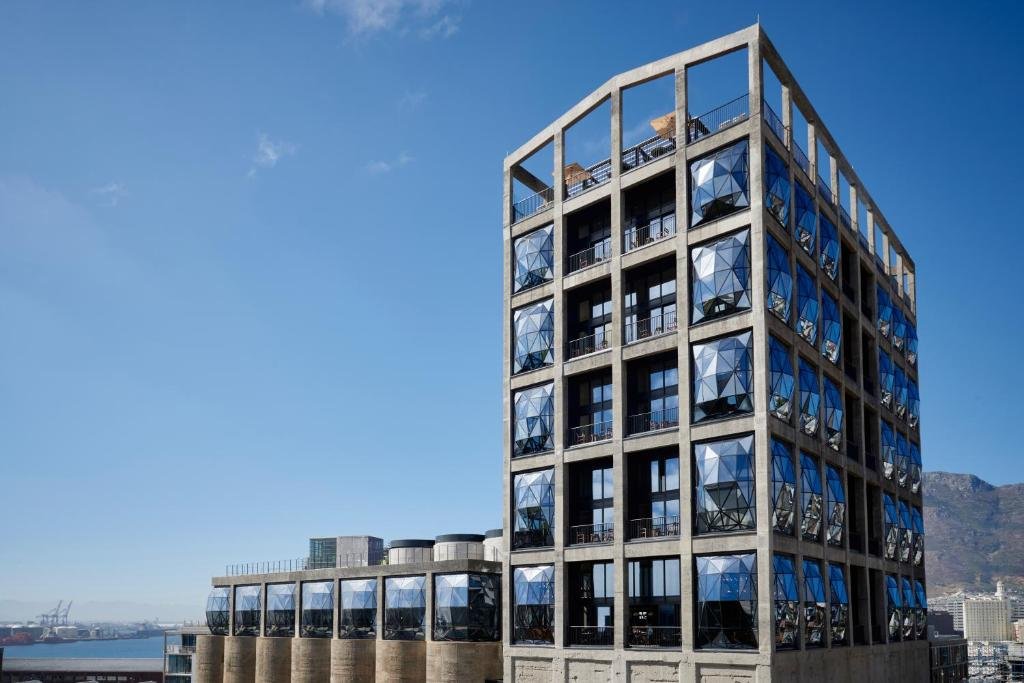
Thomas Heatherwick was commissioned to transform the elevator house and adjacent storage annexe of a 1920s grain silo complex into a one-of-a-kind urban hotel with panoramic views from its triple-height, multi-faceted windows across Cape Town’s bustling waterfront. Those windows, bulging from the industrial concrete exterior like faceted diamonds, are among the most photographed pieces of architecture in contemporary Africa.
With just 28 rooms, The Silo is a proper luxury boutique hotel. Each room is faultlessly comfortable with extraordinary views, especially from the bathrooms. The hotel sits directly above the Zeitz Museum of Contemporary Art Africa, which houses Africa’s largest collection of contemporary African art.
The interiors were designed by hotelier Liz Biden, who built a collection of works by artists including Cyrus Kabiru, Mohau Modisakeng, and Nandipha Mntambo. The hotel includes a subterranean private art gallery called The Vault, which functions as a link between the hotel and local Cape Town galleries.
Holds one Michelin Key. One of the very few hotels in the world where the building, the collection, and the city it sits in are all simultaneously the point.
Best for: Art collectors, design professionals, and travellers who want their accommodation to say something meaningful about where they are.
4. Aman Nai Lert Bangkok, Thailand
Architecture 5/5 | Interiors 5/5 | Sense of Place 5/5 | Sustainability 4/5 | Experience 5/5
Total: 24/25
In a city overflowing with luxury hotels, Aman Nai Lert Bangkok arrives with something most cannot claim: a genuine story. The hotel occupies the first 19 floors of a 36-storey tower rising above Nai Lert Park, one of the largest private green spaces in downtown Bangkok, on land that has been in the Nai Lert family since 1915.
A 12-metre bronze raintree sculpture hovers above a black reflection pool in the ninth-floor lobby, its 6,000 brass leaves catching lantern light in a slow, meditative shimmer. Elsewhere, leopard motifs quietly reference Chao Tam, Nai Lert’s famously free-roaming pet leopard. Bronze lotus leaves nod to a bomb crater turned pond. Even the building’s curves echo the layered rooflines rebuilt after wartime damage.
Designed by Openbox Architects with interiors by Denniston, the hotel unfolds in layers, from a shaded park-side portico to the soaring triple-height atrium. Rooted in Thai craftsmanship, the design integrates woven textures, tactile surfaces, and a rich colour palette inspired by Bangkok’s energy.
Named among AHEAD Global’s Top 10 hotels for 2025 and described by judges as “masterfully designed and executed.”
Best for: Travellers seeking cultural depth alongside extraordinary architecture. One of the great urban retreats of modern hospitality.
5. Mahali Mzuri, Maasai Mara, Kenya
Architecture 4/5 | Interiors 5/5 | Sense of Place 5/5 | Sustainability 5/5 | Experience 5/5
Total: 24/25
The name means “beautiful place” in Swahili. It is not an overstatement. Sir Richard Branson’s 12-tent safari camp sits within the Olare Motorogi Conservancy in Kenya’s Maasai Mara ecosystem, directly in the path of the annual great migration. The camp’s location on a lush valley ridge overlooking rolling plains provides unrivalled panoramic views and wildlife sightings from both the tent decks and communal spaces.
Mahali Mzuri officially reopened in June 2025 following an extensive redesign that elevated an already spectacular property. The new interior design concept, curated in partnership with Lynne Hunt London, reflects a contemporary interpretation of African design, retaining the camp’s iconic tented structures and deep connection to Maasai culture while enhancing the immersive guest experience.
Each renovated tent features claw-foot tubs, separate showers, oversized lounging sofas in dedicated living areas, and private decks, now enhanced with custom Maasai beadwork and contemporary African design elements. The food is pan-African, prepared with locally sourced ingredients. The conservation credentials are built into the property’s operating model.
Voted number 4 Best Resort in Central and Eastern Africa in the Condé Nast Traveler 2025 Readers’ Choice Awards, and named among Esquire’s Best New Hotels in the World 2026.
Best for: Travellers who want exceptional design without sacrificing genuine connection to landscape and local culture.
6. Desert Rock Resort, Hejaz Mountains, Saudi Arabia
Architecture 5/5 | Interiors 4/5 | Sense of Place 5/5 | Sustainability 5/5 | Experience 4/5
Total: 23/25
Named AHEAD MEA Hotel of the Year, Desert Rock Resort redefines the relationship between architecture and landscape. Designed by Oppenheim Architecture with interiors by Studio Paolo Ferrari, the resort uses plaster, limestone, bronze, and charred wood to compose spaces that feel at once ancient and refined. Each guestroom offers a meditative connection to the desert terrain, while dining and wellness spaces unfold organically through the contours of the Hejaz Mountains.
The concept is radical: rooms carved directly into the mountain face, connected by a network of paths that trace the natural geology of the site. Guests do not look at the landscape. They live inside it.
The tactile restraint of the design is deliberate. Nothing competes with the rock. The architecture’s job is to frame the desert, and it does so with the kind of precision that only comes from architects who understood the site’s scale before they picked up a pencil.
Best for: Those seeking silence, geological drama, and one of the most genuinely unusual sleep environments on earth.
7. Rosewood Amsterdam, The Netherlands
Architecture 5/5 | Interiors 5/5 | Sense of Place 5/5 | Sustainability 3/5 | Experience 5/5
Total: 23/25
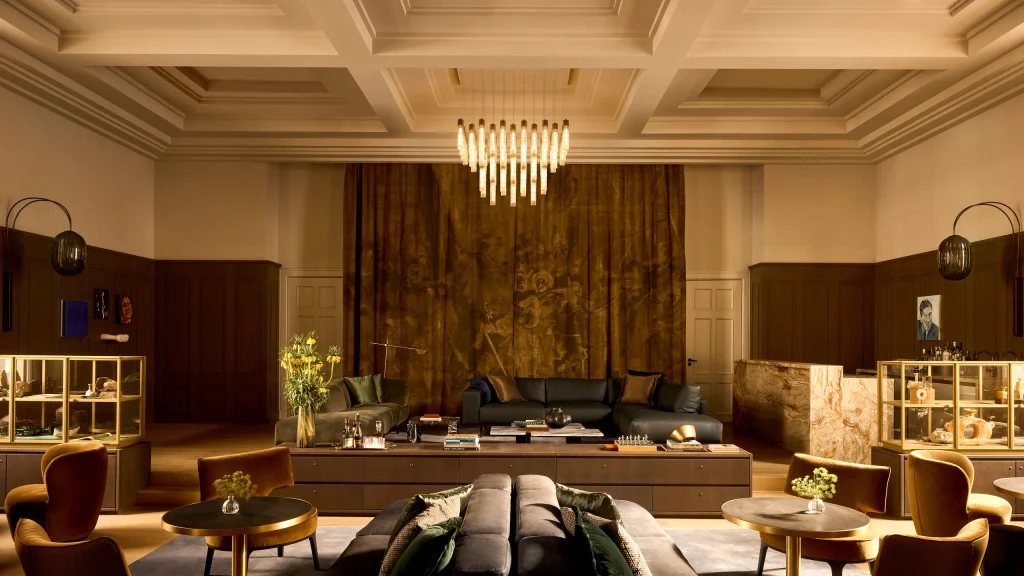
Named among AHEAD Global’s Top 10 hotels for 2025, Rosewood Amsterdam occupies a series of historic canal houses in the city’s UNESCO-listed waterfront district, offering a refined residential charm alongside revived Dutch Golden Age architecture.
The hotel is the result of a meticulous restoration that preserved the individual characters of the buildings while creating a coherent luxury experience across them. Each room reads differently because each house was different: varying ceiling heights, different window proportions, distinct views of the canal or the courtyard. The architecture refuses homogeneity, and the result is a hotel that feels genuinely inhabited rather than staged.
Dutch design detail runs through every surface: hand-painted Delftware references in the tilework, custom furniture in natural oak, and a palette that evokes the silvery light of northern European waterways. It is Amsterdam rendered as an interior argument, and it is persuasive.
Best for: Design travellers, heritage architecture enthusiasts, and anyone who wants to understand what Amsterdam’s Golden Age looked like from the inside.
8. Capella Taipei, Taiwan
Architecture 5/5 | Interiors 4/5 | Sense of Place 4/5 | Sustainability 3/5 | Experience 5/5
Total: 21/25
Named among AHEAD Global’s Top 10 hotels for 2025, Capella Taipei delivers a deeply considered interpretation of Taiwanese architectural heritage within a contemporary luxury framework.
The property occupies a 1970s building that has been transformed through a design process that treated the existing structure as a resource rather than an obstacle. The result is a building that carries traces of its own history while feeling entirely contemporary. Traditional Taiwanese craft, lacquerwork, hand-weaving, stone carving, runs through the interiors in ways that feel embedded rather than decorative.
The hotel’s position in Taipei’s Da’an District gives it access to the city’s dense cultural infrastructure: the National Palace Museum is close, and the design districts of Zhongzheng and Da’an are accessible on foot. It functions as a genuine urban base as much as a destination in itself.
Best for: Travellers interested in Asian design heritage and the relationship between tradition and contemporary luxury.
9. Villa Sahrai, Casablanca, Morocco
Architecture 4/5 | Interiors 5/5 | Sense of Place 5/5 | Sustainability 4/5 | Experience 4/5
Total: 22/25
With hammams, a rooftop pool, and sensorial handcrafted interiors, Villa Sahrai channels Casablanca’s modern pulse through timeless local craft. The hotel is a master class in the specific art of making a contemporary property feel rooted: every material, every technique, every artisanal detail connects to a Moroccan making tradition while remaining thoroughly of its moment.
The architecture draws on the riad typology, an inward-facing building organised around a central courtyard, and reinterprets it for the contemporary traveller. Light enters through multiple planes. The hammam is not a wellness amenity bolted on to the programme. It is the centre of gravity around which the rest of the property is organised.
Casablanca is often overlooked in favour of Marrakech and Fes in discussions of Moroccan design. Villa Sahrai makes the case that the country’s economic capital has a design culture of its own, equally sophisticated and less mediated by the international tourist gaze.
Best for: Design travellers interested in North African craft traditions, and anyone who has been told Casablanca is not worth stopping for.
10. NOA Hotel Shenzhen, China
Architecture 5/5 | Interiors 4/5 | Sense of Place 4/5 | Sustainability 4/5 | Experience 4/5
Total: 21/25
NOA Hotel Shenzhen takes a former factory and transforms it into a new world for the young, creative Shenzhen crowd. The adaptive reuse is handled with the kind of confidence that comes from designers who understood both what the factory was and what the city around it is becoming: a technology and creative capital that is simultaneously one of China’s youngest cities and one of its most rapidly evolving.
The industrial bones of the building are preserved and celebrated rather than concealed. Exposed concrete, original structural columns, and the generous volumes of a manufacturing space repurposed for hospitality: these elements give the hotel a quality of authenticity that new-build hotels in Shenzhen’s gleaming skyline do not possess.
The programming is equally considered. The hotel functions as a cultural venue as much as an accommodation option, with spaces designed for exhibitions, performances, and the kind of creative gathering that Shenzhen’s young professional class is generating at remarkable speed.
Best for: Creative professionals, design enthusiasts, and anyone who wants to understand where Chinese urban culture is heading.
What Makes a Hotel Exceptional
The properties on this list share one quality above all others: they were designed by people who understood that the building’s job is not to impress. It is to disappear into the experience of being there.
The Shebara’s mirrored orbs dissolve into the Red Sea. The Silo’s faceted windows disappear into the Cape Town sky at night and reappear as beacons at dawn. Aman Nai Lert’s bronze raintree becomes the light of Bangkok filtered through sixty years of craft. Mahali Mzuri’s tented suites open onto a plain that has been moving since before there were humans to watch it.
Exceptional design is not about spectacle. It is about the moment, the day after you leave, when you realise you can still describe exactly how a room felt. That is what these ten hotels all deliver. In very different ways, in very different places, they all deliver it completely.