


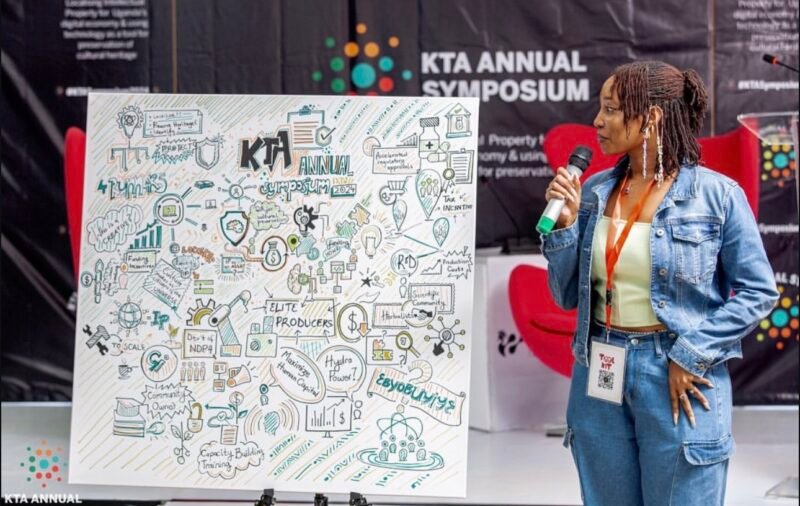
The global art market is in flux, with digital assets and NFTs opening new frontiers that challenge the dominance of traditional galleries. Yet, African artists often find themselves underrepresented in these spaces. Natasha Karungi, a Ugandan visual and digital artist, is helping to rewrite that story. From launching Pineapple’s Day Out, Africa’s first generative NFT project, to building communities around ownership and visibility, she has proven that innovation is not confined to Silicon Valley or Europe. Her journey is as much about artistry as it is about carving a seat at the global table for African creators.
African Mythology Meets Web3: Natasha Karungi Talks NFTs, Success, and Storytelling

FAB: Let’s start from the beginning. You’re a self-taught visual artist. How did it all start? What drew you to art?
Natasha Karungi: I’ve always been an artist. As a child, I started by sketching Barbie dolls and Disney princesses. Those books fascinated me, and copying them was how my journey began. Art quickly became my refuge. Coming from a disruptive childhood, being the first-born daughter in a strict religious family, it was the one thing that gave me comfort.
My parents were pastors, my dad was also in the church, and pursuing a creative path wasn’t easy. In that environment, art was seen as part of the “secular world,” while I was expected to follow a traditional path: settle down, raise a family, maybe teach. Choosing art felt like rebellion, but it was also survival. I’ve always seen art as more than a hobby. For me, it’s a way of life, an intimate relationship. Art has always been my soulmate.
Even in high school and later at university, I faced resistance. My dad pushed me into a Bachelor of Commerce. He convinced me to try one semester, promising I could switch to art afterward. But semester after semester, the switch never came. By my third semester, I realized he was grooming me for a master’s degree and the corporate track: ACCA, finance, and boardrooms. But I didn’t feel aligned with that future.
So I made a decision: I told him I was dropping out of business school to pursue art. We searched for programmes in Kampala, and I eventually got into Artfield, where I studied illustration and graphic design. That’s how I entered the digital art space. Looking back, it was less a career decision and more a declaration of who I already was.
FAB: Do you think the narrative, especially within African families, is changing when it comes to accepting art as a profession? Do you think people now view it as a legitimate career, just as someone can be a lawyer or a doctor?
Natasha Karungi: I think the narrative is changing, but very slowly. Parents are more open-minded than before, but many still prefer when a creative career looks “safe” or corporate. For instance, they’re more comfortable if you’re an artist who works in a gallery, a media company, or a design firm than if you’re an independent, full-time artist.
What really makes the difference is visible success. In African families, pride is tied to achievements. Parents want to go to gatherings and say, “My daughter Natasha Karungi is doing this, this, and this.” Once they see you thriving, they become more accepting and supportive. But at the beginning, it’s often difficult because they don’t understand what you’re building.
Many of our parents grew up with a limited definition of success: you became a doctor, lawyer, or engineer. That blueprint still shapes their expectations. But slowly, with more artists sharing their stories and showing what’s possible, the mindset is shifting. The more examples there are of creatives succeeding on their own terms, the easier it becomes for parents to believe in art as a legitimate path.
Defining Success as an African Artist

FAB: Excellent, thank you. You mentioned something about success, and as we know, success means different things to different people. So, how can a young artist define success for themselves? Or let me put it this way: what would be your own definition of success in a career?
Natasha Karungi: For me, success starts with figuring out a rhythm in your career that truly works for you. As a full-time artist, I plan my days around deliverables and personal goals. When I achieve those, that’s the first layer of success—internal validation. From there, it’s about shifting the goalposts: asking what else I can do and how I can contribute more to the art space in Kampala, East Africa, and beyond.
I also believe success is contagious. When people see my work, it sets new benchmarks for them too. They’ll say, “Oh, Natasha Karungi sold out an NFT project; maybe I can do that too,” or “She exhibited her work here, so why can’t I?” I’ve had people tell me I inspired them to exhibit their art without waiting for a gallery’s approval. Too many artists feel stuck because they think a gallery contract is the only way forward.
To me, success is also about self-awareness: recognising where you are, being grateful for it, and constantly re-evaluating. If I achieve this, what more is possible? How can I turn opportunities into bigger ones? Discipline is key; whatever blessings you receive, you must multiply them. Recognition or one-time payment for a project is great, but if it ends there, it’s incomplete. True success is both external validation and the internal gratification of knowing you’re growing, evolving, and staying rooted in your craft.


FAB: Wow, thank you. That was a long response, but it touched exactly what we hoped for—impacting your community, giving back, and being a light for the people coming behind you. You’ve also been educating Ugandans about NFTs and hosting summits like NFT Africa. But since NFTs are still an emerging trend in Africa, what’s the biggest misconception about them, and how have you been addressing it?
Natasha Karungi: The biggest misconception is that NFTs are a quick money scheme. Many artists enter the space thinking, “I’ll upload my art and make $5,000 in two weeks.” But it doesn’t work like that. Just like in the traditional art world, success depends on how much you’ve built your brand and presence. NFTs are not a shortcut to wealth.
What NFTs do offer—especially for digital artists—is provenance. In the online world, your art can end up anywhere: Pinterest, Facebook, marketplaces. Over time, it becomes almost impossible to trace ownership. NFTs solve that by giving you digital ownership and proof of authenticity. That’s how I explain them in workshops and talks: yes, money is possible, but the deeper value lies in ownership, distribution, and access to new markets. Never miss a beat in fashion, arts, beauty, and lifestyle, follow FAB L’Style Magazine.
NFTs break down borders. They allow me, a Ugandan artist, to showcase my work in New York, LA, and Miami without waiting decades or relying on middlemen. The space is still niche, so you find yourself interacting with major curators and artists on the same level. That creates global visibility faster than the traditional system ever could.
But the market is volatile, and if artists only see NFTs as a financial tool, they’ll burn out quickly. We won’t grow communities, attract collectors, or inspire new artists to join if the only focus is money. So I always ask: how are you building your brand so that market volatility doesn’t wipe you out? For me, it’s about community, ownership, and reimagining how African artists can connect with the world. That’s the narrative we’re working to shift.
Pineapple’s Day Out and the Rise of African NFT Projects


FAB: You launched Pineapple’s Day Out, the first generative NFT project from Africa led by an African team. Most times when we talk about tech innovation, Africa is framed as a consumer rather than a creator. What was the biggest lesson you took from living through such a historic moment?
Natasha Karungi: Honestly, the biggest lesson was that it’s possible; you just have to do it. When we launched that project, we were figuring it out as we went along. At first, the goal was simply to support African artists. I had started as an artist in the space, and selling work was painfully slow. There’s also an unspoken bias in the market: collectors often buy within their regions. Americans collect from Americans, and Japanese from Japanese. African artists rarely had African collectors, so we struggled to gain traction.
We asked ourselves, What can we do to change this? That’s when we realised generative projects were generating real income and attention. So we said, ‘Let’s try this.’ Along the way, we learnt what it takes to build a global community. We learnt about the market, what sells, what doesn’t, and how to keep people engaged.
When we launched our latest project, Bush Baby Club, we applied those lessons. This time, it wasn’t just about selling art; we focused on building IP and storytelling. That shift changed everything.
The biggest takeaway? Confidence. Too often, Africans are left out of the tech conversation. But that project proved we could not only participate, we could lead. Of course, we also learnt the nitty-gritty: team building, leadership, and keeping communities alive. But it all started with the confidence that we can do this.
From Uganda to the Metaverse

FAB: Since Africa is rarely positioned at the forefront of technological advancement, where do you see the future of African artists in Web3 and digital art economies?
Natasha Karungi: African artists are phenomenal, but historically our work has barely been documented. When global art movements are written, African contributions are often reduced to a few clichés: the Benin masks, Tinga Tinga art, and other fragments. That’s not the full story.
The future lies in visibility and documentation on a global scale. Digital tools make that possible. NFTs and Web3 allow us to reach audiences without physically moving. Travel restrictions are a real barrier for African artists; you can’t just decide to attend NFT Paris or NFT NYC. A visa alone can take months to process.
But online, those borders fall away. I’ve showcased my work in New York, LA, and Miami without ever stepping on a plane because of NFTs. For the first time, African artists can join global art movements in real time.
And importantly, we’ll no longer be boxed in as just “African artists”. Our work will be recognised for its individuality and style. Web3 is helping to rewrite art history, and this time Africa won’t just be a footnote; we’ll be at the table.
FAB: Let’s shift gears a little. Let’s talk about the artist’s mind. When you’re creating, do you first see the story or the visuals? Walk us into your studio. What happens before the first line hits the screen?
Natasha Karungi: My creative process isn’t always linear; it shifts depending on the day. But I always start with yoga and meditation. That routine clears my mind. If I’m stuck on a painting, I begin with doodles. Doodling is like my warm-up, the way athletes stretch before a race. It helps me shake off the fog and get ideas flowing.
Most of my inspiration doesn’t come while I’m in the studio. It happens while I’m living life. I might notice how sunlight hits a building during a run, how it reflects on water, or how a scene unfolds when I’m out with friends. Water especially inspires me. I’m always drawn to it. When I finally get to the studio, I gather all these impressions and translate them into sketches.
Even though I’m a digital artist, I always start on paper. There’s something different about it. On paper, mistakes matter; they can even transform a piece in unexpected ways. On a tablet, I can just undo and erase. That’s why sketching on paper feels like my guilty pleasure. I still enjoy it before moving into digital.
FAB: Interesting. So you’re one of those artists who still love the feel of paper—just like readers who prefer physical books.
Natasha Karungi: Exactly.
FAB: The art you create often carries curiosity and sometimes controversy. What’s the most challenging conversation one of your works has sparked?
Natasha Karungi: I’d say it was around my piece Kakalabanda Stole My Heart. Let me explain. The kakalabanda is a mythical figure in Uganda. As kids, we were told, “If you don’t sleep, the kakalabanda will come and beat you.” It was imagined as a skeleton meant to scare children into bed.
I decided to reimagine that story. In my version, the kakalabanda isn’t a monster; it has a lover it visits every night. But because of its frightening appearance, people assume it has come to punish children. That twist completely changed the narrative.
The piece sparked a lot of debate. In a community as superstitious as ours, people felt uneasy engaging with it. Childhood fears resurfaced, and many described the work as demonic. Some even told me, “You can’t tell our stories this way.” Since Ugandan society is deeply religious—both Muslim and Christian—many found the piece controversial. At one point, even close friends avoided it, saying, “I don’t want anything to do with the kakalabanda.”
But for me, that was powerful. It meant the work had done its job. If my art doesn’t make people feel something—whether fear, curiosity, or even discomfort—then I haven’t achieved my purpose. This piece did all of that.
Interestingly, while some rejected it, others embraced it. They saw it as a fresh way of reclaiming African stories. That tension—between fear and acceptance—is what made kakalabanda Stole My Heart so significant to me.


Web3 as a Game-Changer for African Artists
FAB: I love that twist. Seeing mythical figures beyond just being demonic is daring and brilliant. So let me ask: if you were to curate one exhibition to represent the African digital renaissance today, which three of your works would make the cut, and why?
Natasha Karungi: The first piece would be The Most High. It’s a reimagining of a saint, inspired by stained glass art, and one of my favourites. It shows a woman in a position of power and reverence. Growing up in a religious household, I saw how much influence religion had over our lives, how it shaped thinking and carried authority. Yet in most churches, saints and revered figures are men. The only female figure is Mary, and she’s celebrated mainly because she gave birth to Christ. That always made me wonder: what would it look like if a woman herself stood in that sacred position of power? The Most High is my answer to that question.
The second piece would be kakalabanda Stole My Heart. It’s another favourite because it embodies the essence of African storytelling. Our mythologies often feature monsters, supernatural beings, or immortality. These tales carry spiritual weight, which is why many people fear them. Growing up, nothing was ever said plainly. If our elders didn’t want us to walk at night, they didn’t simply say, “It’s unsafe.” Instead, they warned that an old woman would steal us, or a night dancer would take us away. These were cautionary tales, moral lessons delivered through fear. kakalabanda captures that cultural richness, our myth, our ancestors, and our history.
The third piece would be Waliyo Akawala: One Girl, Many Stories. It was inspired by Tinga Tinga art during my residency in Tanzania. This work is a self-portrait that shows different versions of myself, each telling a story of who I was at the time. Parts of it remain unfinished, with patterns replacing unwritten stories. That symbolizes how my life is still unfolding—how some parts remain unknown but are evolving. It’s an ode to myself, a reminder that my journey doesn’t end here.
So if I had to choose, those three—The Most High, kakalabanda Stole My Heart, and Waliyo Akawala: One Girl, Many Stories—would represent the African digital renaissance through my lens.


FAB: You’ve said you want your art to tell stories a thousand years from now. When we read Shakespeare today, we get a vivid sense of his era. What story about this moment in history do you hope future generations will take away from your work?
Natasha Karungi: Lately, I’ve been exploring internet culture in my work. A thousand years from now, I don’t know what the internet will look like or if it will even exist. But I want people to see how deeply it shaped us. We became “internet people”, socialising online more than in person, living lives mediated by screens. I want that shift to be visible in my art. With the archiving and documentation I’m building, I hope future generations will look back and think, “These people were fun, connected, and digital.” Who knows, maybe in a thousand years we’ll return to pen and paper. History has a way of looping; evolution often circles back to something familiar.
FAB: In the next five to ten years, how do you want your work to be recognised? What would you like to be known for?
Natasha Karungi: I’ll break it down. In ten years, I want to be recognised as the social, digital, and change artist—the one who reshaped how people view and experience digital art. In five years, I want my art to open doors for other African artists. I want a seat in the rooms where decisions are made about the future of art in East Africa and across the continent. From there, I hope to give back to my community by breaking barriers, crossing borders, and making my work a reflection not only of myself but also of my country, my people, and my beliefs.
FAB: Those are powerful goals. And I love how you tie success not just to recognition but to impact, how well you touch lives and open doors for others. So finally, when someone encounters your work, what’s the one feeling you want them to leave with?
Natasha Karungi: Nostalgia. I want my art to stir a memory, a feeling, a spark of recognition. Whether it’s romance, mythology, or something deeply personal, I want it to awaken that sense of home, of belonging. Whatever the form it takes, as long as it feels nostalgic, I’ll know my work has done its job.