


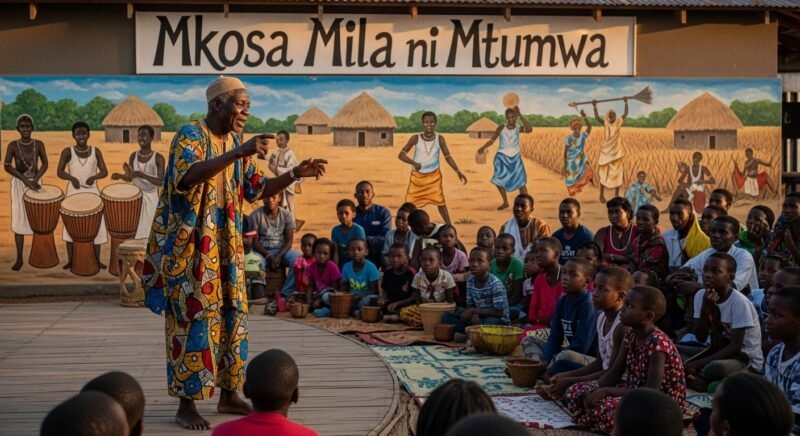
Imagine standing in a bustling marketplace. Everyone around you speaks a language you understand, but they are debating prices based on a currency that holds no value to you. They are pointing to landmarks you cannot see and celebrating holidays you have no context for. You are present, breathing, but utterly adrift. This is the subtle, profound isolation that Mkosa Mila ni Mtumwa describes. This Swahili proverb, popularized in modern discourse by thinkers like Lisa Kibutu, is typically translated as, “He who lacks culture is a slave.”
At first glance, the word slave feels harsh, perhaps overly dramatic for a discussion about tradition. We must immediately redefine the term. The bondage here is not literal, physical enslavement marked by chains and forced labor. This is a far more insidious, modern, and often self-imposed form of servitude: existential slavery. It is the condition of being intellectually un-owned, politically programmable, and psychologically unmoored. It is the fate of the one whose internal map has been replaced by the coordinates of their colonizer or their consumer culture.
We live in a world that sells easy answers and quick identities—branded clothes, transient digital trends, and shallow consumer philosophies. But when you lack a deep-rooted Mila (custom, tradition, way of life), you lack the essential blueprint for authentic selfhood. You are forced to rent your identity from the dominant systems around you. This debt of borrowed identity is the true price of that spiritual slavery.
The Currency of Memory: When the Compass Breaks
Why is culture such a fierce defense against bondage? Because culture is the memory of solutions. It is the comprehensive, peer-reviewed guidebook written by thousands of generations who successfully navigated the challenges of a specific landscape, society, and climate. When you lose that book, you lose your compass and your context.
The Loss of the “Before”
To lack Mila is to live without a Before. If you don’t know how your ancestors managed land without chemicals, dealt with conflict without police, or healed illness without modern pharmaceuticals, you become completely dependent on external, often expensive and unsustainable, systems. You cannot critique the present because you have no memory of an effective past.
Think of indigenous food systems. Many African cultures had complex methods of rotation, companion planting, and seed preservation—knowledge perfectly suited to local soil. When those practices are dismissed as “rudimentary” and replaced by mono-crop farming dependent on foreign fertilizers and imported seeds, the farmer gains money in the short term, but loses food sovereignty forever. They become a slave to global commodity prices, climate vulnerability, and industrial supply chains. The spiritual loss is converted into a tangible economic vulnerability.
The Silence of Language
Language is another major casualty in this spiritual war. Culture is housed in language; it is the unique architecture of a people’s thought. The Swahili proverb itself would lose its powerful resonance if merely translated to “lack of tradition is weakness.” The word Mtumwa (slave) hits differently. When a community shifts entirely to a colonial language—English, French, or Portuguese—they may gain access to global commerce, but they lose access to their own subtle, emotional, and ethical lexicon.
The idioms, the complex praise names, the proverbs that encode thousands of years of ethical philosophy—these are silenced. How can a child truly understand the nuanced relationship to the environment if the local words for specific trees, seasons, or types of rain have been forgotten? This linguistic void creates a dependency on foreign cultural frameworks to articulate even basic human experiences, making the individual intellectually subservient.
The Shackles of Consumerism
If we accept that existential slavery means lacking the means to define one’s self, then the modern marketplace becomes the primary slave driver.
The Illusion of Choice
In the absence of a strong cultural identity, people often seek to fill the void with consumerism. The message of modern capitalism is: You are what you buy. If you don’t have a traditional code of dressing to signal status, you buy a luxury brand. If you don’t have a cultural ritual to mark a milestone, you buy a lavish, commercially standardized party.
The person who lacks Mila becomes the perfect consumer: always chasing the next trend, always feeling inadequate, and forever reliant on brands to supply the missing sense of belonging. The chains are invisible, made of debt and desire, but the bondage is absolute. The mind is constantly worried about external validation rather than internal integrity.
The Art of Resistance: Storytelling as Cultural Liberation
If cultural slavery is rooted in a stolen memory, then art and storytelling become the most potent acts of liberation. They are the means by which a people restore their internal archive, rebuild their self-definition, and disseminate their true history.
The Return of the Griot
In many African societies, the Griot (or historian, praise singer, poet) was the living library, memorizing and transmitting law, lineage, and epic history. This role is being powerfully revived today through contemporary art. Modern African literature, cinema, music, and fashion are all acting as the new Griots.
- Reclaiming Narrative: When a novelist writes a story centered on the ethical dilemmas of a pre-colonial African king, they are actively challenging the colonial narrative that Africa had no history or governance prior to European arrival. The art piece is a documented proof of concept for sovereignty.
- Healing Trauma: Art provides a vital space for processing the trauma of erasure and forced assimilation. Through music, dance, and film, contemporary artists are exploring the complexities of identity, diaspora, and resilience. This creative expression is a form of psychological decolonization, allowing communities to name their pain and articulate their future.
- Accessibility: Art democratizes culture. A complex ancestral code that might take years to master can be presented in a single, emotionally resonant song or a visually stunning film, making the core principles of the Mila accessible to a generation that has grown up far from its source.
The Fashion Statement of Freedom
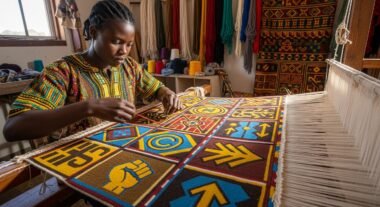
As previously discussed, fashion becomes a language of liberation. When designers utilize ancestral motifs (like Adinkra or Kuba patterns) with respect and reciprocity, they transform a commercial product into a wearable manifesto. To wear such a piece is to make a public declaration: “I know my history, I respect its codes, and I am not defined by your fleeting trends.” It is the creation of a physical, visible tie to a resilient past, reinforcing personal identity against the amorphous pressures of globalization.
Recommended For You
The Swahili Blueprint: Lessons from a 1,000-Year-Old Civilization
Cultural Homecoming: Practical Steps for Revival in the Diaspora
For those in the diaspora, often generations removed from the ancestral homeland, the proverb Mkosa Mila ni Mtumwa hits with particular poignancy. Revival requires intentional, practical steps to reconstruct the memory that was violently disrupted. It is a form of cultural engineering and ethical labor.
1. Language Reclamation: The Gateway to the Soul
The single most effective step toward cultural freedom is language reclamation. As the core vessel of culture, reclaiming a language (even partially) unlocks worldviews that are inaccessible through translation.
- Actionable Step: Commit to learning key phrases, proverbs, or songs in an ancestral language (e.g., Yoruba, Igbo, Swahili, Wolof). Seek out online communities, diaspora tutors, or university courses. The focus isn’t fluency; it’s accessing the unique philosophical framework embedded within the grammar.
2. Documentation and Digitization
Slavery thrives on undocumented memory. Diaspora communities are uniquely positioned to use digital tools to counter this.
- Actionable Step: Build and support community-led digital archives that gather oral histories, family recipes, traditional healing knowledge, and cultural expressions. This creates a secure, democratized, and searchable record, ensuring that the knowledge is owned and controlled by the community itself, protecting it from further appropriation.
3. Ethical Patronage and Reciprocity
True revival demands an end to extractive consumerism. The diaspora must become a source of ethical patronage.
- Actionable Step: Buy art, textiles, and goods directly from African and Indigenous artisans who control their supply chains and set their prices. Demand to know the source and ask about their benefit-sharing models. This practice, often called “buying back the block,” re-establishes the economic link to the source communities, transforming consumption into a tool of economic justice and communal strength.
4. Ritual and Commemoration
Culture is practical; it is how we live. Revival must be integrated into daily life, not confined to museums or heritage months.
- Actionable Step: Adapt or revive traditional rituals for modern contexts. This might mean starting a simple ceremony to mark the changing seasons, consciously incorporating ancestral ingredients into daily meals, or creating a family practice around storytelling and oral history transmission. This intentional creation of new, meaningful custom—rooted in old values—is the ultimate proof that the Mila is not dead; it is dynamic and living.
By engaging in these active steps, the individual in the diaspora moves from being a passive victim of cultural loss to an active architect of cultural revival. They are throwing off the existential shackles, transforming the shame of absence into the profound dignity of belonging. The Mkosa Mila ni Mtumwa becomes Mwenye Mila ni Mkuu (He who has culture is great).