
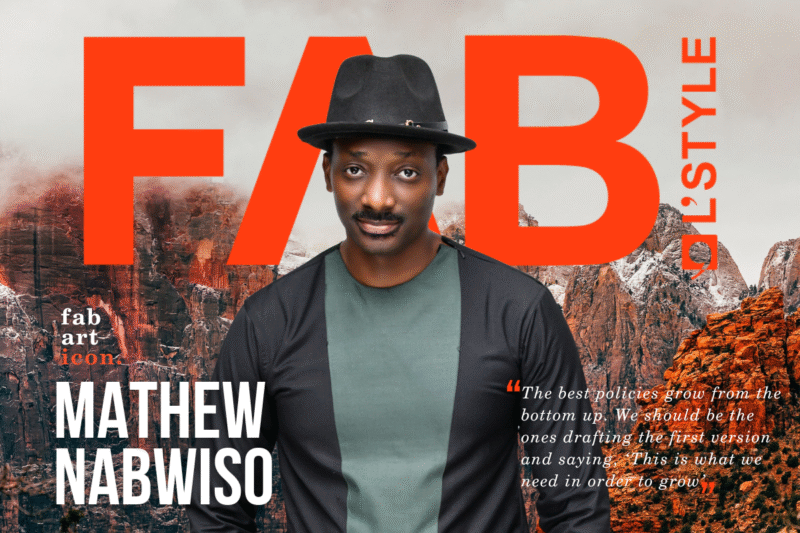
They say a nation writes its future through the stories it chooses to tell. If that is true, then Mathew Nabwiso has become one of Uganda’s most important storytellers. From corporate sales manager to award-winning actor, director, and now the second Ugandan elected to the International Academy of Television Arts and Sciences, his journey reads like a film script sharpened by grit, grace, and undeniable purpose. In this rare conversation with FAB L’Style, Mathew opens up about the global door he has just walked through, why Uganda’s film industry is standing at the edge of a defining moment, and the private battles he fought long before the spotlight found him.
FAB: Let me start by congratulating you on your election to the International Academy of Television Arts and Sciences.
Mathew Nabwiso: Thank you. Thank you. I even saw a musician there, Darey Art Alade. He is one of the members. I am curious to see if he will attend the gala this November.
What Joining the International Emmy Academy Means
FAB: How did the news reach you, and what did it mean to you on both a personal and professional level?
Mathew Nabwiso: Receiving that news was amazing. It mattered to me, to our country, and to our guild. Uganda has rarely had its film and television projects recognized in this way. For a long time, we have been disconnected from the Emmys. Recently, filmmakers have pushed their work to the Oscars, but we have hardly appeared in the Emmy space.
This recognition is an important opening. It gives us a chance to be part of global conversations and to understand what is happening in international television. I also had the opportunity to join the jury team, which is very exciting. So the news was not only a personal achievement. It was a boost for my production house, for the country, and for the Producers Guild as a whole.
FAB: You now sit at the same table with some of the most influential names in global television. How do you plan to use that position to amplify Uganda’s creative voice?
Mathew Nabwiso: I will be traveling this November to attend the Emmys, and we will also have board meetings as members of the Academy. My first goal is to learn as much as possible from the Academy. After that, I want to share this knowledge with filmmakers and producers back home. This information can help us grow, enter global markets, and understand what it takes to compete internationally.
Being a member has already shown me how much training the Academy offers. Some sessions take place in New York, others in Cannes, and others in London. There are about four major training programs each year, all focused on the strongest global practices. They show us where the industry is heading.
This is a huge opportunity for my team and me. These programs cover areas such as distribution and analytics, including how to create online content that appeals to an audience. They also explore artificial intelligence and how it will shape the future of entertainment. In Africa, we are still learning about AI, yet international players are several steps ahead because they receive first-hand updates.
Being part of the Academy allows me and the people I work with to receive that information in real time. We can see where AI is heading, how content formats are shifting, and what steps we need to take to stay relevant. This will directly shape the content we create. I see many opportunities, and I am excited to engage fully.
Funding, Creativity, and Misconceptions in African Storytelling

FAB: From your experience and your current vantage point, where is Ugandan cinema today, and where does it need to go next?
Mathew Nabwiso: I believe we are doing well at this stage. We have produced films and television series that have competed globally and won awards at festivals across Africa, Europe, and the United States. Our technical ability is strong. If it were not, we would not be winning awards.
We also have significant experience. I personally produced and directed a TV series called Sanyu, the most watched show in the country. It performed extremely well on MultiChoice platforms. I produced and wrote 880 episodes of that show.
We also receive feedback from audiences in South Africa, Zambia, and Ghana. For example, when the show had no subtitles, viewers would say, “We love this show, but when you switch to your local language, we miss the meaning. Please add subtitles.” These comments came from both DSTV and ShowMax users. This shows that our work is traveling and being appreciated.
When it comes to equipment, we are using tools that are comparable to those used in Hollywood. Our biggest challenge is distribution. We have not succeeded in pushing our content globally in the way we should. In Uganda, you will see many people watching Nigerian films. But not many Nigerians are watching Ugandan films. Distribution is our largest gap, and the Producers Guild is working with other stakeholders to improve it.
Found For You
What’s So Special About Ugandan Coffee?
Lagos Fashion Week 2025: 15 Years, £1 Million, and the New African Blueprint
FAB: For Uganda specifically, some people believe funding is the main issue. Others argue that content creators are not listening to market demands, which means they are not producing what audiences want. How do we solve this and the other problems in a systematic way rather than simply acknowledging them?
Mathew Nabwiso: I do not fully agree with that view. Funding does limit what we can produce, and there are stories we want to tell that require significant investment. No one is funding those projects at the moment. I personally want to create period pieces, but there is no support for that type of work here. Most funders are NGOs or organizations with specific agendas. Because of that, we are pushed to create stories that align with the interests of the funder.
Even then, the outcome still depends on the creativity of the filmmaker. When telling an NGO story, you can still show your culture, use local languages, and add elements that resonate with local audiences. So I do not accept the claim that we are not creating what people want. The evidence shows the opposite. Ugandans enjoy our content. Every time a Ugandan film premieres, no matter the size of the production, the screening is usually sold out. If audiences did not appreciate the content, those premieres would be empty.
We are producing stories that people want, but funding limits how far we can take them. Once we fix distribution, funding becomes less of a problem. Proper distribution will allow us to tell any story we want, both for Ugandan audiences and for global viewers.
Training the Next Generation of African Filmmakers
FAB: Many young filmmakers today are self-taught and lack industry exposure. Do you think Africa is producing enough formally trained filmmakers? What is missing? We have institutions that offer performing arts, media arts, and theatre arts. What are the gaps in how we prepare students for the industry?
Mathew Nabwiso: I agree that we are not doing enough to prepare young people. I appreciate programs like the MultiChoice Talent Factory, because they make a real difference. However, look at the numbers. In Nigeria, the intake is around fifty students each year. In Uganda, it has been only four students per year. That alone shows how limited the access is.
Local film schools such as Makerere University and Kampala University do offer film courses, but they focus heavily on theory. The practical element is very small. That approach is a disservice to young people who want to work in film.
We, the National Producers Guild of Uganda (PGU), have decided to address this issue. We are looking for partners, and we have already begun forming film clubs in schools. Almost every school has a drama club, because that tradition has existed for years. We are adding film training to those drama clubs. That is how we plan to support young filmmakers at the earliest stage.
When we visit schools, we bring both theory and practical training. During the development sessions, we sit down with the students and teach them how to build a story. We involve our best writers to teach scriptwriting. Then we bring our equipment to teach camera work, sound, and other technical areas. Students go through the entire value chain until they complete a film.
Once they complete their films, we plan to organize school film festivals where the students can compete and showcase their work. That competition will motivate them to create more films. After the festivals, we want to take their work into distribution.
Some members of the Producers Guild have already created online channels for this purpose. Play It Loud will distribute some of these films online. KwisoTV will do the same. Gandalflix and Afromobile are also part of this effort. We plan to collaborate with larger platforms such as Next Media, which recently launched the Next Creator hub. These partnerships will help students go through the full value chain until they see their films distributed and monetized. By the time they leave school, they will understand what the industry requires because they will have gone through each stage practically.
We also plan to reach local communities. Not everyone is in school, so we are working with partners to create regional film hubs where young people outside the school system can also participate. Our goal is to take them through the entire film production process, from development to distribution. This is how we plan to support the next generation of filmmakers.
FAB: Earlier, you mentioned that in Africa we often rely on old technology or trends that the Western world has already moved past. When we look at the industry today, audiences watch both cinema and 30-second reels on the same screen. The entertainment sector is fighting for attention, and many people now prefer short reels or TikTok content. They stay on these platforms for hours and say, “I don’t need a film.” Do you think Africans will adapt quickly to this shift, or will we wait again and end up playing catch-up?
Mathew Nabwiso: We have no choice. That is the future. As much as we love feature films, we must stay flexible and move with the direction the world is taking. Young people struggle to sit through a full animation. Even I struggle to convince my own children to watch a complete film. We sometimes have to force them and say, “Sit, let’s watch this together.” What they want are short and fast reels on YouTube or similar platforms.
This is one of the reasons we are returning to schools. We want young people to understand the work behind a film. When they become part of the process, they learn to value the craft. By the time they leave school, we have trained more than future filmmakers. We are also shaping a new generation of film audiences.
FAB: One major discussion today is about inclusivity, diversity, and sustainability. You directed Prickly Roses, which focuses on women’s experiences. How would you describe the current landscape for women in African film, both on set and behind the scenes?
Mathew Nabwiso: I cannot speak for every country, but in Uganda things are quite balanced. We have many women behind the camera, many female producers, and many directors. My wife is an actress, a film director, and a producer. For years, the global conversation pushed funding toward women, and that helped. As Nabwiso Films worked in conjunction with the American Embassy in Uganda, the team organized a Women in Film workshop in 2019 through the American Film Showcase. Some of the young women who attended that workshop have gone on to become respected producers. One of them is Doreen Mirembe, the producer of the popular DSTV series titled Damalie.
We also work closely with government stakeholders, and some of them now fund training programs for women. I believe we will see even more women in front of and behind the camera. I am not sure what that means for the men, but the boys will keep fighting for their place. Overall, in Uganda, I believe the gender balance in film is strong.
FAB: What is your view of government involvement in the Ugandan film industry right now?
Mathew Nabwiso: For a long time, the Ugandan government did not understand what film is or what it can do for the country. That gap is exactly why we formed the National Producers Guild of Uganda. We have been engaging them nonstop. After this conversation, I am heading into another meeting with the Uganda Tourism Board. We will be discussing exactly what I am saying now.
Our work has focused on sensitization. We want them to understand how film contributes to employment, entrepreneurship, revenue generation, and the GDP. Film creates many indirect jobs across every sector. Think about transport, legal services, accounting, telecommunications, and many others. They never had this information, and we are filling that gap.
Slowly, they are starting to understand. We are not stopping until film receives the attention it deserves. In the past, the government focused heavily on musicians. The National Planning Authority even budgets specifically for music. They never thought seriously about film. Now we are showing them that film is a larger creative ecosystem. Film holds music, fashion, fine art, poetry, comedy, and almost every creative discipline. They never saw this connection, and that is what our work is changing through consistent education and advocacy.
FAB: Do you think the Ugandan film industry is missing something in its positioning? You just mentioned that the music industry receives a dedicated budget. Is there something filmmakers are not doing well enough to attract government support?
Mathew Nabwiso: Yes, I would say so. For a long time, we did not position ourselves well. People in government did not take us seriously and often saw us as jokers. In the music sector, it took a musician running for president to wake up the system. They dismissed him at first, then watched the entire country rally behind him. That moment forced the government to pay attention to music.
As a filmmaker, I will not take that route. Running for office has serious consequences. Instead, we have chosen to stay focused. The Producers Guild of Uganda is now knocking on government doors. Before this shift, we mostly worked in isolation. We made our films, earned our money, and stopped there. We now understand that if the industry wants to grow, we must engage. We are doing that work today. We are positioning ourselves better, and we believe we will get the recognition we deserve.
FAB: What would a successful partnership between the government and the Ugandan film industry look like?
Mathew Nabwiso: The first step is simple. Uganda needs a film policy and a film commission. Once those exist, we can register that as a major win. The second step is for the government to plan and budget for film in the same way it does for other sectors.
The third area is digital content. Today, many creators on YouTube or TikTok have massive followings. You find people with four million followers who are still broke. The problem is that global platforms do not recognize our local banking systems or mobile numbers, so creators cannot fully monetize their work. If the government steps in and negotiates frameworks that allow creators to earn directly through local channels, that would be a powerful partnership.
These are the conversations we are having. When the right systems are in place, creators will earn more and contribute significantly to the national GDP, which is what the government wants. We want a fair environment that lets us create and monetize. They want tax revenue. If both sides get what they need, the partnership becomes truly successful.
FAB: What does it take to create a working policy? We have many policies in Africa, but not all of them work. What should a strong policy document include?
Mathew Nabwiso: In our context, the government usually drafts policies from the top. I do not know how it works in your country, but here, policies are created to benefit the government first. Practitioners come second. The best policies grow from the bottom up. We should be the ones drafting the first version and saying, “This is what we need in order to grow.”
For example, Uganda wants to position itself as a filming destination. Their focus is on getting Hollywood productions to come here. But if a Hollywood team arrives with its full crew, costumes, equipment, and specialists, they will make a beautiful film, show our landscapes, and leave without building anything locally.
A strong policy would require foreign productions to hire a significant percentage of local crew. If they bring 30 percent of their team and hire 70 percent locally, everyone benefits. If the locals need certification or training, the policy should include that. When international productions work side by side with local teams, capacity grows. Thailand has benefited from this. When they filmed White Lotus, 80 percent of the crew was Thai. That single production boosted their local industry.
When governments draft policies without this awareness, the results are weak and ineffective. A bottom-up approach ensures the policy reflects real industry needs. And if leaders act with integrity and focus on long-term growth rather than personal gain, the policies will work and achieve their purpose.
Mathew Nabwiso: What draws me is my own life. I have lived through many struggles. When I reach a stage where I am no longer fighting the same battles, I feel a responsibility to tell stories that can teach and empower people who are facing the challenges I once lived through. I also want leaders to understand the realities our communities face and to use their positions to create real change. That is why I tell these stories. I do not want to entertain only. Entertainment is good, but when a film entertains and teaches, it leaves a stronger and lasting impact. People remember it. They say, “This film taught me something,” and it becomes unforgettable. If a film only entertains, people enjoy it today and forget it tomorrow.
Mathew Nabwiso: There was a time when my biggest struggle was financial. After working in the corporate world for many years, life became stable. My wife grew up in a well-to-do family, but my own family struggled for a long time. When I finally got a good corporate job, things improved. Then we transitioned into film, and like any new business, it was not easy. Cash flow was a real challenge. We had put everything into that one path, and it became extremely difficult.
Only Hani and I knew what we were going through. The rest of the world saw two celebrities who looked like they were doing well. People assumed life was soft for us. There were times when I used public transport and people would stare, wondering why I was there. I would wear caps or certain shirts to disguise myself, but people still recognized me. That period was tough.
But it came with many lessons. It felt like a refining process, similar to gold passing through fire before it becomes something beautiful. We went through moments when we were very low financially, and no one understood it. We could not call people and say, “We are struggling,” because they would not understand, and some might even use it against us. We had to endure it quietly. Thankfully, we are no longer in that place. There are many more stories from my childhood and school days. Primary school alone taught me countless lessons.