


A classic designs are not old. It is correct, in a way nobody has since found a reason to argue with. These five objects, and the very different histories behind them, show what that actually takes.
Pick up a Thonet No. 14 chair in any café from Vienna to Buenos Aires, and you will feel something odd happen in your hand before you even sit down. The wood curves exactly where a spine wants to lean. Nobody explains this to you. Nobody has to. Michael Thonet solved the problem of the chair so completely, in 1859, that a hundred and sixty years of design movements, materials science and manufacturing revolutions have passed clean through it without leaving a mark. That is what a design classic actually is. Not an old object that people still like. An object that answered a real question so precisely that asking it again became pointless.
The trouble with lists of design classics is that most of them stop there, offer a name, a date, a designer, and a photograph, and move on to the next chair. That leaves out the more interesting part. Some objects earn the word ‘classic’ through an engineering breakthrough nobody has bettered. Others earn it by fusing two traditions so well that neither one can claim the result alone. And some earn it the hard way, by being right for centuries before the institutions that hand out the word ‘classic’ ever agreed to say so. These five objects, chosen for range rather than fame, show what that word is actually doing when a design writer reaches for it.
The Chair That Solved Itself
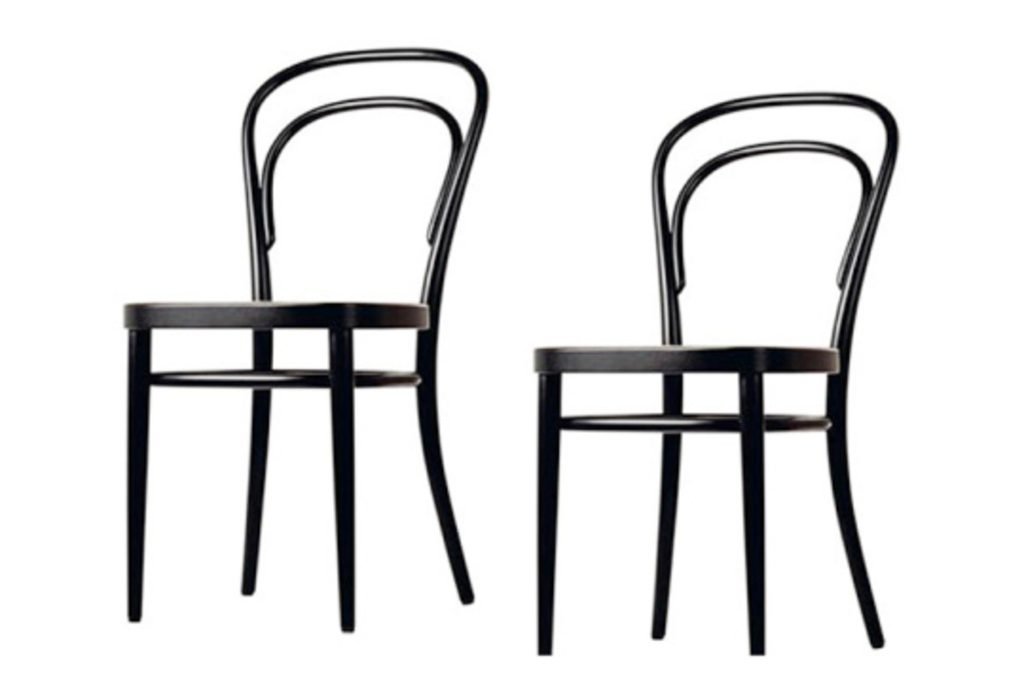
Michael Thonet spent the better part of two decades failing before he got to the No. 14 chair. His early attempts at bending wood involved glueing together stacks of thin “`veneer, a slow and unreliable process that limited how sharply the wood could curve. His breakthrough, patented in the 1850s, was almost brutally simple by comparison: steam solid beechwood until it goes soft, clamp it into a cast-iron mould, then let it dry into permanent shape. Six pieces of bent wood, ten screws, and two nuts. That was the entire chair.
What made the No. 14 a genuine classic rather than merely a clever invention was what Thonet did next. He designed the chair to be shipped disassembled and flat, thirty-six of them fitting into a single cubic metre crate, and built factories that could turn out hundreds a day using semi-skilled labour rather than master carpenters. By 1930, roughly fifty million had been sold. Le Corbusier called it the finest, most precisely made and most practical object ever created, and meant it as something close to an engineering compliment rather than an aesthetic one. The chair shows up in the background of Toulouse-Lautrec paintings and in photographs of Picasso’s studio, not because either man cared about furniture history but because the chair was simply everywhere, doing its job without asking to be noticed. That is the tell. A design classic tends to become invisible exactly because it stopped requiring improvement.
The Stool That Was Never Given a Name
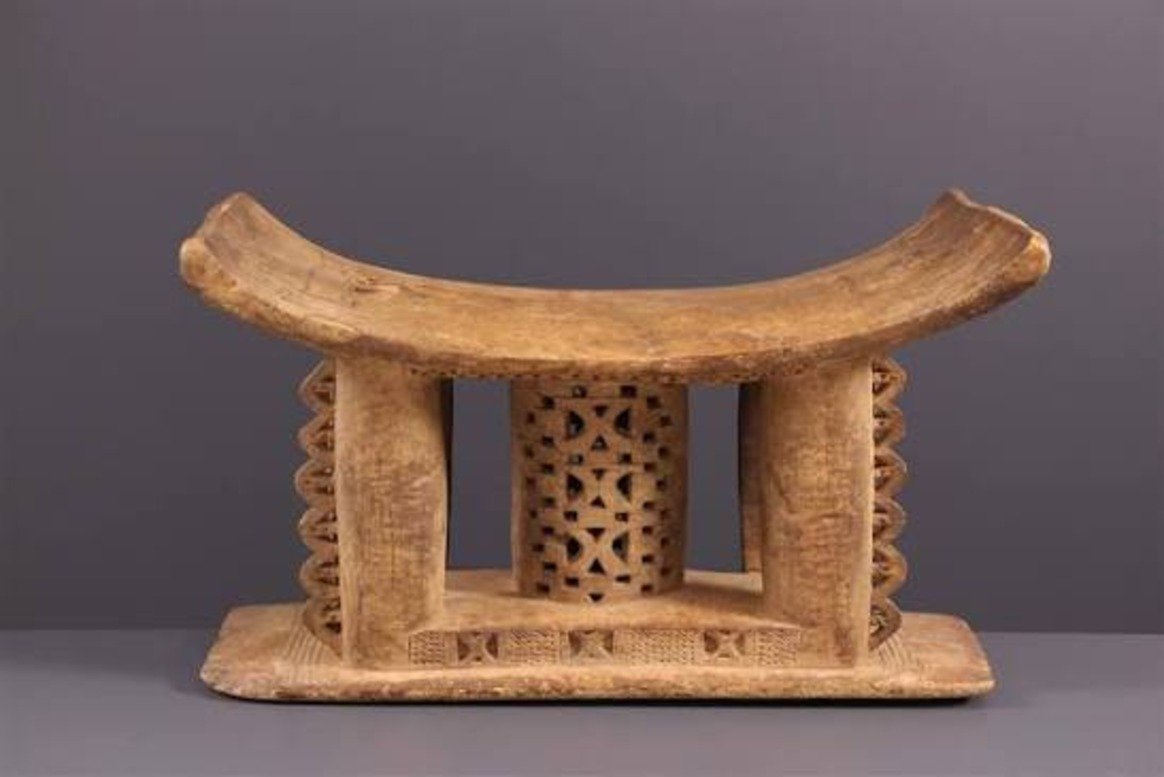
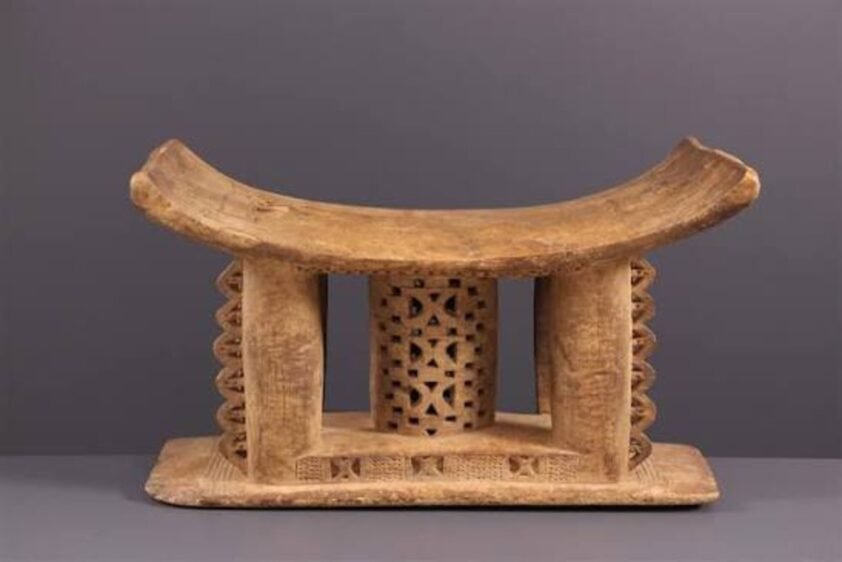
Long before Thonet steamed his first plank of beechwood, the Asante people of what is now Ghana were carving a form of seat so structurally confident it has barely changed in the centuries since. Each Asante stool is cut from a single block of wood, a concave seat balanced above a sculptural base, built without a single joint or screw to fail. Among the Akan peoples, the stool was never merely furniture. It was understood as the seat of its owner’s soul, so central to personal identity that a leader’s death is traditionally announced with the phrase ‘a stool has fallen’, and a stool would be tilted against a wall when not in use, so that no passing spirit could rest where it wasn’t welcome.
That is not incidental cultural colour attached after the fact to explain a shape. It is the reason the shape exists at all, a form built entirely around meaning, at a level of structural and sculptural sophistication that would earn any European object from the same period a place in a design history textbook. The Asante stool rarely gets that treatment. It circulates instead through auction houses and reproduction furniture catalogues, sold as ethnic decor or mid-century-adjacent styling, its maker almost always listed as unknown, its origin flattened into a single word, African, doing service for an entire continent of distinct design traditions. Museums and cultural institutions have only recently begun grappling openly with the tension this creates: how to credit a design tradition properly when the market that profits from its aesthetic has spent a century treating it as ownerless.
The Stool That Answers Two Cultures at Once
Sori Yanagi’s Butterfly Stool, first shown in Tokyo in 1956, resolves a different kind of tension, not between credit and appropriation but between two design traditions meeting honestly and producing something neither could have made alone. Two identical, gently curving pieces of moulded plywood, joined by a single brass rod beneath the seat. The shape reads, depending on the angle, as a butterfly’s wings mid-flight or the sloped roofline of a torii gate marking the entrance to a Shinto shrine. Both readings are intentional.
Yanagi had trained under Charlotte Perriand during her years advising Japan’s Ministry of Commerce, and the plywood-moulding technique he used had been pioneered a few years earlier by Charles and Ray Eames in America. Yanagi never hid either debt. What makes the Butterfly Stool a classic rather than a competent synthesis is how completely he made the borrowed technique his own, folding a distinctly Japanese sensibility, the reverence for craft his father’s mingei folk-art movement had championed, into a structural idea developed on another continent entirely. The stool won a Good Design Award almost immediately, entered MoMA’s permanent collection within two years of its debut, and has remained in continuous production since. It stands as proof that credit and originality are not opposites. Yanagi’s genius was legible precisely because he was honest about what he had borrowed and from whom.
The Object Redesigned Until It Disappeared
Not every classic depends on a single breakthrough moment. Some earn the title through relentless, almost invisible refinement, an object stripped down repeatedly until nothing remains that could be removed without breaking it. The bentwood tradition Thonet started continued this way for a century, passing through the Bauhaus, through Alvar Aalto’s stackable birch stools, through decades of designers asking the same question Thonet had asked and finding, each time, that the honest answer required removing something rather than adding it.
This is the quieter, less romantic version of what makes an object classic, not a single moment of invention but a discipline sustained across generations, an entire design culture treating refinement itself as the creative act. It rarely produces a famous name attached to a single famous date. It produces instead a whole category of objects, café chairs, stacking stools, and flat-pack furniture, that feel inevitable because so many hands worked so hard, over so long, to make them feel that way.
The Classic Being Made Right Now
Jomo Tariku’s Nyala chair takes its form directly from the horns of a mountain antelope native to Ethiopia’s Bale Mountains, curved arms sweeping up and back the way the animal’s own horns spiral skyward. Tariku, born in Kenya and raised in Ethiopia, spent close to a quarter of a century trying to get modern African furniture design taken seriously in an industry that told him, in his own account, that his work was too African for modernism and too modern for African curators. For most of that time, he supported the practice with a day job as a data scientist, sketching and building at night and on weekends.
The recognition arrived late and then arrived all at once. His work now sits in the permanent collections of the Metropolitan Museum of Art, the Smithsonian, the Los Angeles County Museum of Art and half a dozen others, and five of his pieces, including the Nyala chair, appeared on the set of Black Panther: Wakanda Forever. What makes Tariku’s story matter here, beyond the individual achievement, is how directly it answers the Asante stool’s unresolved question from earlier in this piece. Tariku’s Ashanti Stool, one of his own best-known works, is an explicit, credited reinterpretation of the Akan royal seat, made by a designer who has spent his career insisting that African design traditions be treated as authored, specific and worth crediting by name, not absorbed as anonymous inspiration. Whether the Nyala chair will still be called a classic in a hundred and sixty years, the way the No. 14 is today, is obviously unknowable. But it is already doing the thing every object on this list does: solving a real design problem so specifically, and so personally, that copying the surface without understanding the reasoning behind it would miss the entire point.
What Actually Earns the Word
Set against each other, a Viennese bentwood chair, an uncredited Ghanaian throne, a Japanese-American plywood synthesis, and a chair modelled on an East African antelope’s horns share almost nothing in material, era or origin. What connects them is narrower and more demanding than taste. Each one solved an actual problem, structural, cultural, or both, so completely that the solution stopped inviting revision. Thonet solved mass production without sacrificing elegance. The Asante carvers solved the relationship between an object and the identity of the person who owns it. Yanagi solved what happens when two design languages meet each other honestly instead of one absorbing the other. Tariku is solving, in real time, what it means for African design to be authored rather than anonymous.
None of that is a matter of opinion, which is precisely why the word ‘classic’ gets thrown around so loosely and deserves so much more precision than it usually gets. An object earns the title by getting something permanently right, not by getting old enough that nobody remembers asking whether it was right in the first place. The five objects here got there by five entirely different routes. What they share is that nobody, in all the decades since, has found a better answer to the question each one was actually trying to solve.
Sources and further reading:
Design Museum London, the Victoria and Albert Museum and Wikipedia on Michael Thonet and the No. 14 chair; MoMA, Vitra and Aucoot on Sori Yanagi’s Butterfly Stool; Atelier 55, MoMAA and MoMA Design Store on the Asante/Ashanti stool tradition; and Artnet News, Fine Woodworking, Interior Design and 1stDibs’ The Study on Jomo Tariku’s practice and museum acquisitions.