
How aestheticized chaos and vague emotion are replacing real expression in contemporary painting.
Introduction: Looks Like Art, But…
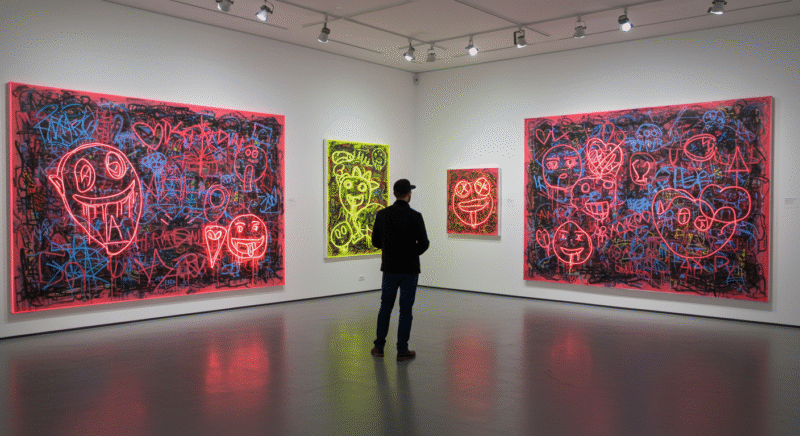
One of the most frustrating contemporary painting trends today is the rise of chaotic, neon-splashed canvases that look expressive but feel empty. You know the kind of painting I mean — abstract, loud, and messy. It’s all over galleries and Instagram. Neon colours, spray paint, chaotic layers. Perhaps a few smiley faces or dots are included for added impact. It feels expressive, raw, and full of emotion — until you look closer and realize… there’s not much there.
More and more, we’re surrounded by work that borrows the visual language of emotional or rebellious art, but without actually saying anything. It’s all gesture, no voice. All surface, no soul.
Copying the Look, Skipping the Work
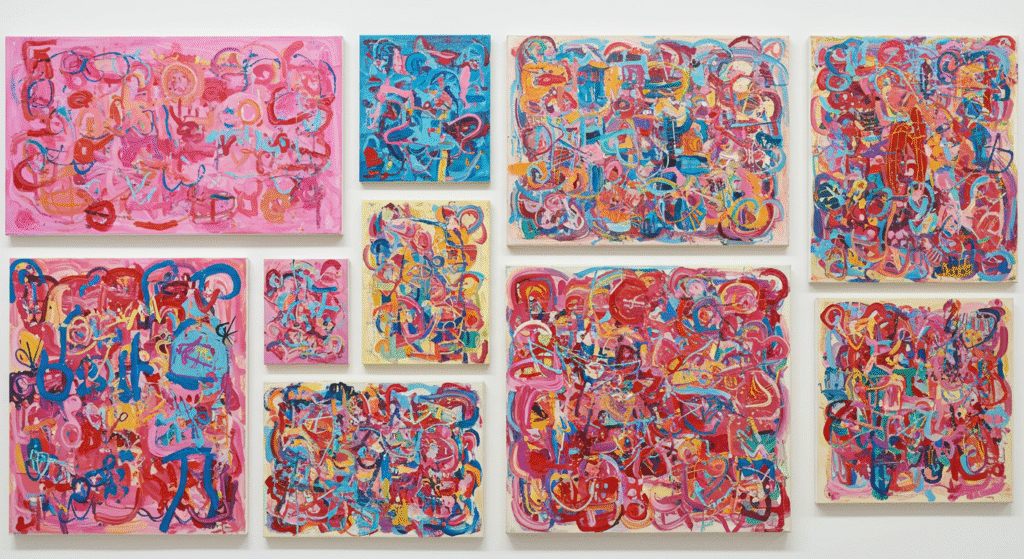
This kind of visual overload has become one of the most recognizable contemporary painting trends, especially among emerging artists mimicking rebellion. This kind of art pulls from movements that once meant something: Abstract Expressionism, Art Brut, street art, and Neo-Expressionism. These movements were personal, political, and wild — sometimes even dangerous. The marks weren’t just paint. They were statements.
But now we see that same visual language stripped down and recycled. Drips, scribbles, spray paint, and collage layers — all used as stylistic tools, not as forms of communication. These paintings often don’t have a point of view — just a vibe. A carefully curated mess.
Pop Art Then vs. Pop Art Now
Like other contemporary painting trends, this superficial style often borrows from deeper, more radical movements—without the context or conviction. A lot of this trend borrows from Pop Art — but misses the point entirely.
In the 1960s, Pop Art was radical. It broke the boundary between high art and commercial culture. Andy Warhol didn’t just paint soup cans — he exposed how mass production, advertising, and fame were reshaping identity and desire. His work wasn’t shallow; it was a sharp reflection of a society obsessed with image and consumption.
Keith Haring took his bold, graphic language to the streets. His work wasn’t just about accessibility — it was about urgency. Haring addressed the AIDS crisis, racial injustice, and capitalism with lines that felt simple but spoke volumes. His language was public, political, and full of purpose.
Now? Their styles are everywhere — copied by artists who repeat the visuals but remove the context. Bright outlines, repeated icons, and mass-produced aesthetics are sold as art, stripped of any message or urgency.
Recommended For You
4 Classic Movies with the Biggest Influence on Pop Fashion
Perspectives on the influence of art movements on contemporary art
Pop Art Evolved: When Playfulness Still Has Depth
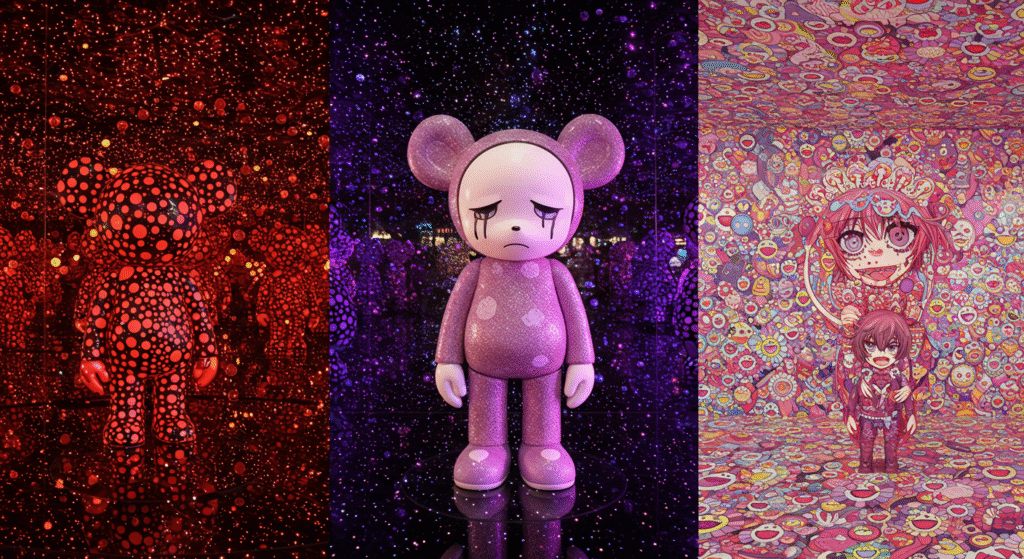
While many contemporary artists reduce Pop Art to a set of symbols — bright colours, flat lines, repeated motifs — others have taken its DNA and evolved it into something far more layered.
Yayoi Kusama’s polka dots and immersive installations are instantly recognizable, but behind them lies a deep engagement with obsession, trauma, infinity, and personal survival. Her repetition is not decorative — it’s radical.
Yoshitomo Nara’s childlike figures may seem innocent, but they carry emotional weight and resistance. His work explores solitude, disobedience, and the tension between vulnerability and rebellion.
Takashi Murakami takes commercial art to its conceptual limit. His ‘Superflat’ aesthetic critiques consumer culture, digital overstimulation, and the blur between high and low art. What looks like candy is often poison — that’s the point.
Why This Matters
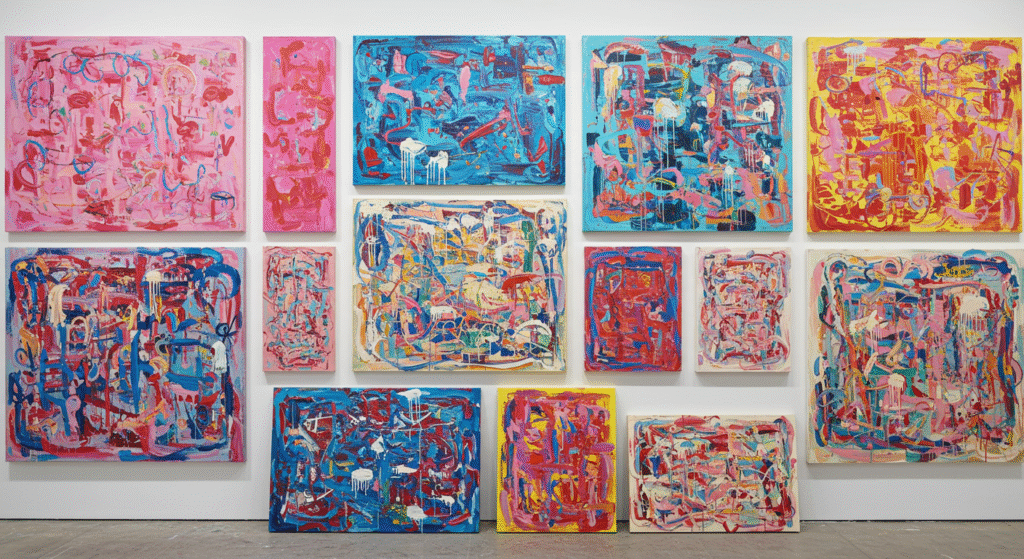
The danger with these hollow contemporary painting trends is that they train viewers to equate visual chaos with meaning, reducing art to decorative noise. This isn’t just about taste. It’s about the value of honesty in art. If every painting looks like it was made by the same hand, if the gesture becomes a preset, if chaos becomes just another aesthetic, we lose the power of expression.
We need more work that dares to be honest — even if it’s strange, subtle, or uncomfortable. Not just art that looks expressive, but art that actually is.
Artist Profile: Yayoi Kusama and the Power of Radical Repetition
Yayoi Kusama (b. 1929) is one of the most influential and unique voices in contemporary art. Her signature polka dots, mirrored installations, and obsessive repetition are not just aesthetic choices — they are expressions of a lifelong battle with mental illness, hallucinations, and the desire to dissolve the boundaries of the self.
Having moved from Japan to New York in the late 1950s, Kusama positioned herself among major avant-garde movements yet always retained her own fiercely original vision. She was a pioneer of performance art, installation, and feminist critique, long before these became institutional categories. Her Infinity Mirror Rooms invite viewers into hypnotic spaces of light and reflection, confronting themes of mortality and infinity in visually arresting ways.
Kusama’s work proves that repetition, when anchored in biography and vision, can be profound rather than decorative. Even now, living voluntarily in a psychiatric hospital, she continues to create daily — a testament to the healing, obsessive, and transcendent force of art.
Credit: Atlanta Kiriacoulis