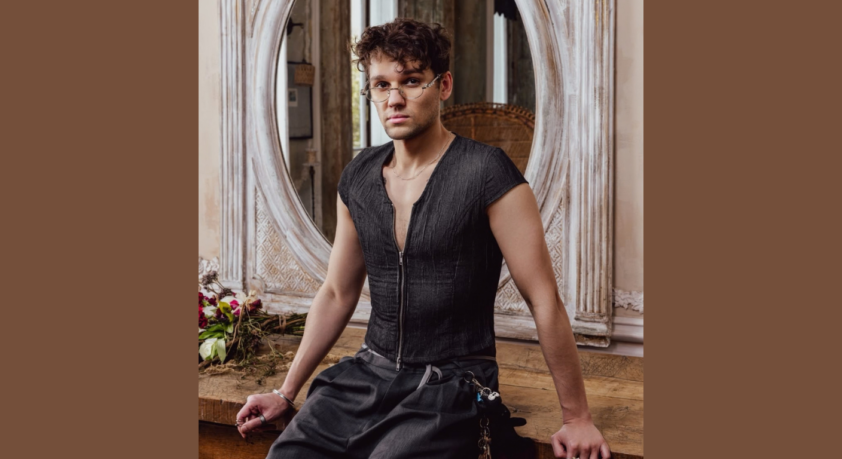
Brian De Carvalho has apparently been rejecting the wrong shoes since childhood. At eight or nine, dressed for a Christmas party by his parents, he disliked his shoes so intensely that he cried, refused to wear them and eventually spent the entire celebration running around barefoot. Looking back, it sounds less like a childhood tantrum and more like an early warning from a future fashion designer: if it does not feel right, destroy the illusion and start again.
Today, the London-based designer turns history’s darkest chapters, queer experience, personal pain and outright theatrical excess into garments that are torn, stained, burned, distressed and, somehow, beautiful. His clothes do not simply arrive on the body looking finished. They have survived something. There is the violence of the Ripper murders, the intimacy of private grief, the drama of survival and the delicious refusal to make any of it polite. “Life is about being theatrical and being too much, otherwise… what’s the point?” he says. For De Carvalho, apparently, there is no point in being subtle when you can make the dress bleed.
Brian De Carvalho sat down with FAB L’Style to talk about fashion, damage, queer creativity, theatricality, survival and why, sometimes, a little destruction is exactly what a garment needs to become itself.
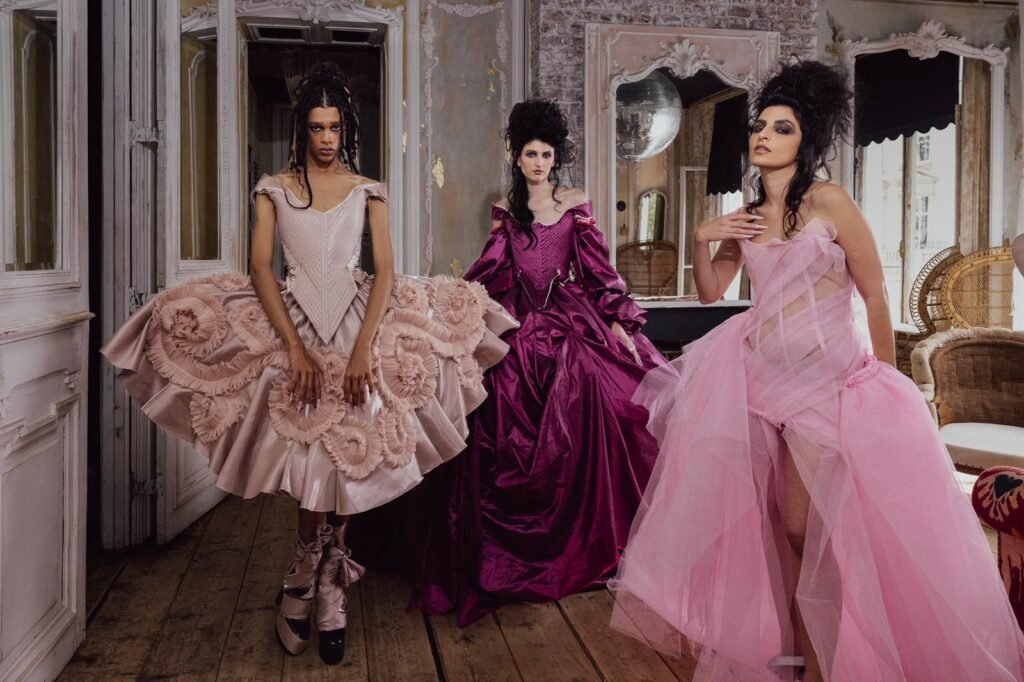
FAB: You work with some very dark material, but that kind of relationship with history and storytelling usually starts somewhere much earlier. What were you like as a child, and when did you first realise that clothes could say things you could not?
Brian De Carvalho: I never grew up in or around fashion. My parents were both immigrants, and they wanted me to become a doctor, a lawyer, or something they could understand as a secure, respectable career. Fashion was never presented to me as a viable option, let alone something I might aspire to.
I did, however, care deeply about how I presented myself from a very young age. My father once reminded me of a Christmas party when I was about eight or nine. My parents had dressed me in a little festive outfit, but I hated the shoes so much that I apparently cried for hours and refused to wear them. When I later looked through the photographs, he was right. In every picture, I was running around completely barefoot. Even then, I would rather wear nothing than wear something that did not feel like me.
Fashion was never a conscious decision. It was simply present in the way I moved through the world. I instinctively understood that clothing could determine how I felt and how other people perceived me. It was only years later, at university, that I suddenly realised, “Oh, I had been interested in fashion this entire time.” I simply did not have the language for it.
That is also why the brand began with me. I was making the clothes I wanted to own, the pieces I wanted to wear and the version of myself I wanted the world to see. In the beginning, my approach was quite egocentric, but perhaps that is true of all honest creativity.
FAB: There is something quite striking about taking subjects that are difficult to look at and turning them into beautiful, theatrical garments. Have you ever worried that beauty could soften the reality of the story you are trying to tell?
Brian De Carvalho: I do think about it, but I am not necessarily afraid of it. Beauty can soften something, certainly, but it can also seduce you into looking at what you might otherwise turn away from. If I presented pain exactly as pain, perhaps people would not want to engage with it. Through beauty, silhouette and theatricality, I can invite them closer and then allow them to discover that something more uncomfortable is happening beneath the surface.
My work is often beautiful from a distance and rather more complicated when you approach it. There may be distressing, staining, tearing or an element that feels almost violent. That contradiction is important to me because difficult experiences are rarely one-dimensional. There can be beauty within grief, glamour within survival and tenderness within something incredibly dark.
I am not interested in making suffering decorative. The beauty has to deepen the story rather than disguise it. Ideally, the garment draws you in before unsettling you slightly. I want there to be a moment when the viewer realises that what initially appeared perfect is actually carrying damage, and that the damage is precisely what gives it its emotional life.
FAB: I am curious about what happens after the garment leaves you. If someone wears a piece that came from a very personal or painful place in your life, does it feel strange seeing them create a completely different story with it?
Brian De Carvalho: It can feel strange because so much of my work begins with something deeply personal. When a garment leaves the studio, however, it no longer belongs entirely to me. The person wearing it brings their own body, history and emotional life to it, and that inevitably changes the story.
I actually find that transformation quite beautiful. Something that may have begun in anger, grief or fear can make somebody else feel powerful, desirable or completely uninhibited. That does not erase what the piece meant to me. It gives it another life. The garment becomes a meeting point between my experience and theirs.
I spent a great deal of my younger life hiding, so there is something incredibly moving about watching another person put on one of my designs and become more visible. Their posture changes. They become louder, stronger and perhaps a little more boisterous. Whatever pain may have initiated the piece has been transformed into somebody else’s confidence, and that feels like a rather wonderful conclusion to the story.
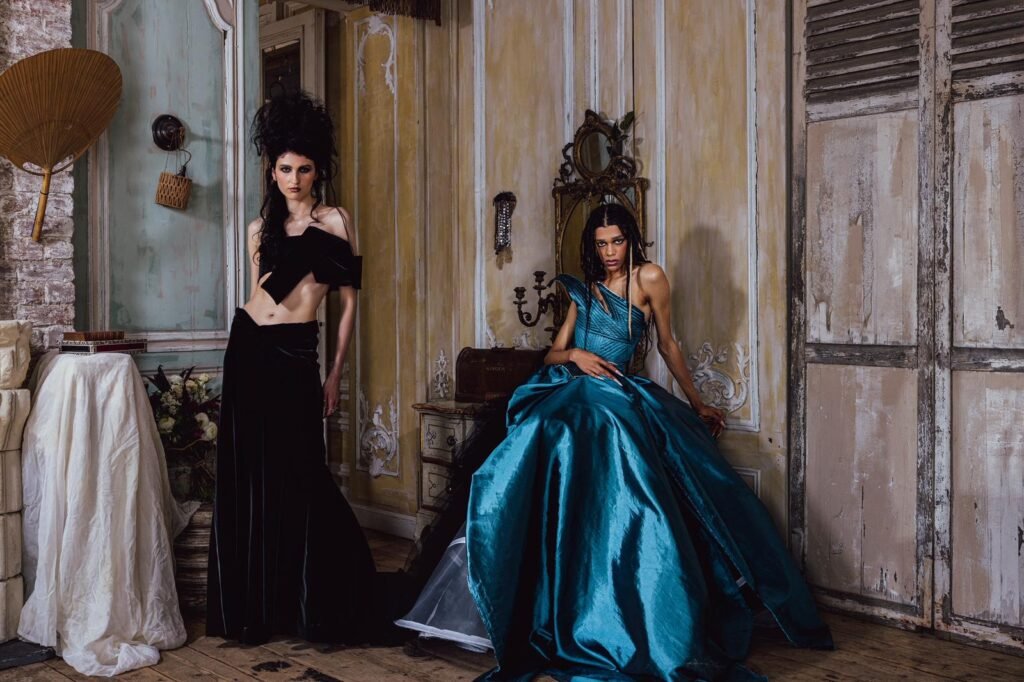
FAB: You have said that your garments are often “damaged” in some way, and that a piece has to go through struggle before it is complete. Where did that idea come from? Was there a moment when destroying or damaging a garment suddenly became part of your design language?
Brian De Carvalho: There are hundreds of thousands of fashion designers in the world, and anyone can make a pretty dress. There are extraordinary brands creating beautiful beaded gowns where everything is feminine, floral, pristine and perfect. I admire the skill involved, but perfection on its own has never been enough for me. It does not always carry a story, an energy or a language.
At the beginning, I was trying very hard to make everything flawless and beautifully finished. Yet I would stand in front of a perfectly lovely dress on the mannequin and think, “Something is missing. This does not feel like it came from my hands, my mind or my emotions.”
Then I would pour paint over it, set it alight, tear into it, stain it or damage it in some way, and suddenly I could recognise myself. It was like, “Ah, there you are. Now you are saying what I need you to say.”
That became part of my language because damage gives a garment history. It suggests that something has happened to it, that it has survived an experience. Perfection can sometimes feel anonymous. The damage makes the piece specific. It gives it tension, character and, strangely, life.
FAB: You once said, “Life is about being theatrical and being too much, otherwise… what is the point?” I want to take that literally. What does “too much” look like in your everyday life, not just on a runway?
Brian De Carvalho: For all my declarations about theatricality, the terribly unglamorous truth is that my everyday life is largely studio, home, studio, airport, repeat. She does not leave the house nearly as often as people might imagine.
But “too much” is not necessarily about wearing a ball gown to buy milk, although I would never discourage it. It is an attitude. It is refusing to make yourself smaller in order to make other people comfortable. It is caring intensely, speaking honestly, laughing too loudly, dressing for your own pleasure and allowing yourself to occupy space without apologising for it.
I spent much of my younger life feeling afraid and trying not to be noticed. Now, even when I am dressed relatively simply, there is usually something deliberate: an exaggerated silhouette, a corset, an impossible shoe or an element that makes no practical sense whatsoever. Practicality has never particularly excited me.
To be “too much” is really to be fully present. Life can be brutal and incredibly short. If we are going to endure all of that, we may as well give people something fabulous to look at.
FAB: There is a fine line between theatrical fashion and costume. Where do you draw that line for yourself, and do you even care if people cross it?
Brian De Carvalho: I am not terribly frightened by the word costume. People sometimes use it dismissively, as though costume requires less imagination, construction or intelligence than fashion, which is absurd. Some of the most extraordinary garments ever created were made for theatre, film and performance.
For me, the distinction lies more in intention. A costume helps someone inhabit a prescribed character, whereas fashion allows the wearer to reveal or invent something about themselves. My clothes may be theatrical, but I never want the person inside them to disappear. The garment should amplify them rather than overwhelm them.
That said, I do not particularly care if someone crosses the line. Fashion should allow us to perform. We all construct versions of ourselves through clothing, whether we admit it or not. If someone wants to wear one of my pieces and become an entirely different creature for the evening, fabulous. Why should reality have the monopoly?
FAB: Because so much of your work deals with despair, violence, identity and survival, people could easily assume that the person behind the work is equally dark. What would surprise people about you?
Brian De Carvalho: I feel as though I am quite an open book. Very much what you see is what you get. But people might be surprised by my sense of humour and by how little I take myself seriously.
The brand is my baby, and, of course, it matters enormously to me. But we are not saving lives. At the end of the day, it is fabric and thread. If someone on my team is in tears because they have cut something incorrectly or missed a seam, my response is generally, “It is fine. Nobody has died. The world is not ending. We will fix it.”
Perhaps I initially come across as more serious, strict or particular than I really am. The work provides a space for the darker parts of me, but that does not mean I walk around the studio like a tortured Victorian ghost. There is a great deal of chaos, laughter and taking the piss out of ourselves.
I think humour is another form of survival. Sometimes the only appropriate response to an impossible situation is to make something beautiful from it and then make a very inappropriate joke.
FAB: Do you think fashion has become more comfortable with queer designers and queer narratives, or has the industry simply become better at knowing how to package them?
Brian De Carvalho: Fashion has always relied upon queer creativity, but relying on queer people and genuinely supporting them are not the same thing. The industry has certainly become more fluent in the language of inclusion. It knows how to package queerness, photograph it, sell it and celebrate it when it is culturally convenient.
The more important question is what happens behind the image. Who is being funded? Who is given time to develop? Who holds authority? Who is protected when something goes wrong? A queer narrative in a campaign does not automatically mean that queer creatives are being respected within the business producing it.
There has been progress, and I do not want to dismiss that. Visibility can be incredibly powerful, particularly for young people who have never seen themselves reflected. But visibility without infrastructure is fragile.
I want queer designers to be allowed complexity, not simply packaged as brave, provocative or diverse. We should be able to succeed, fail, change our minds and make difficult work without our identities becoming the entire marketing strategy.
FAB: With so much fashion now designed to photograph well and move quickly online, do you worry that some of the theatricality you care about gets lost when a garment is reduced to a single image?
Brian De Carvalho: Absolutely. An image can capture the impact of a garment, but not always its presence. It cannot fully communicate the weight of it, the sound it makes, the way the fabric moves or what happens to somebody’s posture when they put it on. Those details are often where the emotion lives.
Social media has trained us to consume fashion almost instantaneously. You see the image, decide whether you like it and move on. There is this relentless demand for “next, next, next”. You post one dress, and people immediately ask what you are producing the following week.
But fashion is a craft, and theatricality requires time, not only to create, but to experience. I do consider how a piece will photograph because imagery is now part of the language of fashion. But I never want the photograph to become the only reason the garment exists.
The best pieces reward a closer look. They should become more interesting when you encounter them physically, rather than revealing everything in a single square on Instagram.
FAB: Looking back at the difficult experiences that have found their way into your clothes, is there anything you understand differently now than you did when you first started making those pieces?
Brian De Carvalho: When I began, I think I was often creating from inside the experience. There was very little distance between the feeling and the garment. I was not necessarily trying to understand what had happened. I was simply trying to survive it, externalise it and turn it into something I could physically confront.
Looking back, I can see that the work was doing more for me than I realised. It gave form to emotions I could not articulate and allowed me to regain a certain amount of control. If something painful could become a dress, a corset or an entire world, then it was no longer simply happening to me. I had transformed it.
I am also more conscious now that struggle should not be romanticised. Pain may have fuelled some important work, but that does not mean an artist must remain in pain to deserve their creativity.
What I understand differently is that the work does not only document what hurt me. It documents the fact that I came through it. Increasingly, I see those pieces less as monuments to despair and more as evidence of survival.
FAB: I keep coming back to your decision to damage your garments. We usually associate damage with something having gone wrong, but in your work it seems almost necessary for the piece to become complete. Do you remember when you first realised that destruction could actually be part of the making?
Brian De Carvalho: I do not think it was one dramatic revelation so much as a pattern I began to recognise. I would complete a garment technically, but emotionally it still felt unfinished. The construction might have ended, yet the piece had not become itself.
The moment I interfered with that perfection by ripping, burning, staining or painting it, the garment began to speak. Destruction became another stage of construction. It was not about ruining something carelessly. It was about challenging it until it revealed the right energy.
There is also an element of surrender in that process. Fashion can make you terrified of mistakes because materials are expensive, time is limited and perfection is constantly demanded. Deliberately damaging a piece removes that fear. Once the pristine surface is gone, you are free to respond instinctively.
The garment has to endure something before I believe it. Perhaps that reflects the way I understand people as well. We are marked by experience, and those marks do not necessarily make us less beautiful. Often, they are what make us recognisable.
FAB: And when you eventually look back at this chapter of your life, what do you hope the clothes will tell us about the person who made them?
Brian De Carvalho: I hope they say that I felt everything intensely and that I was never afraid to put that feeling into the work. I hope they show that I cared about craft, history and beauty, but that I was unwilling to accept beauty as something passive, polite or empty.
I would like the clothes to reveal somebody who spent part of his life hiding and then decided, quite forcefully, to be seen. Somebody who made things with whatever he had, who was not always perfectly trained or resourced, but who possessed instinct, determination and a point of view.
Most of all, I hope they retain evidence of the hands that made them: the time, emotion, mistakes and obsessive care. Fashion can become so consumed by a product that we forget there is a person behind every piece.
If the clothes outlive me, I want them to feel human. Not flawless, not quiet, but alive.
FAB: And perhaps the hardest question: if one day you no longer felt the need to prove anything, fight anything or turn anything painful into something beautiful, what would you want to make?
Brian De Carvalho: That is a difficult one, because part of me wonders whether I would make anything at all. If there were no pain to transform, nothing to fight and no need to create other worlds, perhaps I would no longer feel that same compulsion.
Not to be a Debbie Downer, but many extraordinary artists have created their most powerful work during periods of struggle. I do not think suffering automatically makes somebody more talented. Rather, it forces you to examine life through a different lens.
You look at the darkness more closely, but you also experience joy, tenderness and beauty with greater intensity because you understand their fragility.
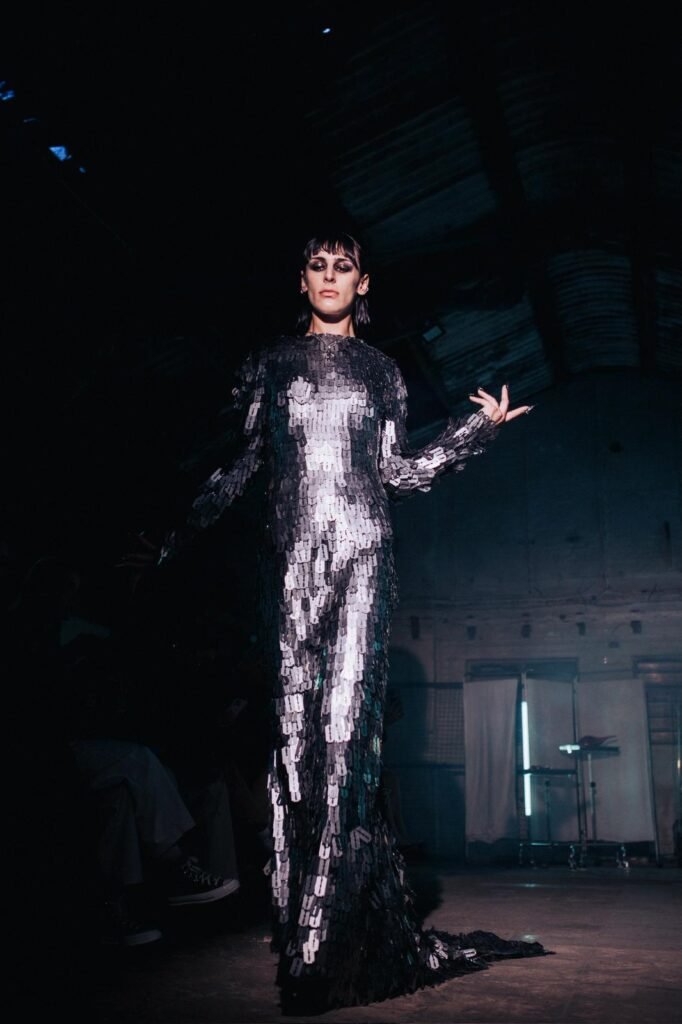
I once made a dress from razor blades, and it remains my favourite piece I have ever created. I made it at an incredibly angry, low point in my life. Perhaps without that rage, my imagination would never have been pushed to that limit. Perhaps I would not have possessed the courage or sheer bloody-mindedness to finish it.
But I would like to believe that creativity could survive happiness. Maybe, without anything to prove, I would make something purely because it delighted me: something excessive, ridiculous and completely unnecessary.
Perhaps the work would become lighter, but I doubt it would ever become quiet. Even at peace, I imagine I would still find a reason to be too much.