
The just-concluded Autumn/Winter 2026 fashion season in London and Milan marked a definitive shift from the era of “performative inclusion” toward a new paradigm of narrative sovereignty and archival preservation. No longer content with merely being “at the table”, Black designers—specifically those rooted in the African diaspora—utilised the 2026 runways to assert their own historical documents and technical mastery. What we witnessed was not a surface-level celebration of “African print”, but a deeply analytical dissection of migration, social mobility, and spiritual technology.They moved past the aesthetic of “the struggle” and into the era of “the mastery,” using ancestral technologies to solve modern fashion’s biggest crisis: the lack of soul in a digital age.
Validation Meets the Migrant Archive
London Fashion Week (LFW) functioned as the epicentre of high-concept storytelling where personal heritage met institutional validation. The season’s strongest symbol of this shift was King Charles III appearing at Tolu Coker’s “Survivor’s Remorse” show.
Coker’s collection was far more than a royal photo-op; it was a psychological exploration of the “push-and-pull” of social mobility. By recreating her childhood environment of West London’s Mozart Street—complete with traffic cones and murals—Coker argued that migrant memories are not something to be outgrown, but are foundational to luxury identity. Her technical execution, featuring cinched waists and sharp pleating, blended the discipline of professional authority with the soft protection of childhood uniforms.
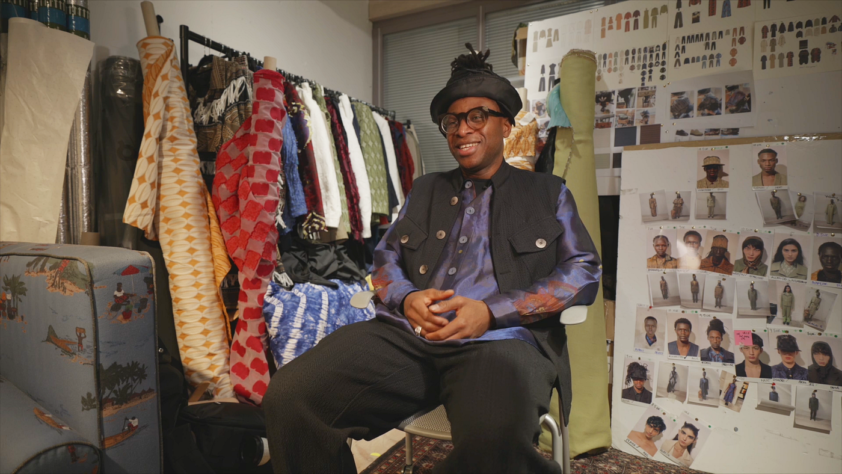
Equally innovative was Foday Dumbuya’s Labrum London, which presented “Threads of Osmosis”. Dumbuya treated textiles as living archives, where every stitch records the movement of people across continents. The collection was a masterclass in global osmosis, incorporating Japanese indigo denim laser-etched with updated passport stamps and wool outerwear featuring hand-embroidered scenes from Sierra Leone. Labrum London continues to be the most intellectually grounded voice in London, proving that the migrant experience is a source of technical innovation rather than just a tragic narrative.
Milan’s Friction: Disruption and Ancestral Technology
While London felt celebratory, Milan Fashion Week (MFW) remained a site of structural struggle and institutional resistance. Amidst a worrying “diversity rollback” and the resurgence of the “ultra-thin” ideal, Black designers in Milan operated as a “digital diaspora”, using creative resilience to bypass traditional barriers.
Tokyo James emerged as the definitive voice of African luxury as a disruptive force. His “Chaos” collection embraced disorder as a creative manifesto, featuring deconstructed leather reassembled into architectural forms and his signature handcrafted crochet bags. James is not making “corporate suits”; he is creating special separates for a global Nollywood-influenced audience that demands both form and movement.
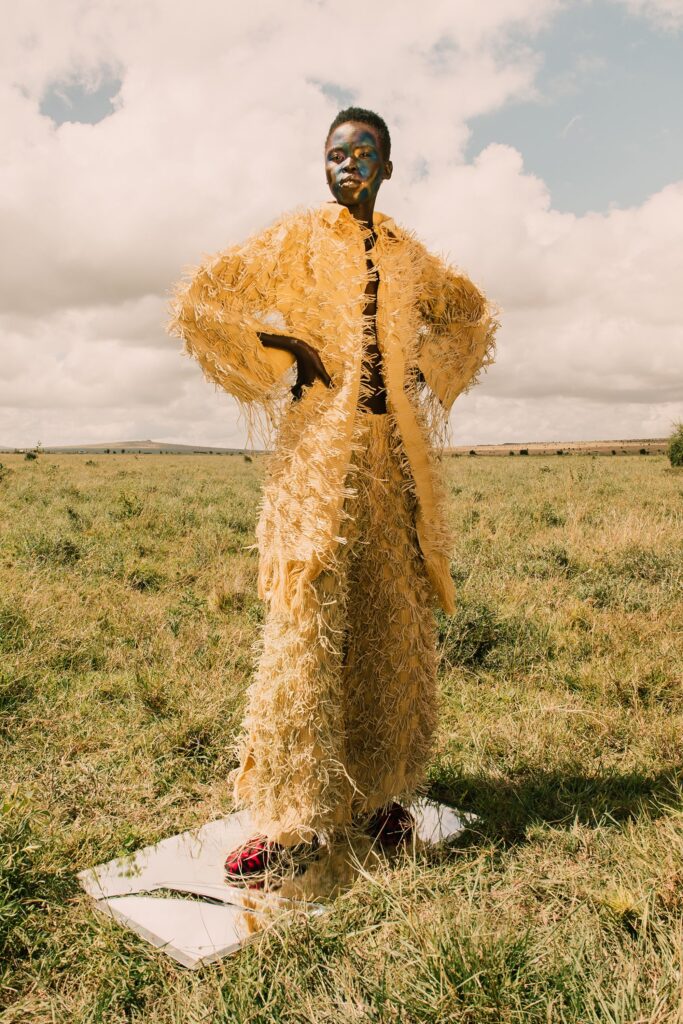
Perhaps the most radical analysis of African culture came from the digital presentations of I Am Isigo and Maxivive.
- Bubu Ogisi (I Am Isigo) presented “Dual Mandate”, reclaiming pre-colonial indigenous techniques like chainmail forging and glass blowing to treat the body as a field for “spiritual technology”.
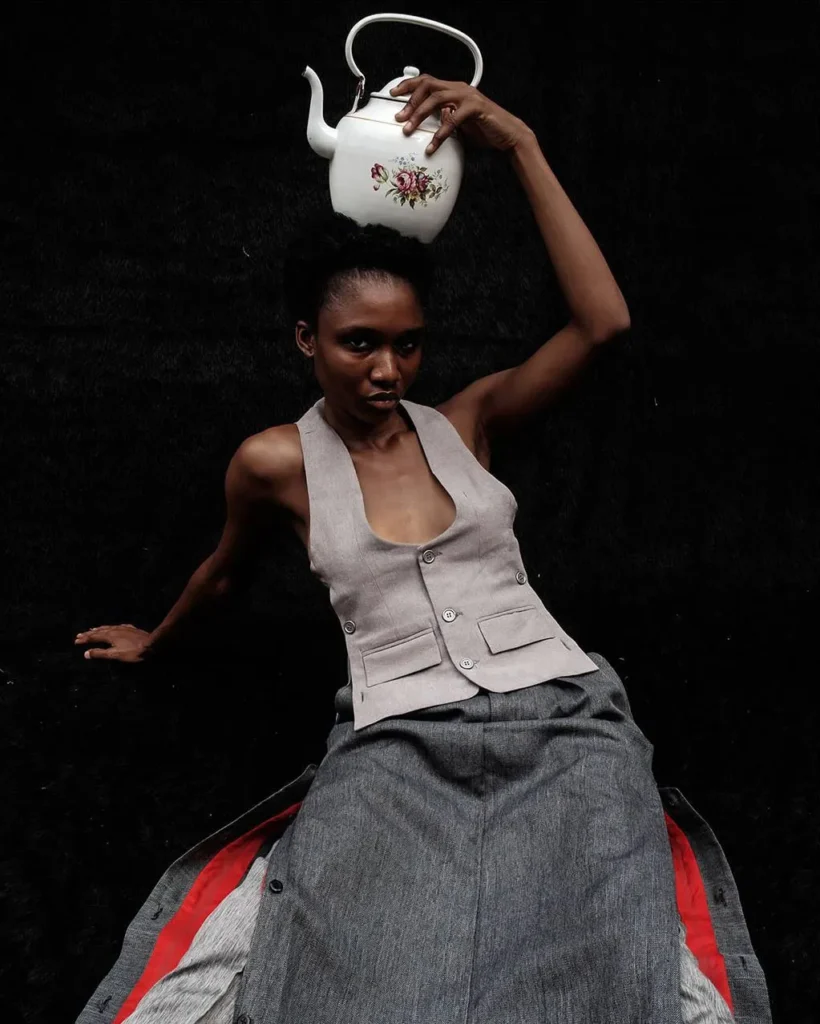
- Papa Oyeyemi (Maxivive) challenged the disposable nature of the fashion cycle by emphasising “longevity”, using leopard print as a symbol of power to frame garments as valuable assets.
Sovereignty vs. Performative Inclusion
Despite these brilliant flashes of innovation, the 2026 season exposed a systemic fragility. In Milan, the withdrawal of activists like Stella Jean over a “lack of commitment to inclusion” highlights that the spotlight on Black talent is often fleeting. The Afrofashion Association’s relaunch of “Communities at Work” serves as a necessary, if exhausting, operational infrastructure to ensure that visibility actually translates into professional contracts and economic sovereignty.
Furthermore, the “Ozempic effect” noted at LFW signals a cultural backslide where the industry’s obsession with thinness is again erasing the body diversity championed by designers like Karoline Vitto. Vitto’s refusal to treat inclusivity as a trend, engineering clothes with hidden elastics and tensioned drapery to fit the wearer rather than the other way around, remains a critical counter-narrative.
Summary of the Most Innovative Voices
The designers who defined the 2026 AW season did so by refusing to separate their progress from their origins. They include:
- Tolu Coker: For turning the Black British archive into a state-validated luxury manifesto.
- Foday Dumbuya (Labrum): For his technical “osmosis” that treats fabric as a documented history of migration.
- Tokyo James: For redefining African luxury through the lens of creative “chaos”.
- Bubu Ogisi (I Am Isigo): For reviving ancestral “spiritual technology” as a modern design language.
- Priya Ahluwalia: For her “Birds of a Feather” philosophy, proving that kinship and over 80% responsibly sourced fabrics are the future of high fashion.
Ultimately, the 2026 runways reflect an African culture that is unapologetic, archival, and technologically forward. The transition from “inclusion” to “sovereignty” is well underway, but as the designers of the WAMI collective have noted, the industry must now decide if it will offer more than just a seasonal curtain call.