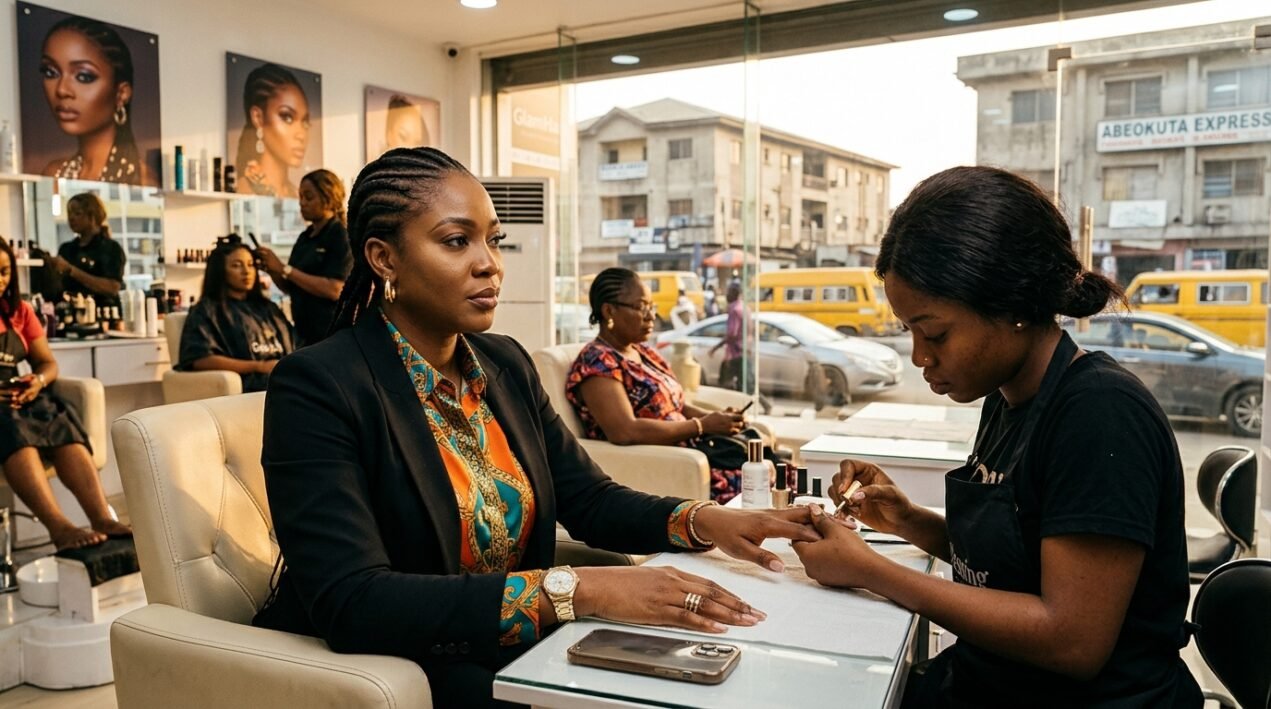
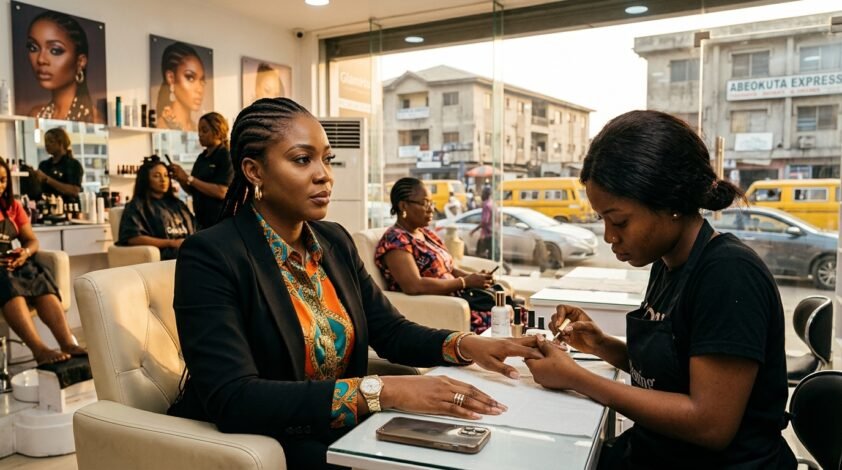
Beauty has always been currency. But the rules governing who trades in it, and at what cost, have never been evenly written. The manicure takes forty minutes. It costs roughly what a market trader in Yaba earns in a day. The woman in the salon chair does not think about this as she holds out her hands. She thinks about the meeting on Thursday, the client who will notice, and the colleague who will not. She thinks about the particular authority that comes from appearing to have never worked with her hands at all. When the technician finishes and she turns her palms upward, the lacquer is the colour of dried roses. Not red, which would read as effort. Not bare, which would read as neglect. Something softer, more considered, and more controlled.
She pays and walks out into Lagos traffic. The nails will last two weeks. The impression, if everything works as she hopes, will last considerably longer.
This is not vanity. Or rather, it is not only vanity. What is happening in that salon, and in the thousands of similar transactions taking place across Lagos, Nairobi, Vienna, Lagos Island, Berlin, and every other city where the social stakes of appearance have been sufficiently internalised, is something far more complex than the desire to look nice. It is a negotiation with power. It is an economic calculation dressed in the language of self-care. It is the deeply human, deeply rational, and deeply costly business of trying to look as though money is not something you have to think about.
The Signal and the System
Economists have a term for it: the beauty premium. The research, which has been accumulating since Daniel Hamermesh and Jeff Biddle first quantified it in a 1994 paper, is consistent enough across decades and continents to be considered settled. Physically attractive people earn, on average, between five and ten percent more than their less attractive counterparts. They are called back for job interviews more often. They receive better performance reviews. They are perceived as warmer, more competent, and more trustworthy in the fraction of a second before they have said a word. The premium is largest in roles requiring interpersonal interaction and negligible in roles that do not, which tells us something important: what employers are rewarding is not beauty as an abstract quality but beauty as a social performance, a visible signal of capacities they are not actually measuring.
The beauty premium does not operate equally on everyone. For women, the returns are concentrated in specific occupational categories and subject to a ceiling: there is a point at which a woman becomes too attractive to be taken seriously in certain professional contexts, a penalty that men do not encounter with comparable frequency. For people of colour, the premium operates within a beauty standard that was not designed to include them and that they must navigate with a degree of strategic calculation rarely required of those who conform to it easily. The economics of attractiveness, in other words, are not a neutral tax on the world’s genetic lottery. They are a system with a history, a geography, and a set of rules that were written, as most rules are, by the people who benefit most from them.
What research published in the Journal of Personality and Social Psychology makes uncomfortably clear is that we read class in faces with an accuracy that significantly exceeds chance, even in neutral expressions, even before a word is spoken. The mouths and eyes of wealthy people carry the accumulated trace of decades of ease, of fewer years of stress, of better nutrition and better dentistry and the particular quality of repose that comes from not having spent a lifetime bracing against the next blow. Psychologist Nicholas Rule and his colleagues found that people sorted faces into rich and poor categories correctly sixty-eight percent of the time, far above what random guessing would produce. The most telling detail: the ability to read social class from a face disappeared when people smiled. Smiling, it turns out, masks the lifetime of habitual expressions that wealth and its absence inscribe on a resting face. We are, all of us, carrying our economic histories in our features, whether we know it or not.
This is the part that no beauty counter sells a fix for. But it sits at the centre of everything else.
The Grammar of Grooming
If the face is where history lives, the rest of the body is where strategy operates. And nowhere is the strategy more intricate than in the semi-visible language of grooming.
There is a class grammar to beauty maintenance that people learn without being formally taught. It is absorbed, like most class knowledge, through observation, imitation, and the quiet social penalties that correct deviation. The grammar has changed significantly over the past thirty years as the definition of what “looking after yourself” requires has expanded to include not just cleanliness and basic presentation but an ever-more-elaborate repertoire of maintenance: regular facials, professional blowouts, shaped brows, lifted lashes, veneered or whitened teeth, treatments that address skin tone and texture and the specific micro-concerns that the industry invents with each new product cycle.
The sociologist Elizabeth Currid-Halkett, writing about what she calls the aspirational class, identifies subtle nail colour as one of the inconspicuous consumption markers favoured by the economically successful. Not ostentatious. Not loud. Deliberately quiet, blush over neon, restraint over display. The signal is pitched at those who know how to read it and opaque to those who do not. This is, she argues, how the upper-middle class encodes status in the era after conspicuous consumption became tacky. You are not showing off what you can afford. You are demonstrating the taste that tells other people you have always been able to afford it. The two things look different. The second one is harder to fake.
The cost of maintaining this grammar is considerable. A survey of 900 salons in Britain found that women spending on nails, hair, and aesthetic treatments averaged over a thousand pounds a month. In Tehran, documented by the sociologist Naeimeh Doostdar, the cost of professional hair, nail care, and injectables in major cities equals several days to a full month of a working-class income. Botox that immobilises expression subtly, fillers that add volume without appearing filled: these techniques create what looks like effortlessness while requiring significant, recurring expenditure. The invisibility is the point. Working-class beauty has historically announced itself, big hair, dramatic lashes, acrylic nails, because visibility was currency when you had less of it. Upper-class beauty performs naturalness. It just costs more to achieve.
This distinction maps precisely onto what psychologists and economists mean when they describe looking expensive: it is not primarily about the price of individual items. It is about the cumulative signal of someone who does not appear to be trying. The quietly well-cut shirt, the skin that looks rested rather than treated, the hands that betray neither neglect nor effort. These things read, to a practised observer, as a particular relationship to money: not new money, not anxious money, but old, settled, confident money that has no need to announce itself.
Recommended For You
The Colour of Status
There is a specific beauty cue that signals status across very different cultural contexts and whose history is dense enough to deserve its own accounting. It is skin tone.
In Nigeria, the country with the highest rate of skin lightening product use in the world, the World Health Organisation estimates that seventy-seven percent of women have used such products. The global skin whitening market was valued at approximately ten billion dollars in 2021 and is projected to reach fifteen billion by 2030. These are not the numbers of a marginal practice. They are the numbers of a system.
The association between lighter skin and social advantage in Nigeria cannot be separated from colonialism and its aftermath, from decades of media representation in which lighter-skinned women appeared on billboards as proxies for beauty and success, from labour market research showing that lighter-skinned women are perceived as more employable and more marriageable, from a beauty industry dominated by multinational companies, including Unilever, Beiersdorf, and L’Oreal, that have profited from and actively reinforced that association while selling the products that address the insecurity they helped create.
What is striking, when you look at the practice closely, is the economic rationality that operates within it. A Nigerian woman who uses skin lightening products is, on one level, responding to a beauty standard that was imposed from outside and has since been thoroughly internalised. On another level, she is making a calculation about opportunity: about job interviews and marriage prospects and social mobility and the documented, real relationship between lighter skin and economic advantage in the environment she inhabits. The practice is not irrational. It is a response to an irrational system. The harm is real, because many lightening products contain mercury, hydroquinone, or corticosteroids that damage skin and kidneys and carry an elevated cancer risk. The logic driving the choice is also real, and the distinction matters for how we understand who is responsible.
What connects the Lagos salon and the Vienna dermatology clinic and the Tehran beauty parlour is not the specific practices or the specific costs. It is the underlying structure: the existence of a visible beauty standard that confers measurable social and economic advantage, the identification of that standard as attainable through expenditure, and the willingness of people across enormous differences of income and cultural context to spend toward it. The form the spending takes differs. The logic is consistent.
What the Body Remembers
Psychologists who study self-signalling, the way that our own behaviour shapes our internal sense of identity, have documented something that the beauty industry has always understood intuitively: appearance affects more than how others see you. It affects how you see yourself, and consequently how you move, perform, and occupy space.
The woman who leaves the salon with precisely shaped nails and a fresh blowout is not only making a statement to others. She is making a statement to herself. She stands differently. She speaks with a different quality of assurance. The preparation has produced a state of readiness, a sense of having attended to the visible and therefore being equipped for the encounter. This is not a minor psychological effect. Research consistently shows that the feeling of being well-groomed correlates with self-reported confidence, with performance in social and professional contexts, and with the willingness to take up space in situations where space-taking matters.
What we call looking expensive is, at bottom, the visible dimension of this internal state. The signal being read by others is real: it reflects actual expenditure of time and money and attention. But it also reflects something less quantifiable, a particular relationship to the self, a daily practice of taking one’s own appearance seriously enough to invest in it. That relationship, and the confidence it produces, is itself part of what reads as status. You cannot always buy the confidence. You can buy the conditions that tend to produce it.
This is the uncomfortable truth that sits at the centre of the beauty premium, the labour market research, the skin lightening statistics, and the sociology of inconspicuous consumption. Appearance is not merely decorative. It is functional. It produces real outcomes, in money and opportunity and social access, for the people who successfully read and perform its signals. To say that this is superficial is technically accurate and practically useless. It tells you nothing about what to do with the information.
The Tax Nobody Names
In Vienna, where many of the women who spend on beauty maintenance are from Nigeria, Ghana, Ethiopia, and other parts of the African diaspora, the grooming calculus carries an additional layer. You are not only performing competence within a shared cultural framework. You are performing it across one. The markers that read as polished and professional within one community may be invisible or illegible to the hiring manager or landlord or colleague whose cultural grammar is different. The reverse is also true: the markers that read as ‘aspiring’ within a predominantly white professional context, the particular haircare regime required for natural hair, and the specific costs of maintaining skin that is not the default shade in European advertising, are borne disproportionately and rarely acknowledged as such.
The beauty tax is real. It just falls differently depending on where you start.
There is no neutral position from which to discuss looking expensive, because there is no neutral standard against which expensive is measured. The standard was built somewhere, by someone, at a particular historical moment, and it has been maintained, modified, and commercially exploited by industries with strong incentives to ensure that it remains just beyond the reach of anyone who does not already possess it. The woman in the Lagos salon, the one in the Vienna dermatologist’s chair, the teenager editing her selfies in Shenzhen with apps that widen her eyes and soften her jaw: they are all negotiating with the same underlying structure, dressed in different local costumes, operating at very different price points, but unified by the same fundamental understanding that how you look will be read, that the reading will have consequences, and that the consequences are worth paying to influence.
Whether that is a story about human vanity, or human rationality, or the ingenuity of industries that have learned to profit from both simultaneously, depends on which part of it you are standing in.