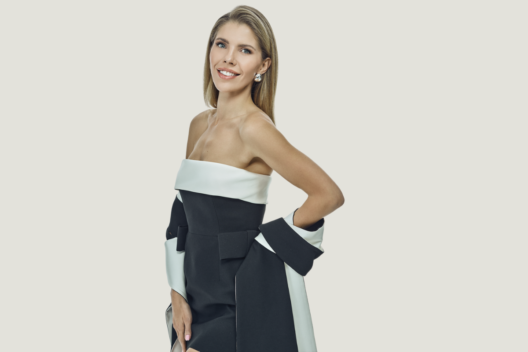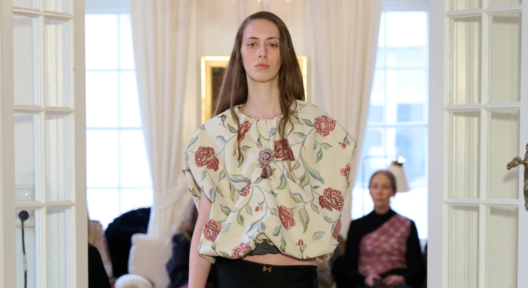

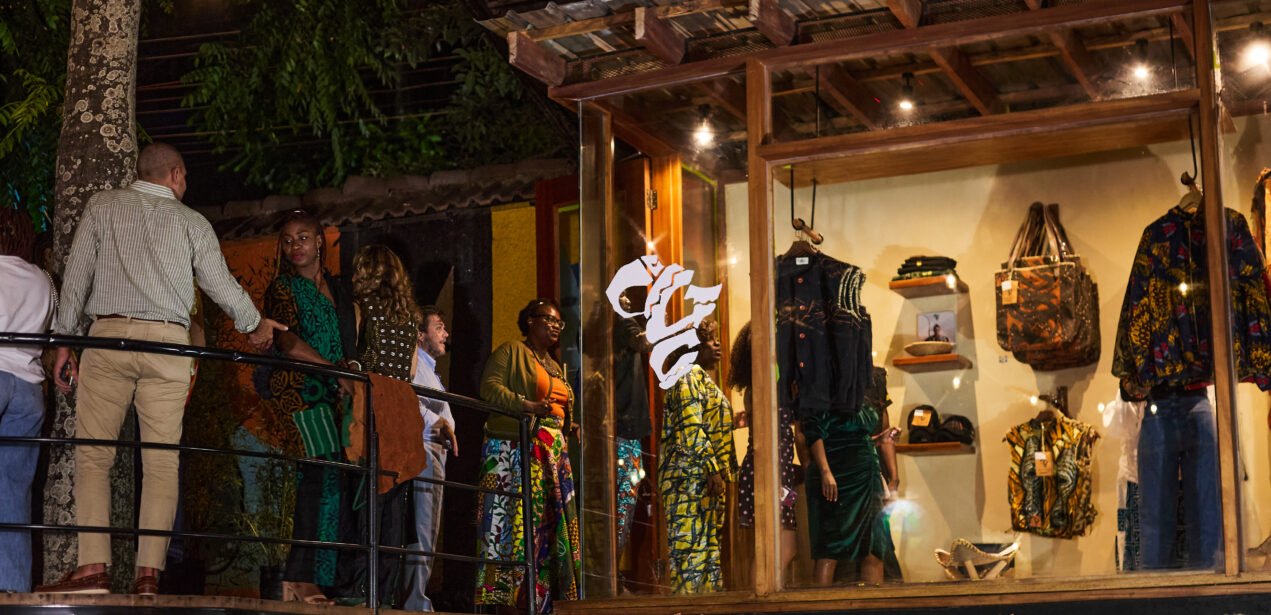
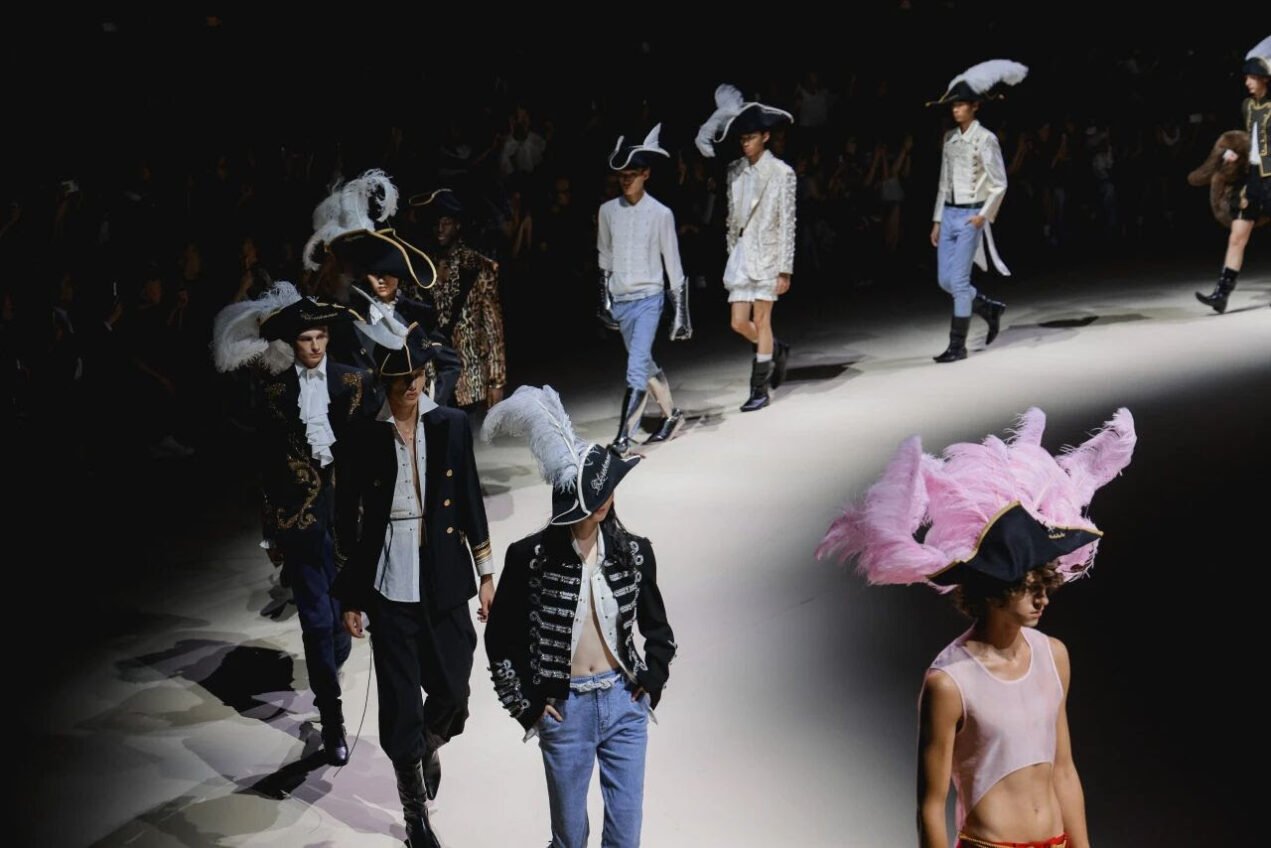
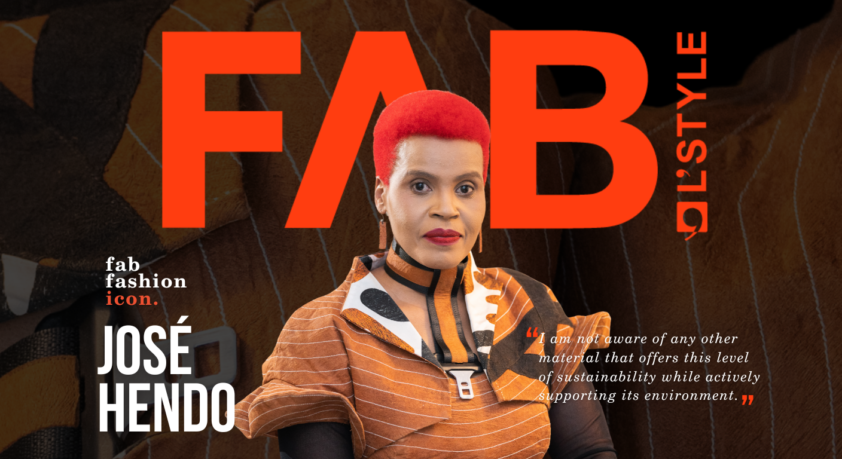
As the world observes Black History Month at 100, the time has come not just for remembering, but for reckoning. A reckoning with the knowledge systems, materials, and philosophies that have been preserved by Black people over the centuries, against all odds of erasure and forgetting. There are few contemporary designers who embody this continuity better than the British-Ugandan designer José Hendo, whose design practice focuses on the oldest known textile on the planet and a living expression of African ingenuity, sustainability, and subversion: barkcloth. This is a world defined by overproduction and disposability, and Hendo’s design practice subverts fashion’s fixation on the new and instead celebrates what has endured. This conversation is not just about fashion. It’s about memory, survival, and why African knowledge systems are not just relics of the past, but blueprints for a better world.
What Barkcloth Really Is and Why It Matters Today
FAB: When people hear the word barkcloth, they often think of something ancient or traditional. When you hear it, what memory, emotion, or image comes to mind first?
Jose Hendo: To answer that, I need to first explain what barkcloth is. Barkcloth is one of the oldest forms of clothing made by humans. It predates weaving. From my research, it is the oldest cloth on the African continent and possibly the oldest cloth in the world. It is completely natural, organic, and biodegradable. It does not harm the environment during production.
What matters most to me is the history behind it. The knowledge of making barkcloth has been passed down from father to son for hundreds of years and continues today. The process has remained unchanged. There is no machinery involved and no chemicals used. It is an entirely natural practice, and that alone deeply excites me.
Even more remarkable is how the tree survives the process. Artisans remove the bark carefully, protect the tree, and return the following year to harvest again. The same tree can be harvested for many decades, sometimes up to a hundred years or more. When the tree finally reaches the end of its productive life, it remains part of the ecosystem, supporting biodiversity and nourishing the soil around it. I am not aware of any other material that offers this level of sustainability while actively supporting its environment.
Knowing that barkcloth is part of Ugandan heritage and the legacy of our forefathers, who understood its value and preserved it, makes it even more important to protect and celebrate it. That connection is deeply personal to me.
During my research in the late 1990s and early 2000s, I was searching for the most ecological, sustainable, and circular material for my fashion practice. That is when I rediscovered barkcloth. Once I found it, I did not look back. I knew this was the path I needed to follow, regardless of what people said. Some felt it lacked excitement or did not carry the luxury often associated with silk.
Silk has a certain smoothness and elegance when you touch it. Barkcloth offers something different. It has an earthiness that feels grounding. That feeling drew me in. I had worked extensively with natural and wild silks, organic cotton, hemp, and many other sustainable materials. I appreciated them and still use them, but I never felt the same emotional connection.
Today, barkcloth sits at the centre of my design practice. Everything I create revolves around it. Whether I am thinking about art, fashion, design, or accessories, I always start with barkcloth. So when I hear the word, I feel genuine excitement. Barkcloth excites me deeply.
Recommended For You
Reduce, Reuse, Recycle as Design Language
FAB: Can you trace the moment when barkcloth stopped being just a material and became a mission for you? How did that shift influence the impact you wanted your work to have?
Jose Hendo: As soon as I understood how important barkcloth was, I took my work back to Uganda for the first time in 2014 and 2015 and connected directly with the communities that make it. When I visited the places where it is produced, it felt like home. That was when I understood my purpose and knew what I had to do.
I started the Bark To The Roots initiative, also known as B2TR. It is an NGO in Uganda and a CIC here. Its purpose is the preservation and protection of the barkcloth heritage and the environment. Because the tree nurtures the environment, preserving the culture also means planting more trees. One of the core goals of the initiative is mutuba tree planting.
In 2016, we launched a one-million-mutuba-tree-planting campaign. It was ambitious, and people questioned it. But we understood how important it was, so we chose a number that matched the scale of the problem. When you want to create positive change for people and for the planet, you have to start somewhere. That campaign sparked action. People who joined the conversation went out and planted trees themselves. Today, we hear stories of people planting thousands and even tens of thousands of trees. We had the idea, and it moved people to act.
What continues to inspire me is knowing how much still needs to be done in such a short time. That one million tree campaign took on a life of its own and continues to evolve. This is where my work comes in. Everything I do tells two connected stories. The first is bark to the roots, where it all began.
In April 2013, a factory collapsed in Bangladesh, and over one thousand people lost their lives. That moment changed the fashion industry forever. So many lives were lost because of fast fashion. If that tragedy did not force us to confront the need for change, then what would? We already knew about sweatshops, toxic cotton, and pesticides, yet the system continued.
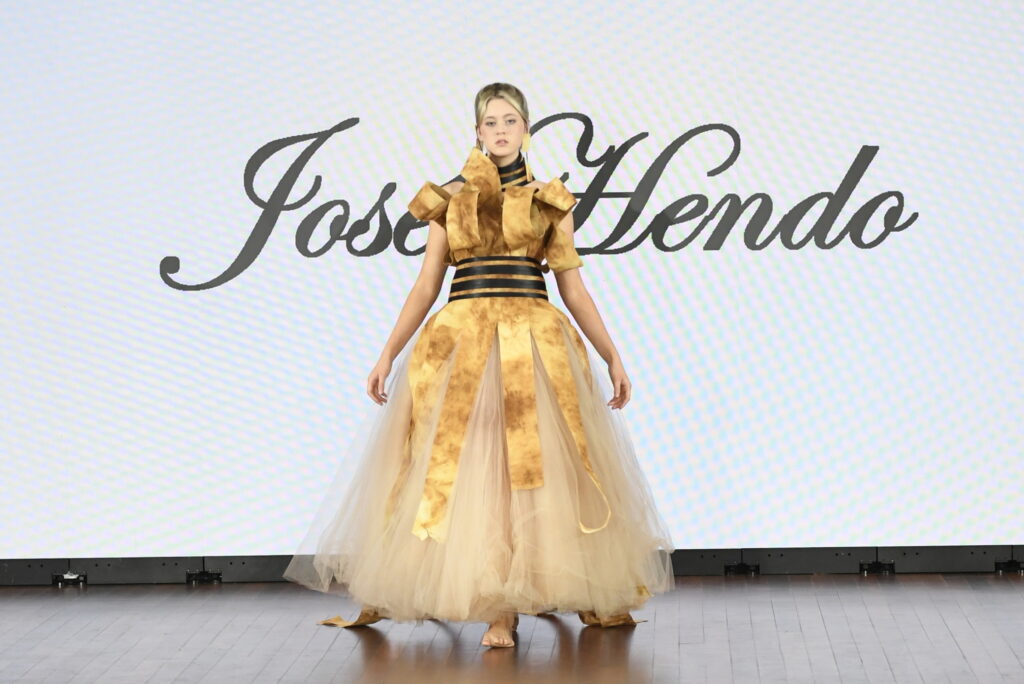
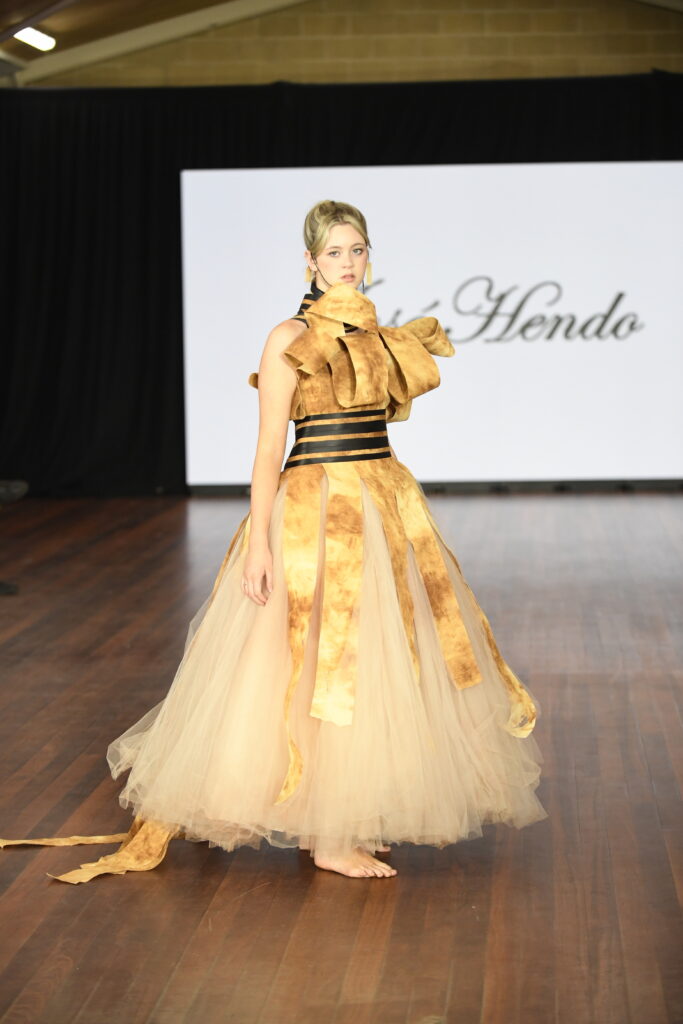
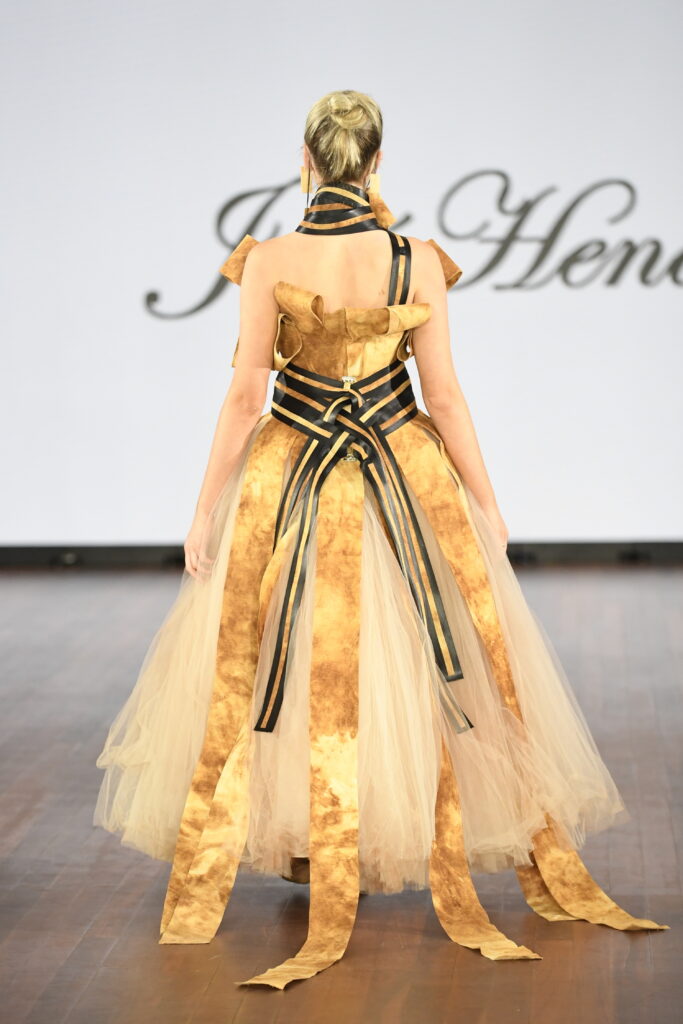
At the time, I was working quietly with sustainable materials like barkcloth, organic cotton and rustic cloth, but I was not telling the bigger story. After that tragedy, I knew I could no longer work in silence. I became vocal about circularity and sustainability, and I chose barkcloth as the material through which to tell that story. This was the start of the R³ Campaign; this stands for REDUCE, REUSE, and RECYCLE. The responsibility lies not just with the producers but the consumers too; the choices we all make have a far-reaching effect.
Rather than searching for new materials, I worked with this cloth. I created symbols/signs and made garments that spelt out ‘reduce’, ‘reuse’, and ‘recycle’. The message was simple and deliberate. Change had to happen. I staged a runway show built entirely around that theme. The shapes varied, but the story remained clear. My work is not about profit alone. It is about people and the planet. I use barkcloth as the centre of that story and as a powerful ambassador for sustainability and circularity.
FAB: Earlier, you spoke about how barkcloth challenged you in ways silk or other materials never did. Rather than seeing it as difficult, you seem to treat it as a collaborator. How has working with barkcloth impacted you creatively and personally, and what continues to surprise you about it?
Jose Hendo: I loved working with barkcloth because it allowed me to discover myself through discovering the material. That may sound abstract, but through it, I came to understand who I am. It grounded me and brought me back home in a way I never expected. It connected me deeply to my heritage.
I have worked with organic cotton, bamboo, organic bamboo, and many other sustainable materials. They are beautiful and can feel earthy and textured, much like barkcloth. But barkcloth continues to surprise me every time I work with it. I experience it almost as a conversation. The cloth speaks, and I respond by translating that message into garments, accessories, or interiors. At the centre of that process is respect for the source.
I make a conscious effort to include the men who create the cloth in the story of every piece I design. I did not make the barkcloth myself. It has been preserved, protected, and crafted by a specific group of people over generations. These men are master craftsmen.
What matters deeply to me is how these craftsmen relate to the earth. They do not try to dominate it. They work with it. The tree gives its bark and regenerates year after year. The craftsman returns to the same tree, sometimes for decades, harvesting without destroying it. That relationship with the tree is transferred into the cloth itself.
The process is physically demanding. The craftsman sits with the bark on a wooden log and pounds it to stretch and refine it. There is a rhythm to the work, almost like a quiet dialogue. They use about five different mallets, starting with one that spreads the bark quickly and moving toward finer tools that refine the surface. Depending on the size of the tree and the level of refinement needed, the process can take anywhere from eight to twenty-four hours or more.
That rhythm remains visible in the finished cloth. After years of working with barkcloth, I can see it clearly. Sometimes the cloth splits, and when it does, it is repaired with raffia. Each maker has a distinct stitching style. To me, that stitching is a signature. I can often tell who made a piece simply by how it is mended.
Some people refer to these marks as blemishes. I do not see them that way at all. They are characters. They locate a person in time. They acknowledge the labour and the human presence behind the cloth. Removing them would be like erasing the maker from the garment. That is why I always keep those details intact and incorporate them into the design.
For me, there is an ongoing conversation between the master craftsman who created the cloth and me as the designer working with it. That dialogue becomes embedded in the final piece. My hope is that whoever wears or uses the product carries that story forward and shares it, so the conversation does not end with me.
FAB: Before you begin creating, do you have any rituals that help ground or guide you?
Jose Hendo: I am glad you asked this. While I speak about campaigns and initiatives like Bark to the Roots, at the core of everything I do is God. That is where I begin. Without Him, I do not have this gift. Everything I am and everything I do is a gift, and I want to use it to support people and the planet. Beyond that, music plays an important role in feeding my creative mind and supporting me through the day. But my true ritual is prayer.
FAB: Sustainability is often framed as a burden in fashion, something designers are forced to carry. But your journey seems far more personal and long-rooted. How did sustainability become central to your life and practice, and why has it never felt restrictive to you?
Jose Hendo: I found this cloth because of sustainability, so it has never felt heavy to me. Let me explain why.
Many years ago, when I had my first child, I became deeply aware that bringing life into the world meant everything I did mattered. How I lived at home. What I bought. What I fed my children. What materials surrounded them? Nothing felt natural anymore.
Around that time, there was a major food crisis in the UK, and we made a conscious decision as a family to go organic. It was expensive then, but I felt it was necessary because my children’s lives mattered. We bought less, but we bought organic. That decision reshaped my entire lifestyle and, eventually, my work.
I reached a point where I could no longer design for the sake of designing. I went back into my practice and began deep research. I studied again and developed a philosophy I later called ‘Sustainable by Design’. That idea demanded that I question every material and every process I used.
Years later, when I had my last child, I had already discovered barkcloth. At the same time, I realised I could no longer work for someone else. I had to work for myself, and that meant my work had to fully align with the values I lived by. Everything I created had to adhere to my ‘Sustainable by Design’ ethos.
What is interesting is that I was working with circularity long before it had a name. I was searching for systems where materials moved from creation back to creation, not toward waste. If something reaches the end of its life, it should return safely to the earth without harm. At the time, people were not talking about this. But it made complete sense to me.
That way of thinking never felt limiting. It felt liberating. Sustainability gave me permission to break rules for the right reasons. It allowed me to reject fast fashion, throwaway culture, and constant excess. It helped me reset my thinking entirely.
This mindset did not come from theory alone. It came from how I grew up. In a large family, we wore hand-me-downs. We reused everything. Clothes passed from one child to another. Old garments became cleaning cloths or were repurposed into something else. Nothing was wasted. That was normal. Throwing things away made no sense to me.
So when I encountered a society built on disposal, it went against my instincts. Sustainability/circularity already existed in my childhood and in African culture long before modern sustainability language existed. We used things fully. My parents lived that way, and I carried it into my own family.
That is why sustainability feels natural to me. It is not a trend. It is not a constraint. It is a continuation of values I already lived by. The difficulty comes not from sustainability itself, but from working within systems that do not genuinely support it.
Today, sustainability is often reduced to a box-ticking exercise. Greenwashing is everywhere. Designers are told to be sustainable without being given the time or space to understand what it truly means for them as people. When that connection is missing, sustainability becomes heavy.
For me, it never has. It is how I live, how I design, and how I think. It came naturally, even when the world was not ready for it.
African Textiles, Global Fashion, and What the World Still Gets Wrong
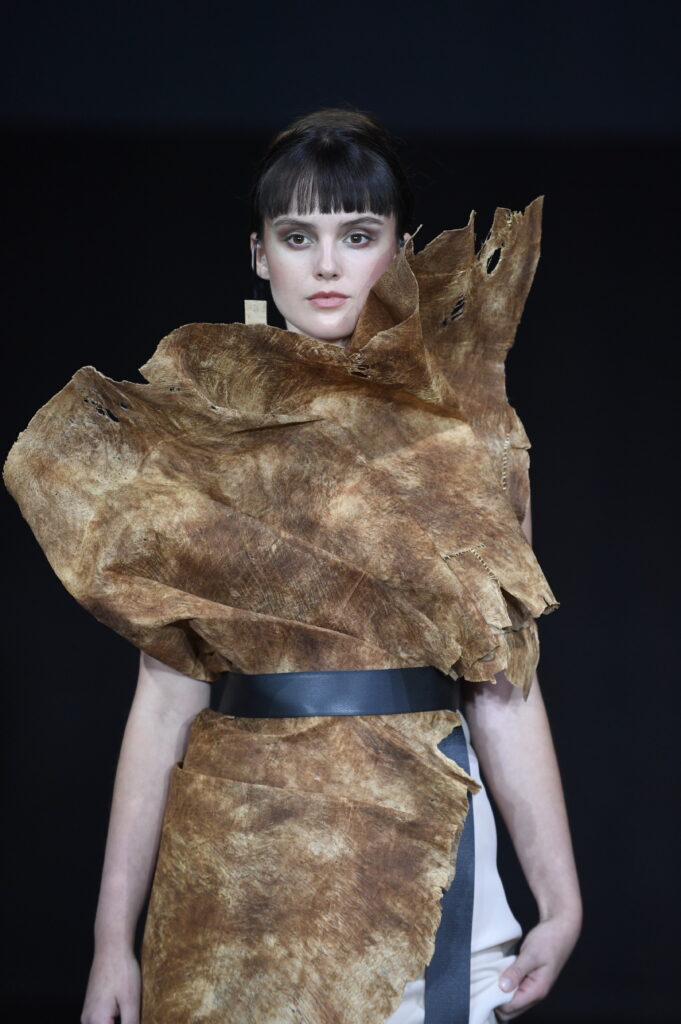
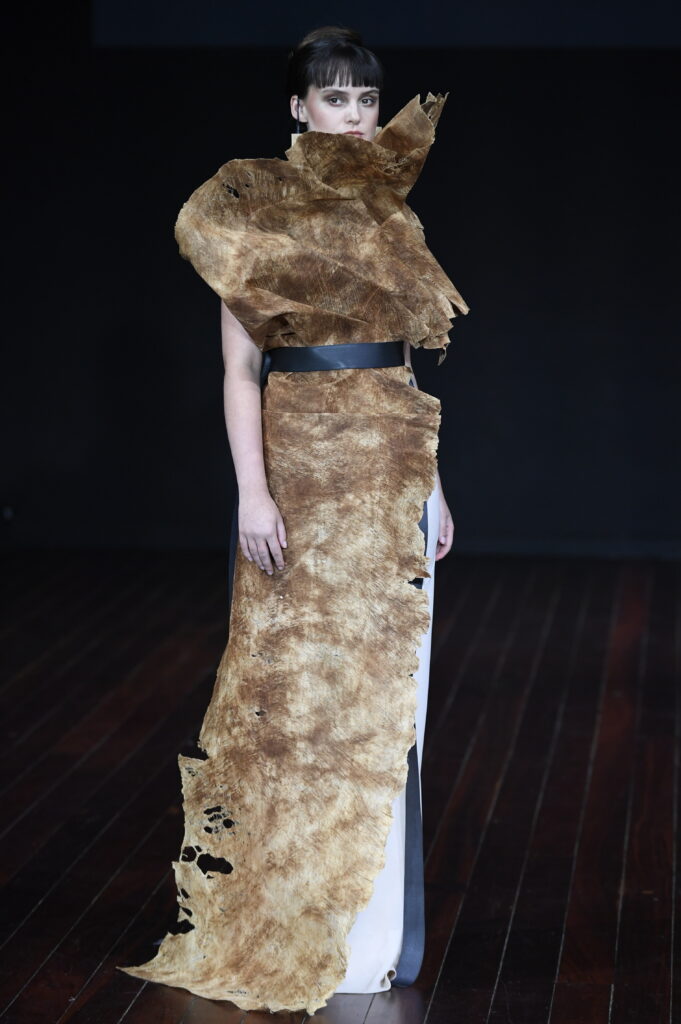
FAB: Your practice moves between fully wearable garments and highly sculptural pieces that feel almost like installations. How do you understand your own work? Are you designing clothes, or are you building concepts that happen to be worn on the body?
Jose Hendo: There are really two dimensions to my practice. On one level, I create fully wearable garments. Jackets, skirts, trousers, accessories. These are clothes people can wear every day, including what I am wearing now.
At the same time, every body of work begins with a concept. Each design series starts as an idea that could just as easily exist as an installation. Because of that, there is always a narrative behind the work. Every piece grows out of a thought process that links directly back to sustainability and circularity. That connection is always present.
At the beginning, for example, ‘Resonance’, the work became very sculptural. That was intentional. The starting point was my decision to fully embrace barkcloth and allow it to speak for itself. I wanted to make it sing. At that stage, I had to resist a lot of negative voices telling me the material was not viable or relevant. I believed deeply that it had to work. If that resonance had failed, we would not be having this conversation today.
From that period came many other garments, and each one carries a story. What people often see on Instagram are the more sculptural or conceptual pieces. Some describe them as wearable art or soft sculpture. They are fully wearable, but they also make strong statements.
Alongside that, there is a more understated line of work that is easier to wear and more accessible. It follows the same philosophy, but it is designed to integrate seamlessly into everyday life.
FAB: Your work now lives in major museums, which is a powerful shift from the early scepticism you faced. The first time you saw one of your pieces displayed behind glass, what did that moment mean to you emotionally?
Jose Hendo: It was overwhelming. Pure emotion. When you work with a heritage cloth like this, and it is not just a heritage but my own heritage through my mother, the connection becomes deeply personal. Years into my practice, I discovered that my grandfather on my mother’s side used to make barkcloth. I did not know this when I began working with it. Learning that helped me understand why I felt such a strong pull toward the material.
That knowledge added another emotional layer to my work. I am very passionate about it, and I think that comes through. My work is not only about presenting garments. It is about telling the stories of the men who have preserved this cloth across generations. They carried it through colonisation, political upheaval in Uganda, the introduction of new materials and new trades. Despite all of that, the practice survived.
That resilience exists for a reason. Barkcloth holds knowledge within its making. Cultural knowledge, environmental knowledge, and systems of care that future generations need if they are to manage and sustain the planet.
So when I see my work in a museum, it never feels like it belongs to me alone. It represents everyone who came before me and everyone who will come after me. I am here only briefly, one moment in time.
Placing these works in museums matters because it turns attention back to the makers in Uganda who produce the cloth. I do not make the cloth myself. Someone else does, and their story is inseparable from mine. Anyone who carries my garment should also carry the story of the men who made it and the sustainability/circularity message.
That is why I feel emotional but also deeply grateful. This work creates space for people to reflect on people and the planet. That is always at the heart of what I do.
FAB: As your work enters museum collections, how do you think about the role of barkcloth in those spaces? Does the museum elevate its meaning, or is there a risk that it becomes frozen and disconnected from lived culture?
Jose Hendo: That is a very important question, and it is something I am actively researching right now. I have spoken to Harriet about this as well. We have to be careful not to lose the meaning of barkcloth by turning it into something that only exists behind glass.
Barkcloth is not just an object. It is a living expression of cultural heritage. At the same time, it offers practical solutions to today’s environmental challenges. The key is finding a way to honour both without compromising either.
This is something I will speak about more deeply in the coming years. When objects like this enter museums, what happens to them? Do they become static collected works, admired only for their aesthetic or historical value, or do we keep the dialogue alive and moving forward?
In the spaces where my work appears, I am grateful for the inclusion. Museums often acquire my pieces because of the sustainability and circularity narrative behind them but also for the barkcloth. Many of these institutions already hold barkcloth artefacts, but my work introduces a contemporary story that links heritage directly to the present and future.
Each museum also has its own focus. For example, the African Museum in Atlanta centres on African and diasporic heritage. In that context, barkcloth naturally sits within a cultural narrative. Within my own work, however, I always emphasise that the Mutaba (ficus natalensis) tree the cloth comes from plays a vital role in ecosystems and deserves protection, not just heritage preservation. That distinction matters to me.
FAB: African fashion is having a strong global moment, from Aso Oke to Kente to Adire. From your perspective, what part of your work or your story do you feel the world still misunderstands or overlooks?
Jose Hendo: First, I want to say how excited I am about the Lagos Fashion Week team winning the £1 million Earthshot Prize. It has opened doors for Africa in a positive way. They have consistently foregrounded sustainability and encouraged designers to work with that mindset.
What many people still do not realise is that Africa has practised sustainability for generations. Long before it became a global conversation, African communities protected ecosystems because their survival depended on it. People understood that if they damaged the land, they would lose their homes, their food systems, and their future.
Today, the global gaze on Africa is very real, but there is also a contradiction. African textiles are copied, produced outside the continent, and sold back to Africa using inferior materials and harmful processes. When you see Vlisco made from polyester or plastic, it loses its meaning entirely.
What is misunderstood about my work is this idea that African textiles exist only as display pieces or aesthetic objects. Barkcloth, in particular, has long been excluded from conversations about African textiles. For years, people spoke about Kente, Bogolan, and Aso Oke, but barkcloth was rarely mentioned.
When people first encounter barkcloth, they often mistake it for leather, suede, or velvet. Even now, when you see me wearing it, the first instinct is to assume it is leather. That tells you how unfamiliar people still are with the material.
So there is a need for education. Barkcloth is completely natural, organic, and biodegradable. It predates weaving. It uses no chemicals and no energy beyond sunlight. You do not cut down the tree to make it. You harvest the bark, protect the tree, and return the following year. The tree continues to live and regenerate for decades. For me, it is the perfect expression of sustainability and circularity. That story is still largely missing from global conversations.
At the same time, we must acknowledge how close we came to losing this heritage. Colonisation, the introduction of new materials, and the perception that barkcloth was primitive almost erased it. One kingdom, Buganda, preserved the practice. That act was a form of cultural resistance.
Without that preservation, we would not be having this conversation today. Barkcloth was used across regions of Uganda and extended into parts of Kenya, the Democratic Republic of Congo, and possibly even further south. It carries a vast and interconnected history.
This is why I always say I am British Ugandan. My work exists because of that dual experience. I could not tell this story if I had lived only in Uganda, and I could not tell it if I had never connected with Uganda at all. My practice sits at the intersection of both worlds.
I call this approach Identity: My Way. Barkcloth allows me to tell that story. And that is what often gets missed. Barkcloth is to Uganda what Kente is to Ghana and what Aso Oke is to Nigeria. It deserves the same recognition, respect, and protection.
FAB: What do you wish someone had told you when you were starting out in fashion?
Jose Hendo: When I started, I was actually working in bridal wear. I graduated and went straight into that space. Everything was clean, polished, and proper. No one told me about the dark side of fashion. I only discovered it later through practice. I became disillusioned and thought, this cannot be it. There has to be more. That was when my path changed.
FAB: What do you mean by the dark side of fashion?
Jose Hendo: One of the most important things is learning to observe. As a student, my university was on Oxford Street. I would walk into stores and see garments on the floor. I kept thinking about the fact that the person buying that garment had no idea what it took to make it.
Someone may have lost their life growing the cotton, harvesting it, or sewing the garment while earning almost nothing and risking their health. A single T-shirt or pair of jeans passes through many hands. Someone designs it. Someone makes it. Then it ends up on a shop floor, stepped on or ignored.
We are often too busy to notice that behind every garment is a human being. That is why I say the history of a garment is just as important as its future. Understanding the process, the lives affected, how you buy it, how you use it, and where it ends up all matter. That is how you create a circular system. If you do not care about history, the future will not matter either.
FAB: Absolutely.
Jose Hendo: That belief impacts how I design. From the very beginning, you have to think about everything going into a piece. Are you using organic materials? Are you making choices that reduce harm? Design matters too. Create timeless pieces people can live with, connect to, and keep.
When I design, I want someone to feel that they want to keep the piece and tell its story. They should know where it came from and whose lives it touched. When it is time to let it go, it can be passed on, repurposed, or reused. That is sustainable design to me. History and the future must exist together.